A Compendium of the Ancient Gods
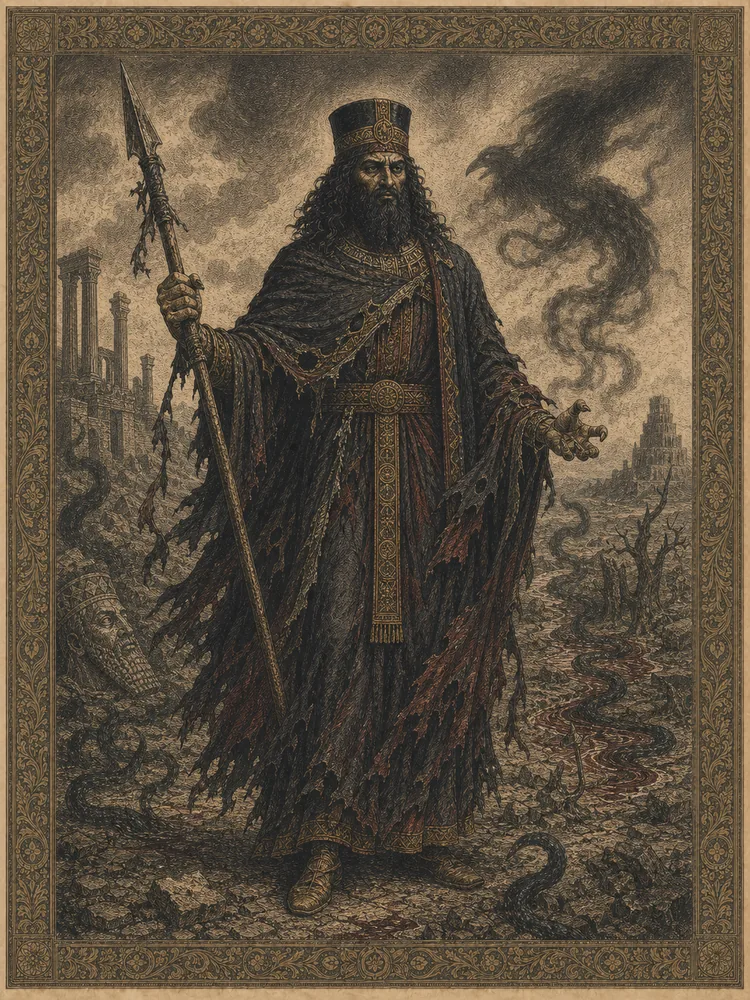
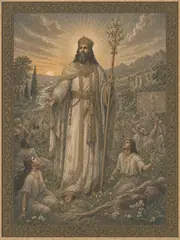
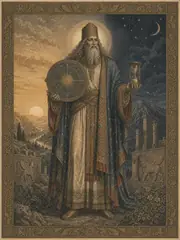
Angra Mainyu, plate

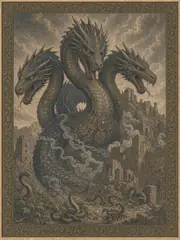
Angra Mainyu — "the Hostile Spirit," or, in the later Middle Persian, Ahriman — was the cosmic adversary of Ahura Mazda, the source of all evil in the world, the chief opponent of all that is true and right. He was not a created being (so the priestly tradition insisted, against the temptation of Zurvanism that we shall meet below) but a principle equally primal with the Holy Spirit Spenta Mainyu — though always inferior to Ahura Mazda in being and knowledge. He had emerged at the beginning of the world from a certain darkness, and his first act had been to attack the good creation; from that attack came every disease, every death, every winter, every drought, every poison, every lie.

The Bundahishn — the Pahlavi cosmogonic text — describes Angra Mainyu's first irruption into the world in terms of horror. He came in the form of a great serpent (or as a fly, or as a black smoke); he pierced the sky, polluted the water, scorched the earth, killed the first plant, killed the first ox, and made his attack on Gayomard the first man. From his attack came death — for before Angra Mainyu's irruption, nothing had died — and from death came every other evil. The world that we know, in which all things suffer and die, is the world contaminated by his presence; the world Ahura Mazda had originally made was wholly good and wholly immortal.

But the Hostile Spirit's attack was also his trap. By entering the world to attack it, he had committed himself to a struggle in which he could not in the end prevail. Ahura Mazda had foreseen exactly this: the long war was the means by which Angra Mainyu would be exhausted, weakened, and at last defeated. The whole present age — the age in which we live — is the period of the war, called the period of "mixture," in which good and evil are tangled together in every thing and every person. At the end of the age, the Saoshyant will come, the dead will rise, the final battle will be fought, and Angra Mainyu will be cast down forever. After that comes the Frashokereti, the renewal of all things, in which the world is restored to the wholly good condition Ahura Mazda originally intended.

Until that day, the Hostile Spirit must be opposed by every righteous person, in every act of life. To eat, to wash, to sleep, to pray, to till the field, to keep the fire on the hearth — these are all small contributions to the great cosmic war on the side of Truth. The Iranian believer was a soldier in a war that had no neutral ground; he must take a side, and the side he took determined his eternal destiny.
Curator’s note

What the sources say, and what later tradition added. The sources for this bay

Angra Mainyu is named in the Gathas (most explicitly Yasna 30.3-6, the great passage on the choice of the two primal spirits), throughout the Yashts and Yasna, and in the Vendidad (where he is the supreme demonic adversary). The Pahlavi Bundahishn is the chief source for his cosmogonic role; Greater Bundahishn 1-4 gives the fullest account. The name Ahriman (Middle Persian) is a development of Ahra-mainyu / Angra Mainyu. The Christian Fathers were aware of Angra Mainyu through their encounters with Manichaeism (which radicalized the Zoroastrian dualism); Augustine's account of Manichaean dualism in Confessions and Contra Faustum reflects the Iranian background indirectly. The relation between Angra Mainyu and Spenta Mainyu (the Holy Spirit through whom Ahura Mazda creates) is technically distinct from the relation between Angra Mainyu and Ahura Mazda himself; in strict Zoroastrian theology, the dualism is between the two Spirits, with Ahura Mazda being the creator who chose the Holy Spirit. This distinction was later collapsed in popular and Sasanian theology, but the Gathas preserve it; Mary Boyce and Stanley Insler have written closely on the matter.

Kin in the sources

Each tie is quoted from the entry that states it.

When the sources speak

Dated witnesses for Ahura Mazda and the Cosmic Dualism. A date marks when the evidence was written down, not when the belief began. The whole timeline

late 2nd–early 1st millennium BCE, debated
The Old Avestan Gathas and Yasna Haptanghaiti emerge in an eastern Iranian ritual-poetic setting; Zarathustra’s date remains disputed.
1st millennium BCE
Younger Avestan hymns, ritual texts, and legal-purity materials develop over a long period of oral transmission.
c. 550–330 BCE
Achaemenid inscriptions invoke Ahuramazda in imperial royal ideology; their relationship to later Zoroastrian orthodoxy requires care.
330 BCE–224 CE
Hellenistic and Parthian eras preserve Iranian cults through sparse and regionally varied evidence.
224–651 CE
Sasanian institutions sponsor priestly learning and the redactional organization associated with the Avesta and Zand.
7th–10th centuries CE
After the Islamic conquest, Middle Persian books record cosmology, law, exegesis, and summaries of lost material.
c. 9th century CE
The Bundahišn, Dēnkard, Wizīdagīhā ī Zādspram, and related works preserve systematic late antique and early Islamic syntheses.
c. 977–1010 CE
Ferdowsi composes the Shāhnāmeh from epic and royal traditions with both pre-Islamic and Islamic-period mediation.

Floor plan

The rooms follow one another in the order their peoples first appear in the written record.

  1. The Cradle of Citiesc. 3400 BCE to 395 CE. 115 works
  2. The Gift of the Nilec. 4000 BCE to 395 CE. 73 works
  3. The Olympian Orderc. 1600 BCE to 750 CE. 152 works
  4. The Persian Worldc. 2000 BCE to 1010 CE. 30 works
  5. The Levantine Borderlandsc. 1200 BCE to 500 CE. 20 works
  6. The Edges of Empirec. 2000 BCE to 1500 CE. 33 works
  7. The Etruscan Worldc. 900 BCE to 750 CE. 22 works
  8. The Roman Inheritancec. 1200 BCE to 500 CE. 58 works
  9. The Northern Inheritancec. 2000 BCE to 1600 CE. 131 works