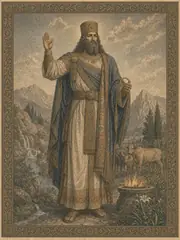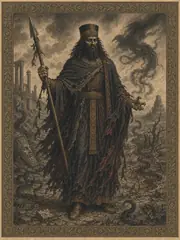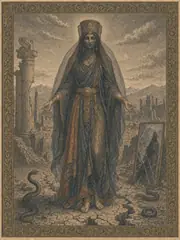
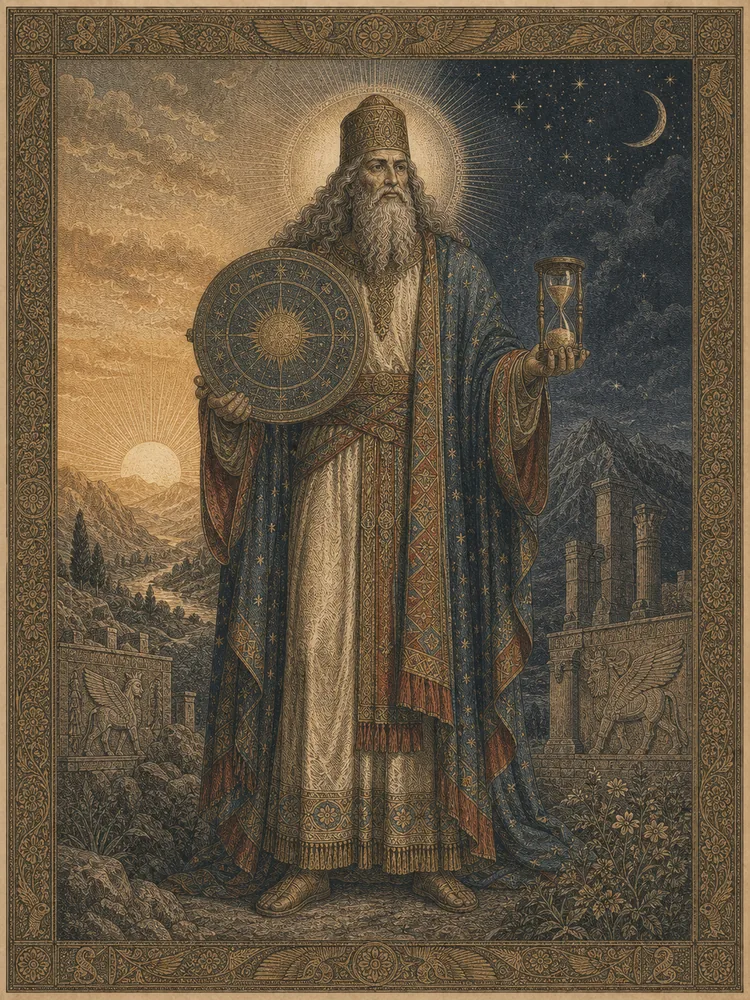
Zurvan — "Time" — was a figure of considerable theological importance in a particular variant of Zoroastrian theology that flourished during the Sasanian period, called by modern scholars Zurvanism. In this variant, the dualism between Ahura Mazda and Angra Mainyu was held to be subordinate to a higher principle, namely Zurvan Akarana — Infinite Time — from whom both spirits had emerged at the beginning of the world. Zurvan was the transcendent first principle; Mazda and Ahriman were his twin sons, born from his ritual sacrifice, and rivals from before the creation.
The myth of Zurvan, as preserved by the Armenian historian Eznik of Kolb in the fifth century of our era, ran thus: Zurvan, desiring a son, performed a thousand-year sacrifice for the purpose. Toward the end of the period he doubted whether his sacrifice would succeed; from the doubt was conceived Ahriman, and from the unwavering devotion was conceived Ohrmazd (= Ahura Mazda). The two were born together. Zurvan, when he saw them, mistook the dark one for the firstborn and gave him sovereignty of the world for nine thousand years; only then did he learn his mistake. He could not revoke the gift, but he ordained that Ohrmazd should rule in the time after the nine thousand years. So Ahriman has dominion in the present age, and Ohrmazd will have dominion in the age to come.
The Zurvanite myth was a sophisticated theological response to a pressing problem: if Ahura Mazda is the supreme being, where does Angra Mainyu come from? The orthodox Zoroastrian answer was that Angra Mainyu had simply always been, equally primal with the Holy Spirit, and that the question "where did he come from" did not apply. But this was philosophically uncomfortable, and the Zurvanites resolved the discomfort by positing a still higher first principle, Time, from whom both Spirits emerged. The cost was a softening of the original dualism — Ahriman became the inferior twin of Ohrmazd rather than his primal opposite — and the orthodox priesthood eventually denounced Zurvanism as a heresy.
But Zurvanism was the dominant theology of the Sasanian court for several centuries, and many of the Greek and Roman accounts of Zoroastrianism (those of Theodore of Mopsuestia, of Eznik, of certain Manichaean writers) reflect Zurvanite theology rather than the orthodox Mazdayasnian version. The figure of Zurvan accordingly cannot be ignored; he is part of the Iranian religious imagination, even if not part of its strictest theology.