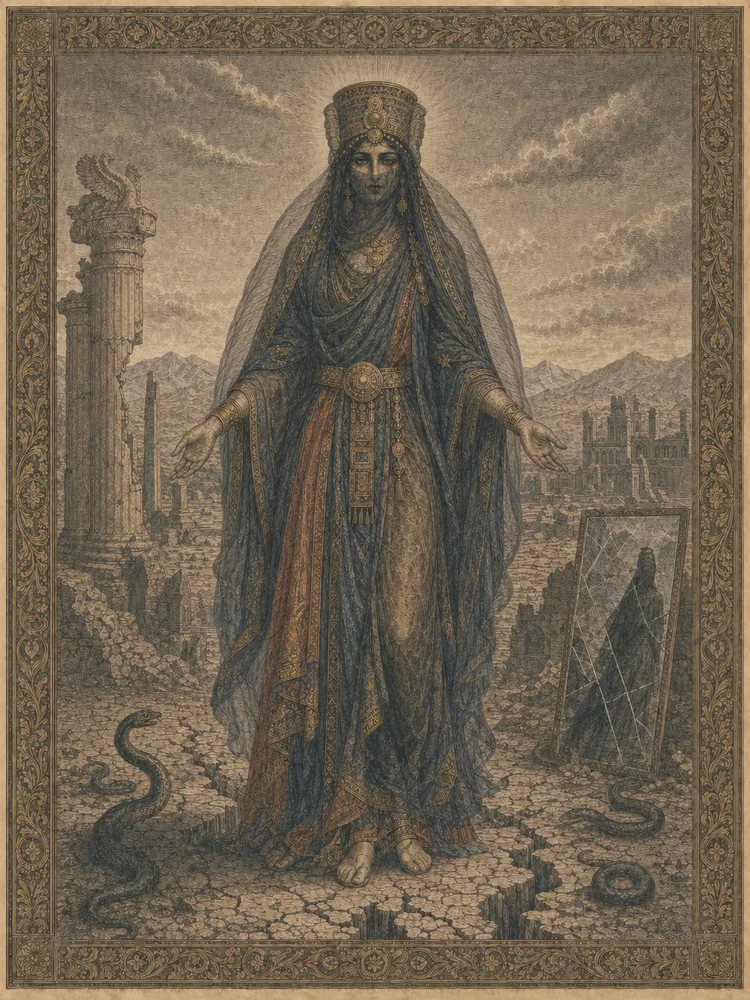

Druj — "the Lie" — was the great cosmic principle of falsehood and disorder, the personified counter-truth to which Asha was opposed. She (the word is feminine in Avestan) was not a single demon but the entire principle of untruth in the cosmos: every lie spoken, every promise broken, every distortion of right, every disorder of the seasons, every deviation from the proper way of things, was a manifestation of Druj. She corrupted the world through the inroads of falsehood, and she found her servants in every man who chose the lie over the truth.
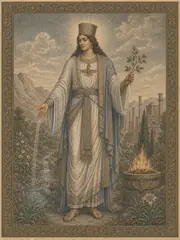
The opposition between Asha (Truth, Right Order) and Druj (the Lie, Disorder) was the most fundamental ethical opposition in Zoroastrianism. Where Asha was the cosmic right way, Druj was the deviation from it — and not just any deviation, but the specifically deceptive deviation, the deviation that pretended to be what it was not. A man could fail to be just through weakness, through ignorance, through the limits of his nature; that was unfortunate but not wholly damning. But to be a follower of the Lie — to deceive others, to misrepresent the truth, to swear oaths with a hidden reservation — was to align oneself with the cosmic adversary, and from that alignment there was no easy return.
The man who followed Truth was an ashavan; the man who followed the Lie was a drugvant. These two categories ran through all of Zoroastrian society, and the priesthood worked vigorously to distinguish them. The Vendidad — the great priestly law-code — devotes much of its space to identifying the various forms in which Druj manifests in the world (illness, putrefaction, menstrual blood, contact with corpses, snakes, scorpions, insects of every kind), and to prescribing the rituals of purification by which a contaminated person could be restored to the company of the ashavans.
Druj had specific manifestations as well — Druj Nasu, the corpse-demon, was the demoness of putrefying bodies, who entered any unguarded corpse and required complex rituals of expulsion. Other named druj-figures presided over particular categories of evil. But behind them all stood Druj as a single principle, the cosmic falsehood whose service led to the worst place after death and whose opposition was the central work of the Zoroastrian life.