A Compendium of the Ancient Gods
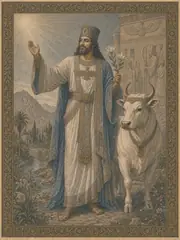
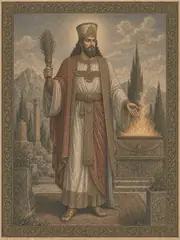
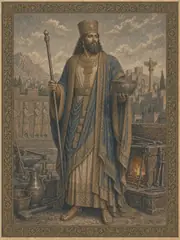
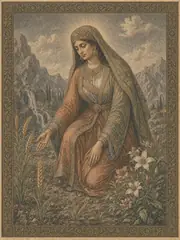
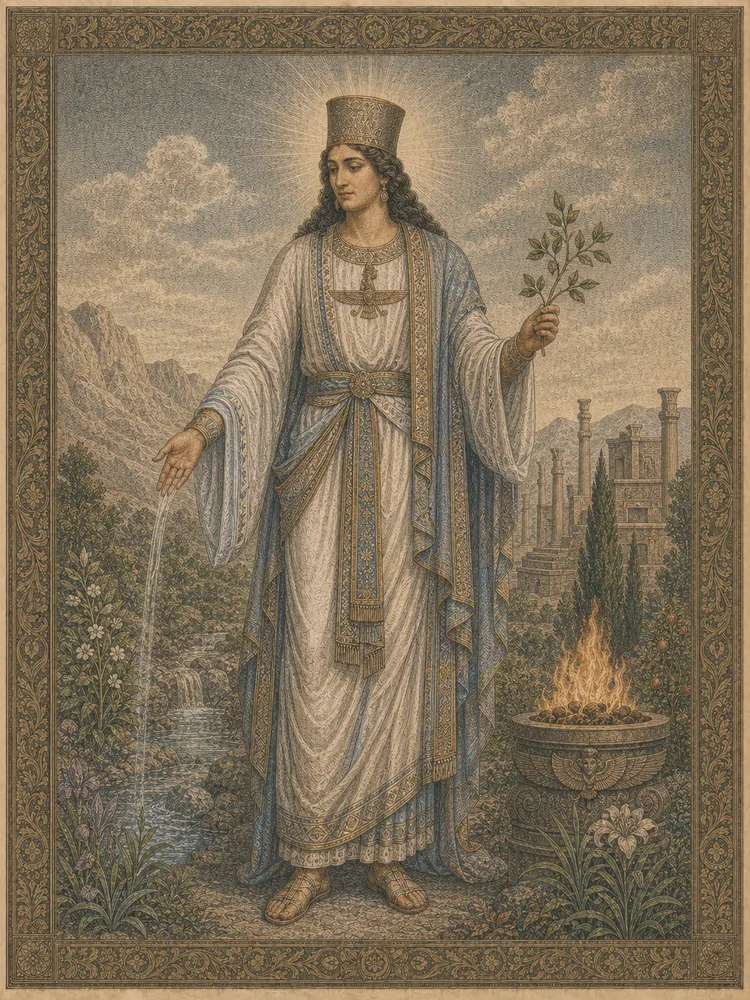
Spenta Mainyu, plate

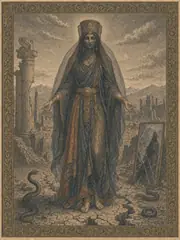
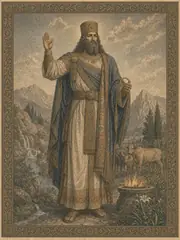
Spenta Mainyu — "the Holy Spirit" or "the Bountiful Spirit" — was the creative principle by which Ahura Mazda made the world. In the most rigorous Zoroastrian theology (the theology of the Gathas themselves), the cosmic dualism is technically a dualism not between Ahura Mazda and Angra Mainyu but between the two Spirits — Spenta Mainyu the Holy and Angra Mainyu the Hostile — both of whom had been present at the beginning of the world, and one of whom Ahura Mazda had chosen. Spenta Mainyu was thus the choice Ahura Mazda made; and through this Spirit, the Wise Lord acted in the world.

Yasna 30.3, the great passage of the choice, reads: "In the beginning there were two Spirits, twins by nature, of whom the Better and the Worse made decision in thought, in word, in deed. Between them, those who do good have rightly chosen, but not those who do evil." The two Spirits chose for themselves before any creature was made; Spenta Mainyu chose truth, life, and light; Angra Mainyu chose the lie, death, and darkness. Their choices set the polarity of the world. Each man, in his own life, repeats their choice in miniature.

In the later Sasanian and Pahlavi theology, the distinction between Ahura Mazda and Spenta Mainyu was sometimes collapsed: Ahura Mazda himself was identified with Spenta Mainyu, and the dualism was reformulated as between the supreme creator and the cosmic adversary directly. This was theologically simpler but philosophically less rigorous, and the Gathic original is often preferred by modern scholars as preserving the more refined original conception.

Spenta Mainyu was also the source of the seven Amesha Spentas — the Holy Immortals, who were aspects of his (and so of Ahura Mazda's) creative will. From him came Vohu Manah the Good Mind, Asha Vahishta the Best Truth, Khshathra Vairya the Ideal Dominion, Spenta Armaiti the Holy Devotion, Haurvatat the Wholeness, and Ameretat the Immortality, with himself as the seventh. Through the Amesha Spentas, the Holy Spirit's will became the ordered cosmos.
Curator’s note

What the sources say, and what later tradition added. The sources for this bay

Spenta Mainyu is the central concept of Yasna 30 and 45 in the Gathas. The technical relation between Ahura Mazda and Spenta Mainyu is the subject of long-running scholarly debate; Stanley Insler's The Gathas of Zarathushtra (1975), Mary Boyce's History (Vol. 1), and Almut Hintze's various articles are standard references. The collapsing of Ahura Mazda and Spenta Mainyu in later Pahlavi theology is documented in the Bundahishn and the Denkard. The translation "Holy Spirit" is conventional in Iranian studies and is etymologically defensible (spenta < proto-Iranian *spánta, "holy, bountiful, beneficial"); the doctrinal parallel with the Christian Holy Spirit is striking but probably accidental, the two terms developing independently.

Kin in the sources

Each tie is quoted from the entry that states it.

When the sources speak

Dated witnesses for Ahura Mazda and the Cosmic Dualism. A date marks when the evidence was written down, not when the belief began. The whole timeline

late 2nd–early 1st millennium BCE, debated
The Old Avestan Gathas and Yasna Haptanghaiti emerge in an eastern Iranian ritual-poetic setting; Zarathustra’s date remains disputed.
1st millennium BCE
Younger Avestan hymns, ritual texts, and legal-purity materials develop over a long period of oral transmission.
c. 550–330 BCE
Achaemenid inscriptions invoke Ahuramazda in imperial royal ideology; their relationship to later Zoroastrian orthodoxy requires care.
330 BCE–224 CE
Hellenistic and Parthian eras preserve Iranian cults through sparse and regionally varied evidence.
224–651 CE
Sasanian institutions sponsor priestly learning and the redactional organization associated with the Avesta and Zand.
7th–10th centuries CE
After the Islamic conquest, Middle Persian books record cosmology, law, exegesis, and summaries of lost material.
c. 9th century CE
The Bundahišn, Dēnkard, Wizīdagīhā ī Zādspram, and related works preserve systematic late antique and early Islamic syntheses.
c. 977–1010 CE
Ferdowsi composes the Shāhnāmeh from epic and royal traditions with both pre-Islamic and Islamic-period mediation.

Floor plan

The rooms follow one another in the order their peoples first appear in the written record.

  1. The Cradle of Citiesc. 3400 BCE to 395 CE. 115 works
  2. The Gift of the Nilec. 4000 BCE to 395 CE. 73 works
  3. The Olympian Orderc. 1600 BCE to 750 CE. 152 works
  4. The Persian Worldc. 2000 BCE to 1010 CE. 30 works
  5. The Levantine Borderlandsc. 1200 BCE to 500 CE. 20 works
  6. The Edges of Empirec. 2000 BCE to 1500 CE. 33 works
  7. The Etruscan Worldc. 900 BCE to 750 CE. 22 works
  8. The Roman Inheritancec. 1200 BCE to 500 CE. 58 works
  9. The Northern Inheritancec. 2000 BCE to 1600 CE. 131 works