A Compendium of the Ancient Gods
Ameretat, plate

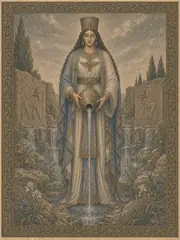
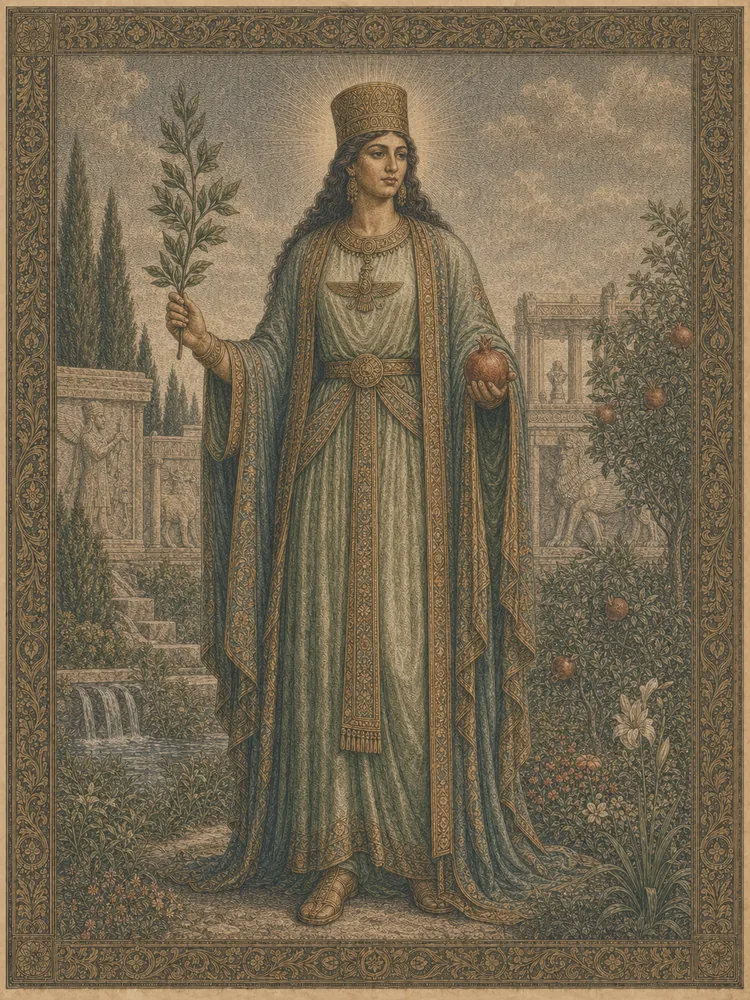
Ameretat — "Immortality," or "Deathlessness" — was the seventh of the Amesha Spentas, the patroness of the plants, and the inseparable companion of her sister Haurvatat the Wholeness. Where Haurvatat was the perfection of being whole, Ameretat was the perfection of being unending; the two together were the gifts that the renewed world would receive in their fullness, when the work of redemption was complete.

Her element was the plants, the green vegetable life of the world, the gift of Ahura Mazda by which living creatures were nourished. The herbs of healing, the trees that gave fruit, the grain that gave bread — all were under her care, and the Zoroastrian was particularly to honor her by tending growing things. The destruction of a healthy plant was an act of impiety against Ameretat, just as the wounding of an animal without ritual purpose was an offense against Vohu Manah's cattle. To plant a tree, to nurture a garden, to make the desert bloom — these were religious acts, cooperations with Ameretat against the powers of death.

She was sometimes connected with the haoma plant in particular — the sacred plant from which the priestly drink was prepared, identified by some as Ephedra — for the haoma was held to grant a small measure of immortality to those who consumed it ritually. So Ameretat presided over the rite of the haoma in alliance with the yazata Haoma himself, and the worshipper who drank the haoma-juice was for that moment a participant in her gift.

Her opposition was the demon Astovidhotu, "the Bone-Disconnector," who was the demon of death, who appeared at the moment of dying to lay his hand upon the soul and separate it from the body. Against him stood Ameretat, who would in the end of time, at the resurrection, restore all who had died to the immortality that was originally Ahura Mazda's intention for his creatures. The Zoroastrian doctrine that death is not original to the world but an intrusion of Angra Mainyu, and that the final state of the world will be deathless — the foundation of the Zoroastrian apocalyptic — was rooted in the doctrine of Ameretat.
Curator’s note

What the sources say, and what later tradition added. The sources for this bay

Ameretat is invoked throughout the Avesta in pair with Haurvatat. Her domain over plants is in Bundahishn 26. The connection to haoma is in the Hom Yasht (Yasna 9-11) and elsewhere. The opposition to Astovidhotu is in Vendidad and in the Pahlavi books on death and the soul (notably the Arda Viraf Namag and the Greater Bundahishn). The cognate Vedic amṛta "immortal, the immortal drink (= soma, = haoma)" confirms the Indo-Iranian antiquity and the etymological link with the priestly drink. The Greek ambrosia is from the same Indo-European root (a-mbro-sia, the negative + the verb "to die"), giving us the famous chain Vedic amṛta = Iranian Ameretat = Greek ambrosia, all referring to the food or drink of the gods that confers immortality. The triple cognate is one of the cleanest pieces of evidence for the unity of Indo-European religious vocabulary.

Kin in the sources

Each tie is quoted from the entry that states it.

When the sources speak

Dated witnesses for The Amesha Spentas. A date marks when the evidence was written down, not when the belief began. The whole timeline

late 2nd–early 1st millennium BCE, debated
The Old Avestan Gathas and Yasna Haptanghaiti emerge in an eastern Iranian ritual-poetic setting; Zarathustra’s date remains disputed.
1st millennium BCE
Younger Avestan hymns, ritual texts, and legal-purity materials develop over a long period of oral transmission.
c. 550–330 BCE
Achaemenid inscriptions invoke Ahuramazda in imperial royal ideology; their relationship to later Zoroastrian orthodoxy requires care.
330 BCE–224 CE
Hellenistic and Parthian eras preserve Iranian cults through sparse and regionally varied evidence.
224–651 CE
Sasanian institutions sponsor priestly learning and the redactional organization associated with the Avesta and Zand.
7th–10th centuries CE
After the Islamic conquest, Middle Persian books record cosmology, law, exegesis, and summaries of lost material.
c. 9th century CE
The Bundahišn, Dēnkard, Wizīdagīhā ī Zādspram, and related works preserve systematic late antique and early Islamic syntheses.
c. 977–1010 CE
Ferdowsi composes the Shāhnāmeh from epic and royal traditions with both pre-Islamic and Islamic-period mediation.

Floor plan

The rooms follow one another in the order their peoples first appear in the written record.

  1. The Cradle of Citiesc. 3400 BCE to 395 CE. 115 works
  2. The Gift of the Nilec. 4000 BCE to 395 CE. 73 works
  3. The Olympian Orderc. 1600 BCE to 750 CE. 152 works
  4. The Persian Worldc. 2000 BCE to 1010 CE. 30 works
  5. The Levantine Borderlandsc. 1200 BCE to 500 CE. 20 works
  6. The Edges of Empirec. 2000 BCE to 1500 CE. 33 works
  7. The Etruscan Worldc. 900 BCE to 750 CE. 22 works
  8. The Roman Inheritancec. 1200 BCE to 500 CE. 58 works
  9. The Northern Inheritancec. 2000 BCE to 1600 CE. 131 works