A Compendium of the Ancient Gods
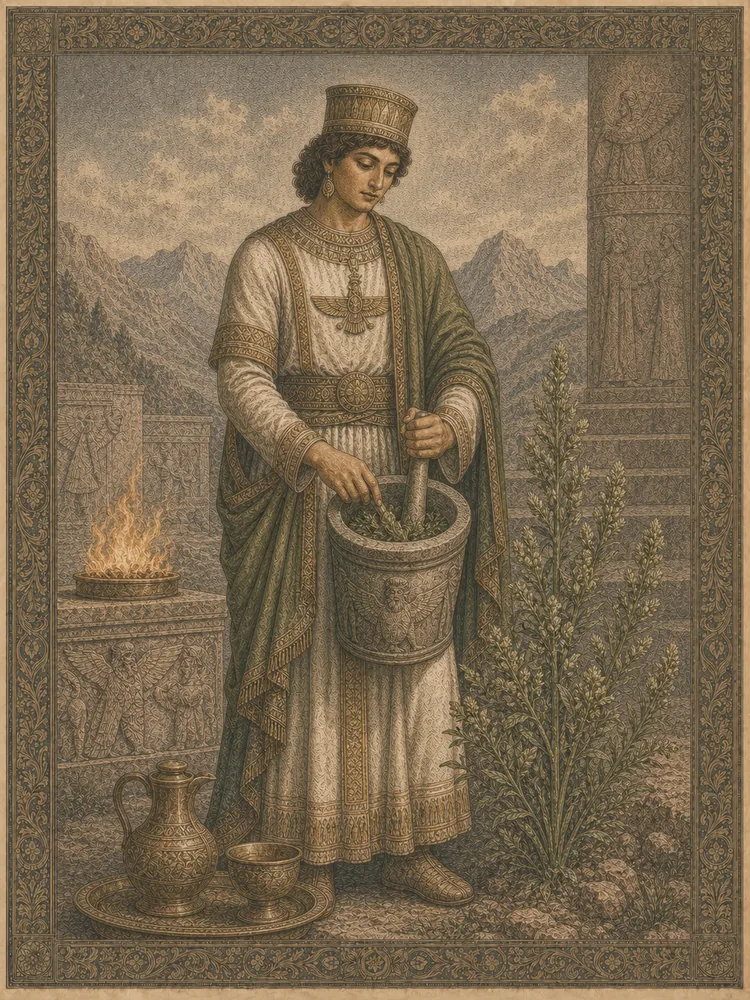
Haoma, plate

Haoma was a plant — and the drink prepared from the plant — and the yazata of both. The plant has been variously identified in modern times (the most common candidates are Ephedra, a stimulant; Peganum harmala, a hallucinogen; Amanita muscaria, the fly-agaric mushroom; and various others); the question is unresolved. Whatever its botanical identity, the plant was central to the Zoroastrian priestly rite. The Yasna — the daily liturgy of the Zoroastrian priesthood — was in essence a Haoma-rite, in which the plant was pressed, the juice mixed with water and milk, the prayer chanted, and the consecrated drink consumed by the priest.

Haoma the yazata was thus a divinity who could be imbibed; in the rite, the worshipper took the god into his own body. The Hom Yasht (Yasna 9-11) gives the foundational mythology: Haoma had been the discoverer of the rite, had been the first priest, had given the drink to the great heroes of the past (Vivanghvant the father of Yima, Athwya the father of Thraetaona, Thrita the father of Keresaspa), each of whom had received as a result a son who became a hero of the Iranian people. The catalog is explicit: the worshipper of Haoma is rewarded with a heroic son.

The drink itself was held to confer wisdom, strength, fertility, healing, victory in battle, and (in moderation) a small participation in immortality. The Hom Yasht praises Haoma as the "green-stalked," "golden-eyed," "healing," "victorious," and gives him the epithets that are also given to the great yazatas. He was the priestly equivalent of what Mithra was to the warriors and Anahita was to the women — the patron of the function, the channel of the divine to the role.

The Indian counterpart of Haoma is Soma — the sacred plant and drink of the Vedic Indo-Aryans, with whom the Iranians shared a common religious heritage. The two religions diverged in their attitude toward the rite: the Iranian Zarathushtra reformed but preserved it; the Vedic Aryans developed it lavishly into the central rite of the priesthood. The Soma question and the Haoma question are essentially the same question — what plant was being used? — and the linguistic and ritual continuity between the two traditions is one of the surest in comparative Indo-European religion.

Curator’s note

What the sources say, and what later tradition added. The sources for this bay

Haoma is the central figure of Yasna 9-11 (the Hom Yasht). The Vedic Soma counterpart is the central topic of Rigveda Book 9 (entirely devoted to Soma hymns). The botanical identification has been the subject of long debate; R. G. Wasson's Soma: Divine Mushroom of Immortality (1968) proposed Amanita muscaria; J. M. Stewart and others have argued for Ephedra; the more recent consensus, based on the Iranian archaeological evidence (residues from the Bactria-Margiana culture sites), tends toward a multi-plant preparation including Ephedra and possibly Peganum harmala. Mary Boyce's articles are essential. The continuity of the rite from proto-Indo-Iranian times to the present-day Zoroastrian Yasna is one of the most striking features of religious history; the rite has been performed continuously for at least three thousand years.

When the sources speak

Dated witnesses for The Yazatas. A date marks when the evidence was written down, not when the belief began. The whole timeline

late 2nd–early 1st millennium BCE, debated
The Old Avestan Gathas and Yasna Haptanghaiti emerge in an eastern Iranian ritual-poetic setting; Zarathustra’s date remains disputed.
1st millennium BCE
Younger Avestan hymns, ritual texts, and legal-purity materials develop over a long period of oral transmission.
c. 550–330 BCE
Achaemenid inscriptions invoke Ahuramazda in imperial royal ideology; their relationship to later Zoroastrian orthodoxy requires care.
330 BCE–224 CE
Hellenistic and Parthian eras preserve Iranian cults through sparse and regionally varied evidence.
224–651 CE
Sasanian institutions sponsor priestly learning and the redactional organization associated with the Avesta and Zand.
7th–10th centuries CE
After the Islamic conquest, Middle Persian books record cosmology, law, exegesis, and summaries of lost material.
c. 9th century CE
The Bundahišn, Dēnkard, Wizīdagīhā ī Zādspram, and related works preserve systematic late antique and early Islamic syntheses.
c. 977–1010 CE
Ferdowsi composes the Shāhnāmeh from epic and royal traditions with both pre-Islamic and Islamic-period mediation.

Floor plan

The rooms follow one another in the order their peoples first appear in the written record.

  1. The Cradle of Citiesc. 3400 BCE to 395 CE. 115 works
  2. The Gift of the Nilec. 4000 BCE to 395 CE. 73 works
  3. The Olympian Orderc. 1600 BCE to 750 CE. 152 works
  4. The Persian Worldc. 2000 BCE to 1010 CE. 30 works
  5. The Levantine Borderlandsc. 1200 BCE to 500 CE. 20 works
  6. The Edges of Empirec. 2000 BCE to 1500 CE. 33 works
  7. The Etruscan Worldc. 900 BCE to 750 CE. 22 works
  8. The Roman Inheritancec. 1200 BCE to 500 CE. 58 works
  9. The Northern Inheritancec. 2000 BCE to 1600 CE. 131 works