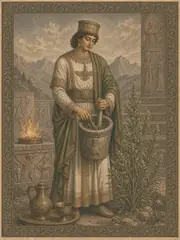
A Compendium of the Ancient Gods
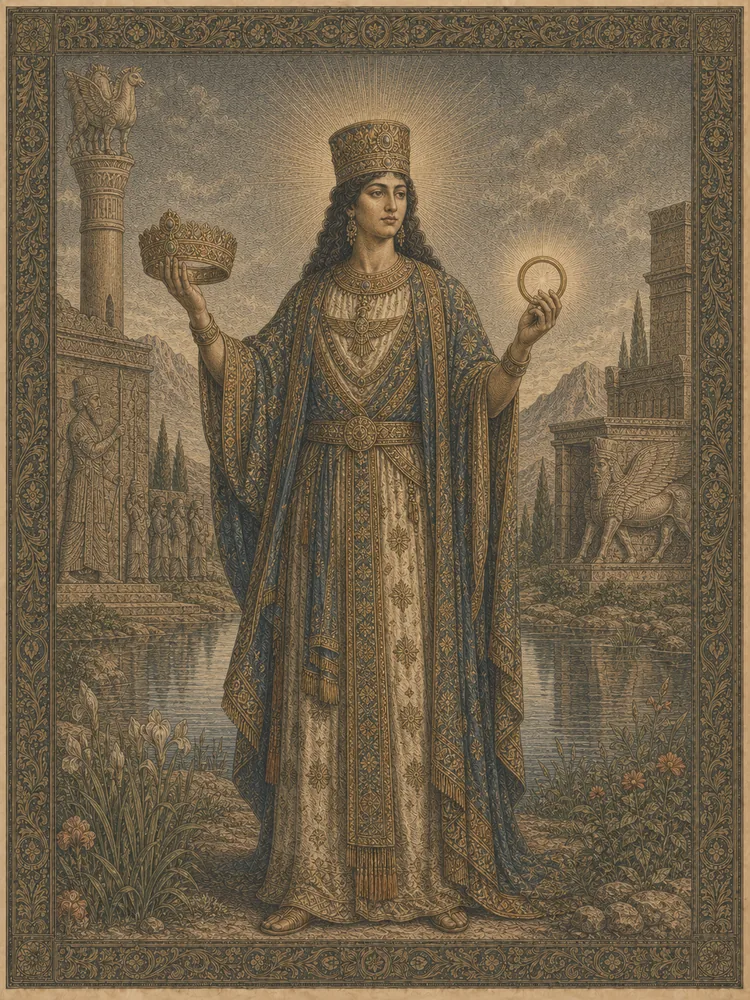
Khvarenah, plate

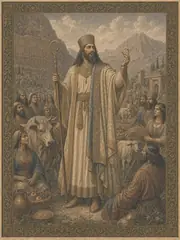
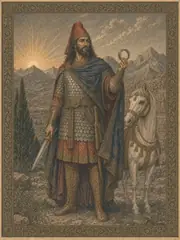
Khvarenah — "Glory," "Splendor," or "Divine Charisma" — was the yazata, or perhaps better the impersonal divine principle, of legitimate royal authority. He was the radiant glow that surrounded the rightful king, the sign and warrant of his right to rule, the gift of Ahura Mazda by which a man became truly a king and not merely the wearer of a crown. The Khvarenah was visible — the king's halo, the radiance of his presence — and was felt by all who came near the legitimate ruler. When the Khvarenah departed from a king (because of his wickedness or his loss of divine favor), his rule lost its legitimacy, and rebellion against him became proper.

The doctrine was the Iranian theology of royal power. The king did not rule by mere force; he ruled by Khvarenah. He was the chosen of Ahura Mazda, the visible bearer of the divine glory, the transmitter of cosmic order to the human realm. From the Achaemenid period through the Sasanian, Iranian kingship was theorized through this doctrine; the royal coinage often depicted the king with rays emanating from his head, the visible Khvarenah, in a manner that influenced the iconography of crowned and haloed rulers in Byzantine and Islamic art.

Yima the first king (treated below) had the Khvarenah in fullness, and ruled the world in a golden age that lasted for centuries. When Yima erred and lied, the Khvarenah departed from him in three flashes, each of which was caught by a different yazata: Mithra, Thraetaona, and Keresaspa. The departure of the Khvarenah brought Yima's golden age to an end. Thereafter, the Khvarenah passed to other rightful kings, to the Iranian people as a whole, to the prophet Zarathushtra, and finally to the Saoshyant, the eschatological saviour, who would receive it in fullness at the end of the age.

The Avestan hymn to the Khvarenah is Yasht 19, the Zamyad Yasht, which is one of the most historically important poems in the corpus, for it preserves the great royal-historical tradition of Iran in compressed form: the catalog of the kings who held the Khvarenah, the heroes who held it, the figures who lost it. The Shahnameh of Ferdowsi, the great Persian national epic, is in many respects a long poetic elaboration of the Zamyad Yasht's compressed catalog.
Curator’s note

What the sources say, and what later tradition added. The sources for this bay

Khvarenah is the central concept of Yasht 19, the Zamyad Yasht. The doctrine of royal Khvarenah and its visual representation is documented archaeologically in Achaemenid and Sasanian royal iconography; G. Gnoli's various studies are foundational. The Shahnameh adaptation gives the Persian-Islamic afterlife of the doctrine. The cognate Vedic svar "sun, heaven" is from the same Indo-European root; the Iranian semantic shift to "glory, charisma" is distinctive. The figure has been compared to the Greek tyche and the Roman fortuna, but Khvarenah is more specifically royal and more directly tied to legitimate authority than these.

Kin in the sources

Each tie is quoted from the entry that states it.

When the sources speak

Dated witnesses for The Yazatas. A date marks when the evidence was written down, not when the belief began. The whole timeline

late 2nd–early 1st millennium BCE, debated
The Old Avestan Gathas and Yasna Haptanghaiti emerge in an eastern Iranian ritual-poetic setting; Zarathustra’s date remains disputed.
1st millennium BCE
Younger Avestan hymns, ritual texts, and legal-purity materials develop over a long period of oral transmission.
c. 550–330 BCE
Achaemenid inscriptions invoke Ahuramazda in imperial royal ideology; their relationship to later Zoroastrian orthodoxy requires care.
330 BCE–224 CE
Hellenistic and Parthian eras preserve Iranian cults through sparse and regionally varied evidence.
224–651 CE
Sasanian institutions sponsor priestly learning and the redactional organization associated with the Avesta and Zand.
7th–10th centuries CE
After the Islamic conquest, Middle Persian books record cosmology, law, exegesis, and summaries of lost material.
c. 9th century CE
The Bundahišn, Dēnkard, Wizīdagīhā ī Zādspram, and related works preserve systematic late antique and early Islamic syntheses.
c. 977–1010 CE
Ferdowsi composes the Shāhnāmeh from epic and royal traditions with both pre-Islamic and Islamic-period mediation.

Floor plan

The rooms follow one another in the order their peoples first appear in the written record.

  1. The Cradle of Citiesc. 3400 BCE to 395 CE. 115 works
  2. The Gift of the Nilec. 4000 BCE to 395 CE. 73 works
  3. The Olympian Orderc. 1600 BCE to 750 CE. 152 works
  4. The Persian Worldc. 2000 BCE to 1010 CE. 30 works
  5. The Levantine Borderlandsc. 1200 BCE to 500 CE. 20 works
  6. The Edges of Empirec. 2000 BCE to 1500 CE. 33 works
  7. The Etruscan Worldc. 900 BCE to 750 CE. 22 works
  8. The Roman Inheritancec. 1200 BCE to 500 CE. 58 works
  9. The Northern Inheritancec. 2000 BCE to 1600 CE. 131 works