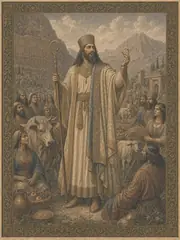
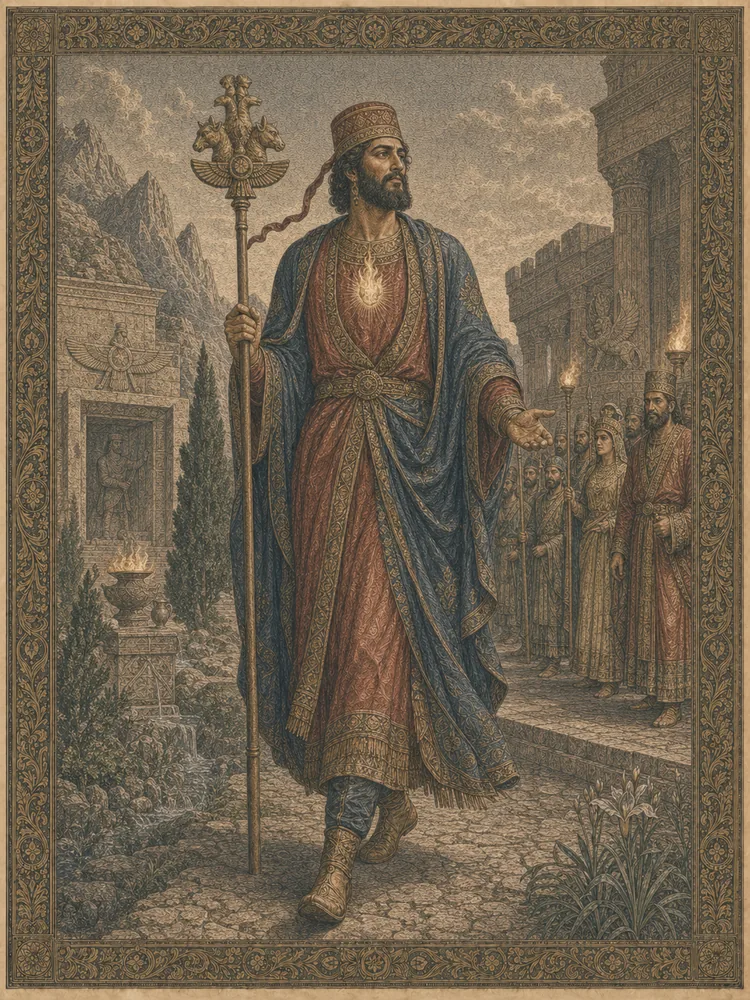
Nairyosanha — "the Manly Utterance," or "the Heroic Speech" — was the messenger-yazata of the Iranian pantheon, the spokesman of Ahura Mazda, the carrier of divine messages between heaven and earth. He embodied a particular kind of fire — the fire that burns at the heart of the king and the warrior, the fire of authoritative speech, the fire that gives the priestly recitation its power. He was the hierophant of the spoken word as a sacred instrument, and his presence in the rite gave the words their efficacy.
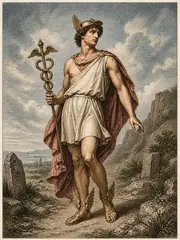
His role as messenger has parallels elsewhere in Indo-European religion: the Greek Hermes, the Roman Mercury, the Norse Hermod (and even Loki in his messenger function), all served similar offices. But Nairyosanha's distinctive feature was the connection to fire — specifically, to the fire of speech and royal command — and through this connection he was associated with the priestly and royal functions of Iranian society. He carried Ahura Mazda's commands to the kings and the heroes; he carried their petitions back to Ahura Mazda. The dialogue between the divine and the human ran through his channel.
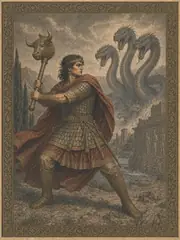
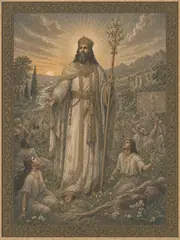
In the great Iranian heroic legends preserved in the Avesta and elaborated in the Shahnameh, Nairyosanha appears at moments of crisis to deliver the message that turns the action: he tells Yima the doom that has befallen him; he summons Thraetaona to the battle against Aži Dahāka; he speaks to the Saoshyant in his prophetic dreams. So he is woven through the heroic tradition as the divine voice in the human ear, the channel by which the cosmic war became known and intelligible to those who must fight it.
His name has the curious distinction of being preserved in fragmentary form in the Vedic tradition as well — the Vedic Naraśaṁsa, an epithet of Agni (the fire-god) meaning "the praise of men" or "the praising of men." The cognate confirms that Nairyosanha was an Indo-Iranian inheritance, with his fire-and-speech function dating back to the proto-Iranian period. The Iranian preserved him as a distinct yazata; the Vedic absorbed him into the broader figure of Agni.