Hermes was the messenger of the gods, the conductor of souls to the underworld (psychopompos), the patron of travelers and merchants and (with a winking acceptance that the Greeks found amusing) of thieves, the protector of flocks and of the wayside herm — the boundary-marker that bore his name and his bearded head atop a square pillar with phallus carved beneath. He was a son of Zeus and the Pleiad Maia, born in a cave on Mount Cyllene in Arcadia, and his career began with extraordinary precocity: on the first day of his life, he stole his half-brother Apollo's cattle, drove them backwards (so that their tracks would point the wrong way), invented the lyre by stretching strings across a tortoise-shell, and returned to his cradle to feign infancy. When Apollo, having tracked him by divine power, came in fury to demand his cattle back, the infant Hermes denied everything with such charm that Apollo was won over; the lyre was given as compensation; the cattle were returned; and Hermes was admitted to Olympus as the youngest of the gods.
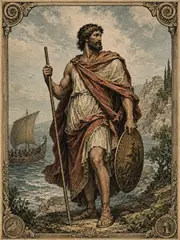
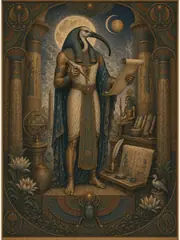
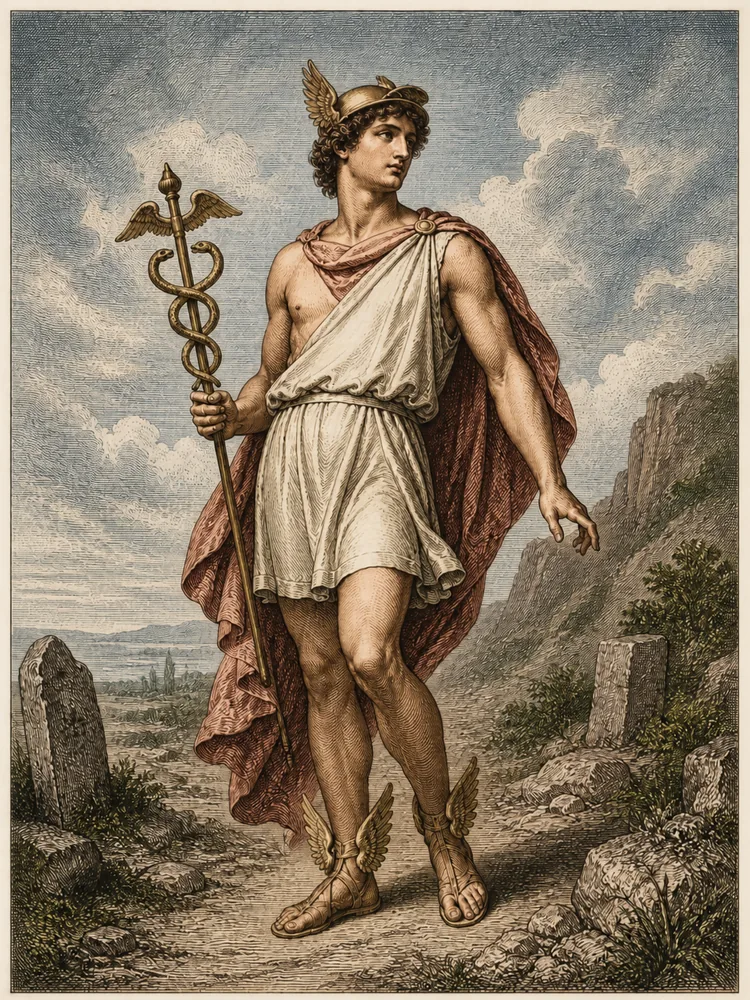
His offices were various and well-suited to his nature. As messenger of Zeus, he traveled freely between Olympus, the earth, and the underworld; his winged sandals (the talaria) and winged cap (the petasos) and golden rod (the caduceus, with its two intertwined serpents) were his attributes. As psychopompos, he led the souls of the dead down to Hades; as protector of merchants and travelers, he was honored at every roadside and at every market; as patron of athletes (he was credited with inventing wrestling and other sports), he was honored at the gymnasia. As patron of communication and language, he was the patron of interpreters, of orators, of writers, and (in late antiquity) of the alchemical and esoteric tradition that took his name (Hermes Trismegistus, treated under Thoth in Volume II).
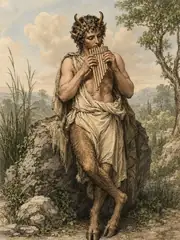
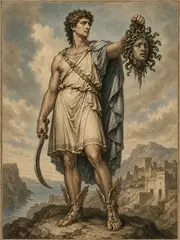
He was the father of Pan (by the nymph Dryope, in some accounts), of Hermaphroditus (by Aphrodite), of Autolycus (the great trickster, grandfather of Odysseus), and many others. His role in heroic narratives was that of facilitator and rescuer: he brought Pandora to Epimetheus, gave Perseus the magical implements with which to behead Medusa, conducted Priam through the Greek camp to Achilles to ransom Hector's body, freed Odysseus from Calypso's island. He was generally well-liked among the gods; he was the Olympian most accessible to mortals, the most genially helpful, the least implacable. His Roman counterpart Mercury preserved his commercial and messenger functions but lost some of his Greek complexity.