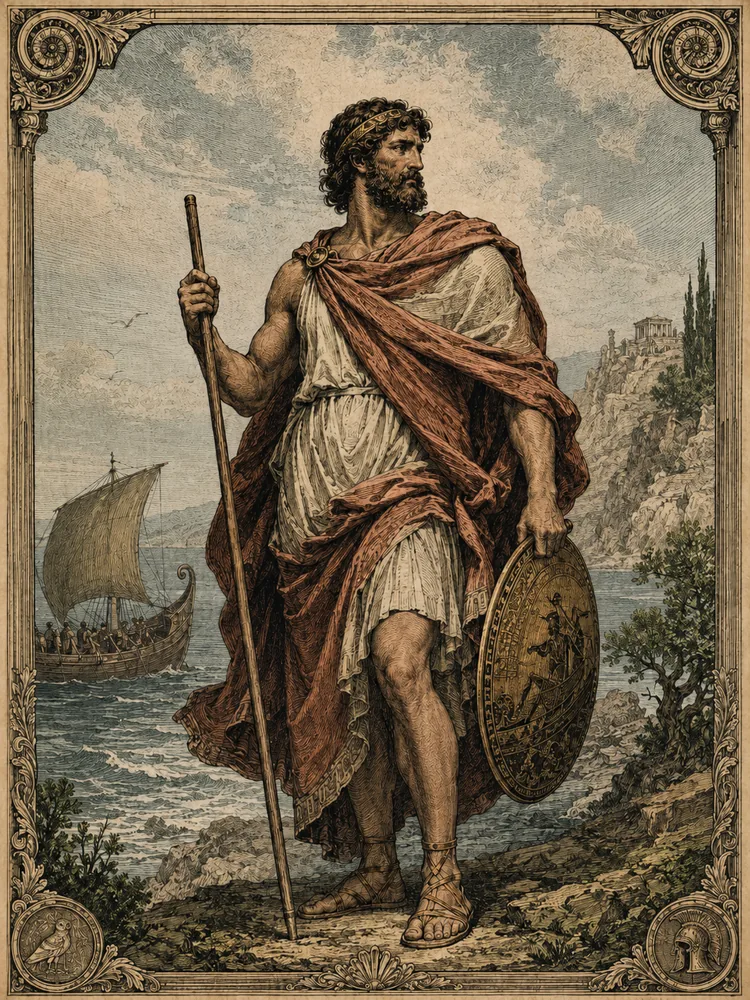
Odysseus (whom the Latin tradition calls Ulysses, from a parallel form of the name) was the king of Ithaca, son of Laertes, husband of Penelope, father of Telemachus, and the hero of the Odyssey. He was renowned among the Greeks for his cunning rather than for his strength; he was the schemer of the Trojan War, the deviser of the Wooden Horse by which Troy was at last taken, the diplomat whose embassies were successful where blunter men's failed. The Iliad presents him as resourceful and shrewd; the Odyssey makes those qualities the hinge of the entire narrative.
After the fall of Troy, his return-voyage to Ithaca (the matter of the Odyssey) was prolonged by Poseidon's enmity (for the blinding of the Cyclops Polyphemus, Poseidon's son) into a ten-year wandering of extraordinary range. He blinded Polyphemus the one-eyed Cyclops, who had eaten several of his crew, by a stratagem of false names and a sharpened olive-stake. He was held a year by the witch Circe, who had transformed his men into swine and was made to release them. He visited the borders of the underworld and consulted the shade of Tiresias for prophetic guidance. He passed the Sirens (whose song no man could resist) by stopping his crew's ears with wax and having himself bound to the mast, that he might hear the song without being able to leap into the sea after them. He passed Scylla and Charybdis (treated in Book VII), losing six of his men. He came to the island of Helios's cattle, which his men, against his orders, slaughtered for food; in punishment Zeus destroyed Odysseus's ship and all his crew. Odysseus alone survived, washed up on the island of the nymph Calypso, who held him as her lover for seven years. At last released, he was wrecked again, came to the kingdom of the Phaeacians, told them his story, was taken home to Ithaca by their magical ship, found his palace overrun by the suitors of his wife Penelope (who had refused to remarry, holding to his return), revealed himself, slew the suitors with bow and sword, and was reunited with his wife after twenty years away.
Odysseus's character — the master of cunning, the survivor by wit, the husband faithful in heart through long absence and many infidelities of body, the king who returned to find his house occupied — has had a long subsequent life in Western literature. Dante placed him among the false counselors in Hell (for the deception of the Wooden Horse, and for, as Dante imagined, sailing past the Pillars of Heracles to his own death in pursuit of forbidden knowledge); Tennyson's Ulysses speaks the famous aged-king's resolution to set forth again; Joyce's Ulysses takes Odysseus as the secret model of an ordinary man's day in modern Dublin; the figure has not lost its hold on the imagination.