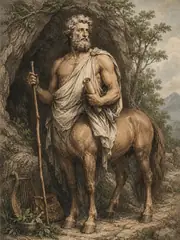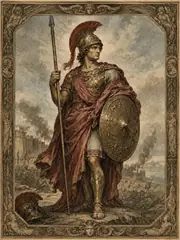
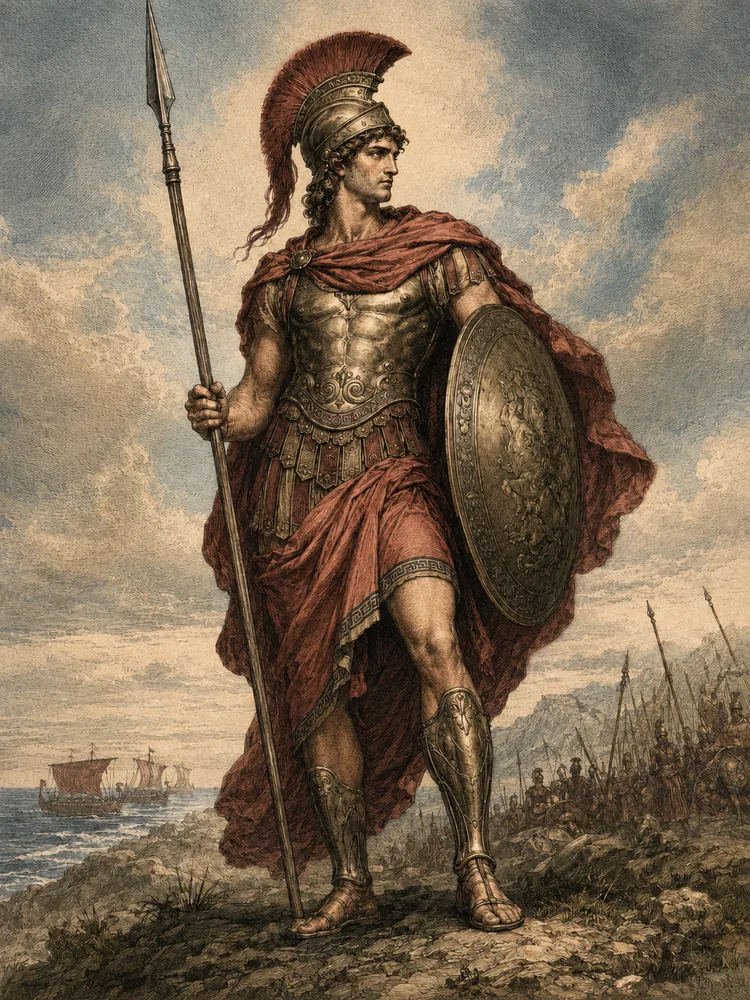
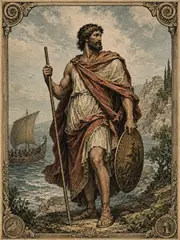
Achilles was the greatest of the Greek heroes at Troy, son of the mortal Peleus king of Phthia in Thessaly and the sea-goddess Thetis. The marriage of Peleus and Thetis had been arranged because the gods had a prophecy that any son of Thetis would be greater than his father; the gods accordingly preferred to give her to a mortal, that the prophesied son would not threaten Olympus. The wedding was attended by all the gods (and was the occasion of the Judgment of Paris, when Eris's golden apple inscribed "to the fairest" set Hera, Athena, and Aphrodite quarreling, with Trojan-War consequences). Thetis, hoping to make her son immortal, dipped the infant Achilles in the waters of the Styx, holding him by the heel — and so he was invulnerable everywhere except where her grip had been (the famous "Achilles' heel" of the post-Homeric tradition; in Homer himself the detail is absent, and Achilles is mortal but not specifically invulnerable). She also tried, in some traditions, to burn away his mortal portions in fire, which Peleus interrupted; she also entrusted him to the centaur Chiron for education in heroic arts.
Achilles was given by oracle a choice between two destinies: to live a long, peaceful, obscure life at home, or to go to Troy and win immortal fame and die young. He chose the latter, but his mother attempted to delay the choice by hiding him on the island of Scyros disguised as a girl among the daughters of King Lycomedes; Odysseus, sent to find him, brought a peddler's pack of fine cloths and weapons to the palace, and the disguised Achilles betrayed himself by reaching for the weapons. He went to Troy with his Myrmidons and his beloved companion Patroclus, and at Troy he distinguished himself above all the Greek warriors.
The matter of the Iliad is a brief episode late in the Trojan War, in which Achilles, dishonored by Agamemnon (who had taken Achilles's prize-girl Briseis to replace one he had had to return), withdrew from the fighting in wounded honor; without him the Greeks were driven back to their ships; Patroclus, in Achilles's armor, led the Myrmidons out to relieve the pressure and was killed by Hector; Achilles, in inconsolable grief, returned to the fighting, killed Hector in single combat, dragged his body around the walls of Troy three times, and refused to let it be ransomed; at length the aged King Priam came alone in the night to Achilles's tent, kissed the hands that had killed his son, and begged for the body's return; Achilles wept, gave him the body, and the poem ends with the funeral of Hector. Achilles's own death is not in the Iliad — it is, as it were, just after the poem's close. He was killed by Paris, with an arrow guided by Apollo, that struck him in his vulnerable heel (in the post-Homeric tradition); his armor was disputed between Ajax and Odysseus, with grim consequences (Ajax's madness and suicide, the matter of Sophocles's Ajax).