
A Compendium of the Ancient Gods
Medea, plate

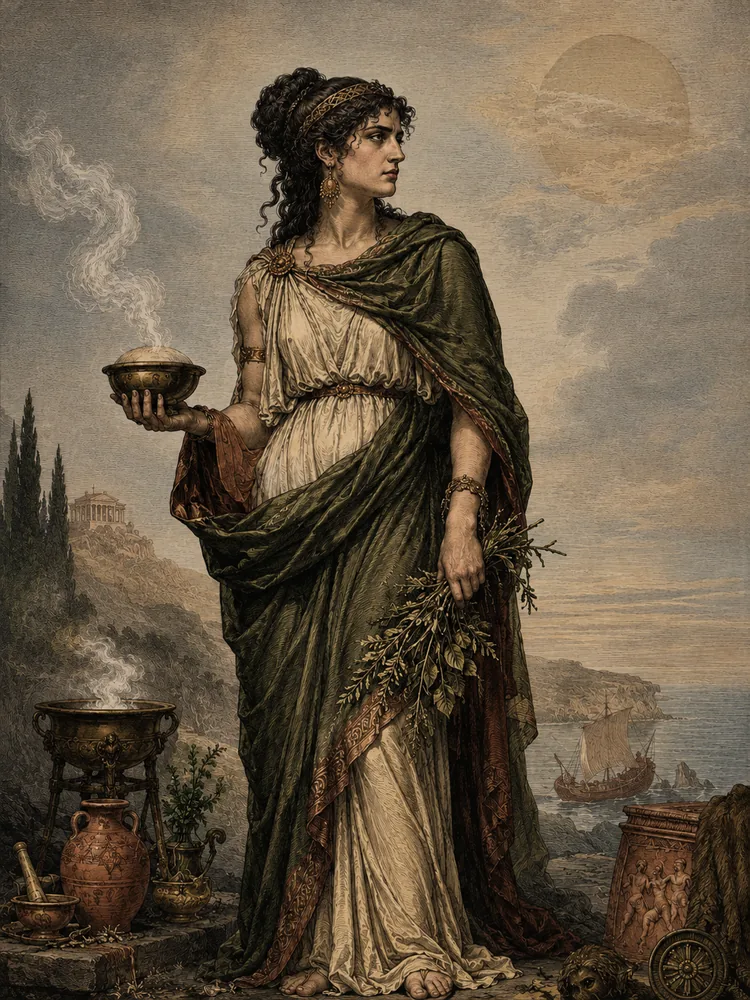
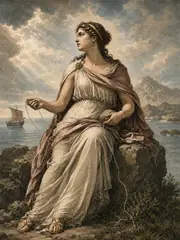
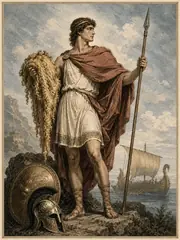
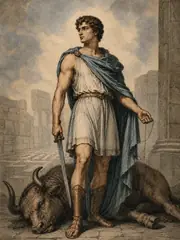
Medea was the daughter of King Aeëtes of Colchis, granddaughter of Helios the sun, and niece of the witch Circe; she was a princess and a sorceress both. When Jason and the Argonauts came to Colchis seeking the Golden Fleece, Aphrodite, prompted by Hera, caused Medea to fall in love with the Greek hero. By her arts she helped him perform the impossible tasks her father had set — yoking the fire-breathing bulls, sowing the dragon's teeth, putting to sleep the dragon that guarded the Fleece — and afterward she fled with him on the Argo, taking her young brother Apsyrtus with her.

When her father pursued the ship, Medea killed Apsyrtus, dismembered the body, and threw the pieces into the sea, knowing that Aeëtes would stop to gather them up for proper burial; so by the cost of her brother's life she purchased the escape. Whether this was done with Jason's knowledge the ancient sources differed, but Medea's hands did the deed. Returning at last to Iolcus, Medea procured the death of King Pelias — Jason's enemy — by persuading his daughters to dismember him and boil him in a cauldron, falsely promising that he would emerge restored to youth. For this murder Medea and Jason were exiled, and they took refuge in Corinth.

There they lived ten years, and Medea bore Jason two sons. But Jason, weary of his foreign sorceress-wife, sought to put her aside in favor of Glauce, daughter of King Creon of Corinth — a younger and more politically advantageous bride. When Medea was informed of this and ordered to leave the city, she answered with one of the most terrible acts in all mythology. She sent Glauce a wedding-gift, a robe and crown that, when worn, burst into supernatural flame and consumed the princess and her father; and then, that no son of hers should be left for Jason to take into his new life, she killed her own two boys with a sword. When Jason ran to the house, Medea had already escaped — riding in a chariot drawn by dragons, sent by her grandfather Helios — and was bound for Athens, where King Aegeus had promised her sanctuary.

Of her later story the sources told fragments. At Athens she attempted to poison the young Theseus, was discovered, and fled again — this time eastward, back to Asia, where she was at last reconciled with her father and, in some accounts, became immortal in the Elysian fields, married to Achilles.
Curator’s note

What the sources say, and what later tradition added. The sources for this bay

Medea's story before her arrival in Greece is told in Apollonius of Rhodes (Argonautica), the great Hellenistic epic of Jason's voyage. The Corinthian tragedy is the subject of Euripides's Medea (431 BCE), one of the most terrible plays of Greek drama; Euripides may have invented the detail that Medea kills her children with her own hand — earlier sources had the Corinthians stoning the children in revenge for Glauce — and his version became canonical. Pindar (Pythian 4) gives the earliest substantial poetic treatment. Pseudo-Apollodorus (Bibliotheca 1.9.16-28) is the basic mythographic source. The Athenian portion of her career is in Plutarch (Theseus 12) and Pseudo-Apollodorus (Epitome 1.5-6). Medea is the great Greek instance of the foreign woman whose transgression is so absolute that she stands outside both the human and the divine order; Euripides's portrait of her, as both a victim of betrayal and a perpetrator of monstrous revenge, is one of the most morally complex characters in ancient literature.

Kin in the sources

Each tie is quoted from the entry that states it.

When the sources speak

Dated witnesses for The Heroic Cycle and the Tragic Houses. A date marks when the evidence was written down, not when the belief began. The whole timeline

c. 1600–1100 BCE
Mycenaean palace tablets in Linear B record offerings and divine names, but little continuous myth.
c. 1100–800 BCE
Post-palatial oral traditions and changing cult landscapes precede the surviving alphabetic epics.
late 8th–7th centuries BCE
The Iliad, Odyssey, Hesiodic Theogony and Works and Days give influential but non-exclusive divine orders.
7th–6th centuries BCE
Homeric Hymns, lyric poetry, colonization, and local sanctuary traditions multiply regional narratives.
6th–5th centuries BCE
Orphic, Pythagorean, and mystery materials develop alternative cosmogonies and afterlife doctrines.
5th century BCE
Athenian tragedy and comedy recast heroic houses and divine justice for civic audiences.
4th century BCE
Philosophers, antiquarians, and local historians interpret or criticize inherited myth.
323–31 BCE
Hellenistic poets and scholars systematize variants across an enlarged Greek world.

Floor plan

The rooms follow one another in the order their peoples first appear in the written record.

  1. The Cradle of Citiesc. 3400 BCE to 395 CE. 115 works
  2. The Gift of the Nilec. 4000 BCE to 395 CE. 73 works
  3. The Olympian Orderc. 1600 BCE to 750 CE. 152 works
  4. The Persian Worldc. 2000 BCE to 1010 CE. 30 works
  5. The Levantine Borderlandsc. 1200 BCE to 500 CE. 20 works
  6. The Edges of Empirec. 2000 BCE to 1500 CE. 33 works
  7. The Etruscan Worldc. 900 BCE to 750 CE. 22 works
  8. The Roman Inheritancec. 1200 BCE to 500 CE. 58 works
  9. The Northern Inheritancec. 2000 BCE to 1600 CE. 131 works