A Compendium of the Ancient Gods
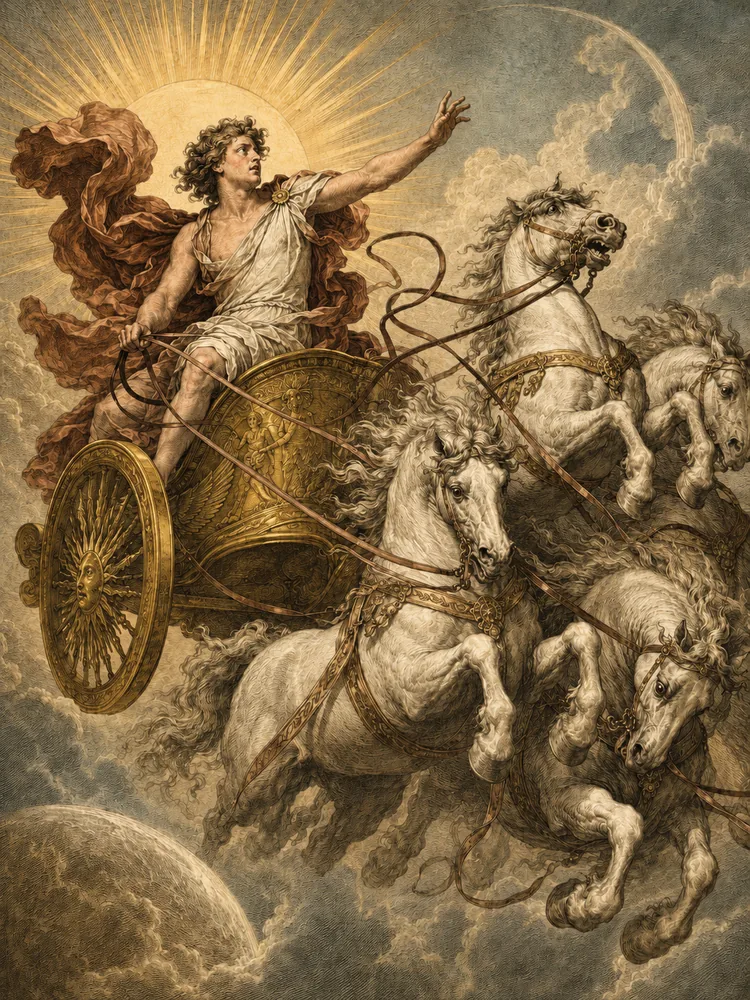
Phaethon, plate

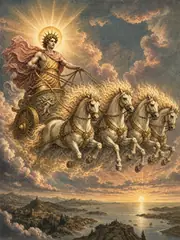
Phaethon was the son of Helios the sun-god by the mortal woman Clymene, but had been raised by his mother and her husband Merops, an Ethiopian king, and was uncertain of his true paternity. When his playmates mocked his claim to be a son of the sun, Phaethon went to his mother in distress; and Clymene, swearing it was true, sent him to Helios's palace at the eastern edge of the world to demand acknowledgment.

Phaethon came to the palace of dawn and was received by his father, who, joyful at the meeting, swore by the Styx — the unbreakable oath of the gods — that he would grant the boy any boon he wished, in earnest of his fatherhood. Phaethon asked for the one thing his father could not safely give: to drive the chariot of the sun for one day across the sky. Helios pleaded, warned of the dangers, named the difficulties of the route — the steep ascent, the high apex from which the sea looked impossibly far below, the rearing horses that even he could scarcely control — but the oath had been sworn and could not be revoked. So at dawn the boy mounted the chariot, took the reins from his father, and the four horses sprang forward.

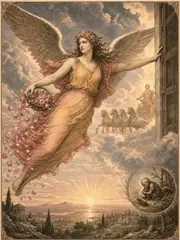
What followed was disaster. The horses, finding the chariot lighter than usual, left the proper road and ran wild — first too high, scorching the heavens, then too low, parching the earth. The clouds caught fire, the rivers ran dry, the seas withdrew from their beds, and the dark-skinned peoples of Africa got their skin (so the ancient mythographers said) from the heat of that day; the Sahara was made a desert. Earth herself cried out to Zeus, and Zeus, with no choice, hurled his thunderbolt against Phaethon. The boy fell flaming from the chariot into the river Eridanus; his sisters, the Heliades, came to mourn him beside the river, and they were transformed into poplars whose tears congealed into amber, which the river carried down to the sea. So the Greeks accounted for the origin of amber from the rivers of the north.
Curator’s note

What the sources say, and what later tradition added. The sources for this bay

Phaethon's story is preserved in fullest form in Ovid (Metamorphoses 1.747-2.400, an extended set-piece), but it is older: Hesiod mentions him (Theogony 986-991, where he is a son of Eos, not of Helios — a different tradition); Euripides wrote a Phaethon (lost, but substantial fragments survive); Pseudo-Apollodorus (Bibliotheca 3.14.4) gives a brief version. The amber-from-Heliades-tears motif is the Greek explanation of the Baltic amber trade, the source of which was unclear in antiquity but evidently lay somewhere to the north of the Black Sea. The constellation Eridanus, into which Phaethon fell, is identified with our familiar long meandering southern constellation by Eratosthenes and Aratus. The story is one of the great instances in Greek myth of the disastrous oath — the divine swear by Styx, cannot be revoked, and must be fulfilled even when the consequences are catastrophic.

Kin in the sources

Each tie is quoted from the entry that states it.

When the sources speak

Dated witnesses for The Heroic Cycle and the Tragic Houses. A date marks when the evidence was written down, not when the belief began. The whole timeline

c. 1600–1100 BCE
Mycenaean palace tablets in Linear B record offerings and divine names, but little continuous myth.
c. 1100–800 BCE
Post-palatial oral traditions and changing cult landscapes precede the surviving alphabetic epics.
late 8th–7th centuries BCE
The Iliad, Odyssey, Hesiodic Theogony and Works and Days give influential but non-exclusive divine orders.
7th–6th centuries BCE
Homeric Hymns, lyric poetry, colonization, and local sanctuary traditions multiply regional narratives.
6th–5th centuries BCE
Orphic, Pythagorean, and mystery materials develop alternative cosmogonies and afterlife doctrines.
5th century BCE
Athenian tragedy and comedy recast heroic houses and divine justice for civic audiences.
4th century BCE
Philosophers, antiquarians, and local historians interpret or criticize inherited myth.
323–31 BCE
Hellenistic poets and scholars systematize variants across an enlarged Greek world.

Floor plan

The rooms follow one another in the order their peoples first appear in the written record.

  1. The Cradle of Citiesc. 3400 BCE to 395 CE. 115 works
  2. The Gift of the Nilec. 4000 BCE to 395 CE. 73 works
  3. The Olympian Orderc. 1600 BCE to 750 CE. 152 works
  4. The Persian Worldc. 2000 BCE to 1010 CE. 30 works
  5. The Levantine Borderlandsc. 1200 BCE to 500 CE. 20 works
  6. The Edges of Empirec. 2000 BCE to 1500 CE. 33 works
  7. The Etruscan Worldc. 900 BCE to 750 CE. 22 works
  8. The Roman Inheritancec. 1200 BCE to 500 CE. 58 works
  9. The Northern Inheritancec. 2000 BCE to 1600 CE. 131 works