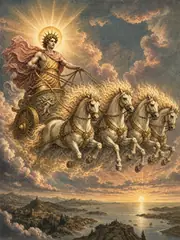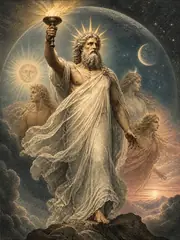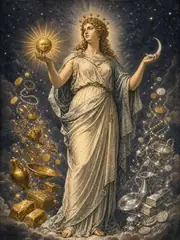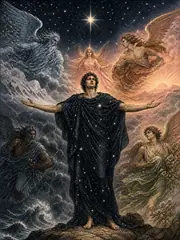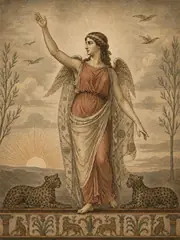
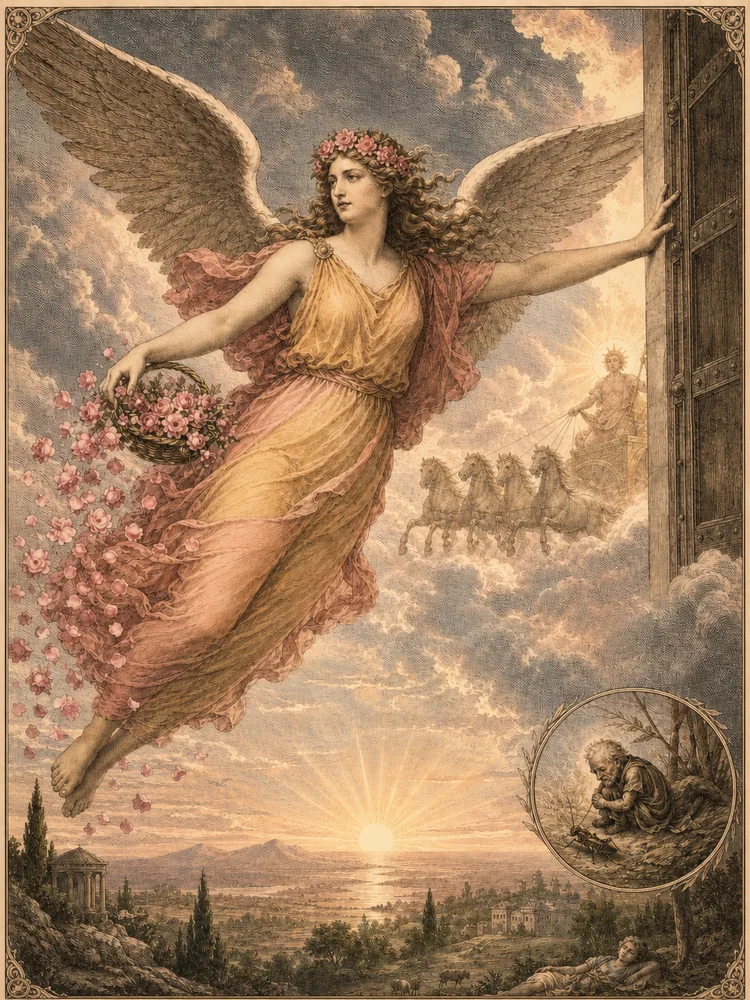
Eos was the dawn — the rosy-fingered goddess who preceded Helios each morning, opening the eastern gate, casting her rose-tinged light upon the sky as her brother prepared to follow. She was a familiar figure of Homeric formula: "and as soon as the early-born rosy-fingered Dawn appeared." She was given by some traditions a chariot of her own, drawn by two horses, ahead of her brother's; she had wings; she scattered the dew from her urn upon the earth.
Her loves were many and unfortunate. She conceived a passion for the youth Tithonus, son of Laomedon king of Troy, and bore him away to her palace in the east. She begged Zeus to grant Tithonus immortality, which he did; but she had forgotten to ask also for eternal youth, and Tithonus aged inexorably while remaining unable to die — until he was so old and wizened that he was a mere shrunken cricket-like creature, kept (in the late versions of the tale) in a basket where his ceaseless chatter could not disturb the goddess. The myth is one of the most poignant cautionary tales in Greek tradition, and has been the subject of much subsequent poetry, most famously Tennyson's monologue "Tithonus." Eos also loved the great hunter Cephalus and the giant Orion (whose presumption Artemis punished with death), and she bore Memnon to Tithonus before his decline; Memnon went to fight at Troy on the side of his Trojan kinsmen and was killed by Achilles, after which Eos's daily appearance was always marked by tears (which we still call dew) for her dead son.