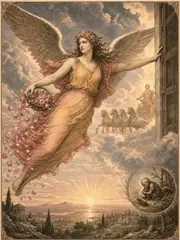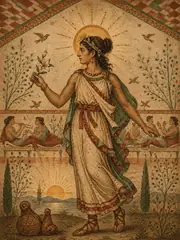
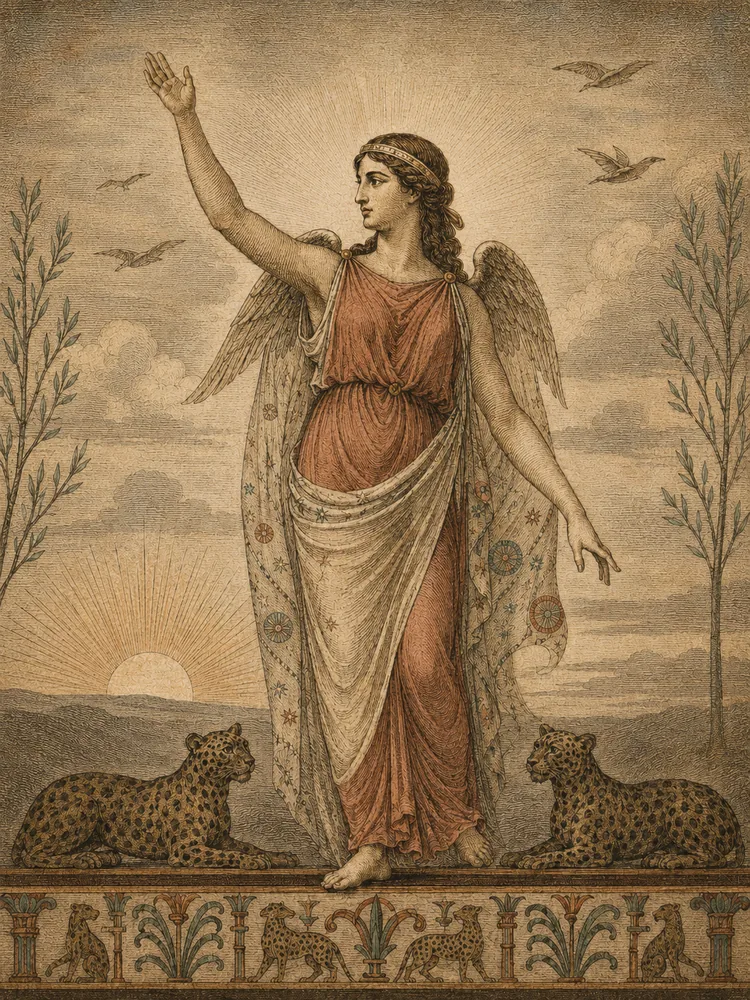
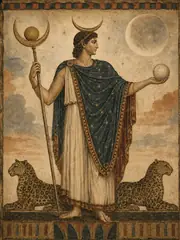
Thesan was the Etruscan goddess of the dawn — the figure equivalent to the Greek Eos and the Roman Aurora, with whom she was identified by Hellenizing tradition. She was depicted on mirrors and in painted tombs as a winged young woman rising from the eastern horizon, often bearing a youth in her arms (the Etruscan version of the Greek myth of Eos and Tithonus, or of Eos and her various beloved mortals). She was the harbinger of the new day, the deity of the moment between night and full sunrise, the one who opened the gates of heaven for the sun's coming.
Her cult is attested chiefly through inscriptions and through iconographic evidence on mirrors. Numerous bronze mirrors depict her in the act of rising, with rays around her head and great wings spreading from her shoulders; one famous mirror from the British Museum shows her bearing a young man (perhaps the Etruscan version of Tithonus) up into the heavens. The iconography is heavily Hellenized, but the cultic function — the daily sanctification of the dawn — was indigenous and probably older than the Greek influence.
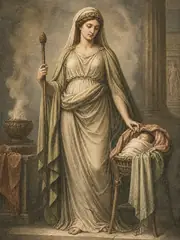
Thesan was the patroness of childbirth in some traditions, on the symbolic ground that birth and the dawn were both moments of new life emerging from darkness. The connection between dawn-goddesses and childbirth is widespread in Indo-European religion (the Greek Eileithyia, the Roman Lucina, the Vedic Ushas), and the Etruscan parallel may be either an inheritance of an older common conception or an independent development from the obvious symbolic resonance.
After the Romanization of Etruria, Thesan was absorbed into the Roman Aurora and largely disappeared from independent cult; her iconography continued in tomb paintings (where the soul's journey to the afterlife was sometimes figured as a passage through the gates of dawn), but her name vanished from the inscriptions of the imperial period.