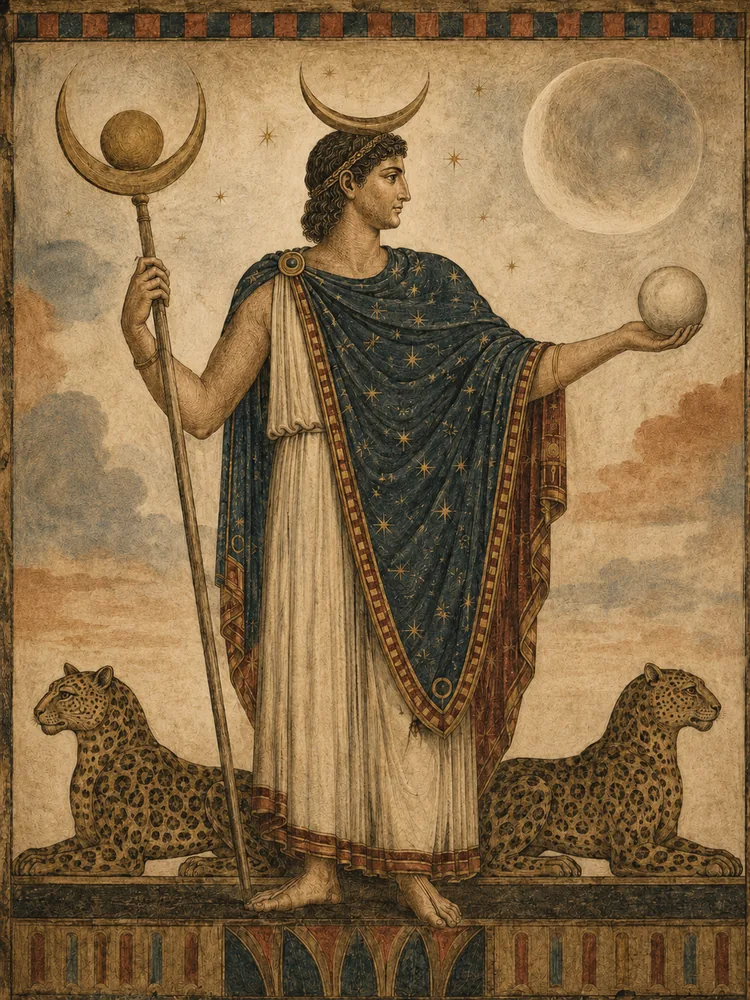
Tiur was the Etruscan moon-deity, the companion or counterpart of Usil the sun. Whether Tiur was male or female is uncertain — the Etruscan inscriptions are ambiguous, and the iconographic evidence is scant — but the function is clear: Tiur was the personified moon, the divine power of the lunar cycle, the timekeeper of the months. The Etruscan word for 'month' was tiur, the same word as the deity's name; so the moon and the month were linguistically and theologically one, just as Latin mensis and Greek mēn preserve the same root in the parallel words.
The Etruscan calendar was lunar, with months marked by the new moon, and Tiur's appearances regulated the religious year. The Liber Linteus — the great surviving Etruscan religious calendar, preserved on the linen wrappings of an Egyptian mummy now at Zagreb — is organized around the months of the year, each with its proper rites; Tiur as the moon-deity oversaw this entire annual cycle, providing the basic rhythm of religious time.
On the Piacenza Liver, Tiur occupies a region in the lower (chthonic) hemisphere of the bronze model — perhaps reflecting the Etruscan understanding of the moon as a deity who descended below the earth at the dark of the moon, only to be reborn at the new moon's first crescent. The descent and return of the moon was a regular sacred event in the Etruscan calendar, marked by appropriate ceremonies of mourning at the disappearance and rejoicing at the renewal.
Of Tiur's personal mythology — stories of Tiur as protagonist — almost nothing survives. The deity is known to us as a calendar-marker and a region on the divinatory liver, but no narrative myth has come down. After the Romanization, Tiur was identified with Roman Luna and disappeared as a distinct figure.