A Compendium of the Ancient Gods
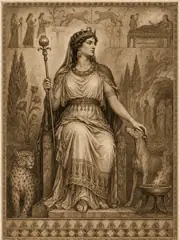
Cel, plate

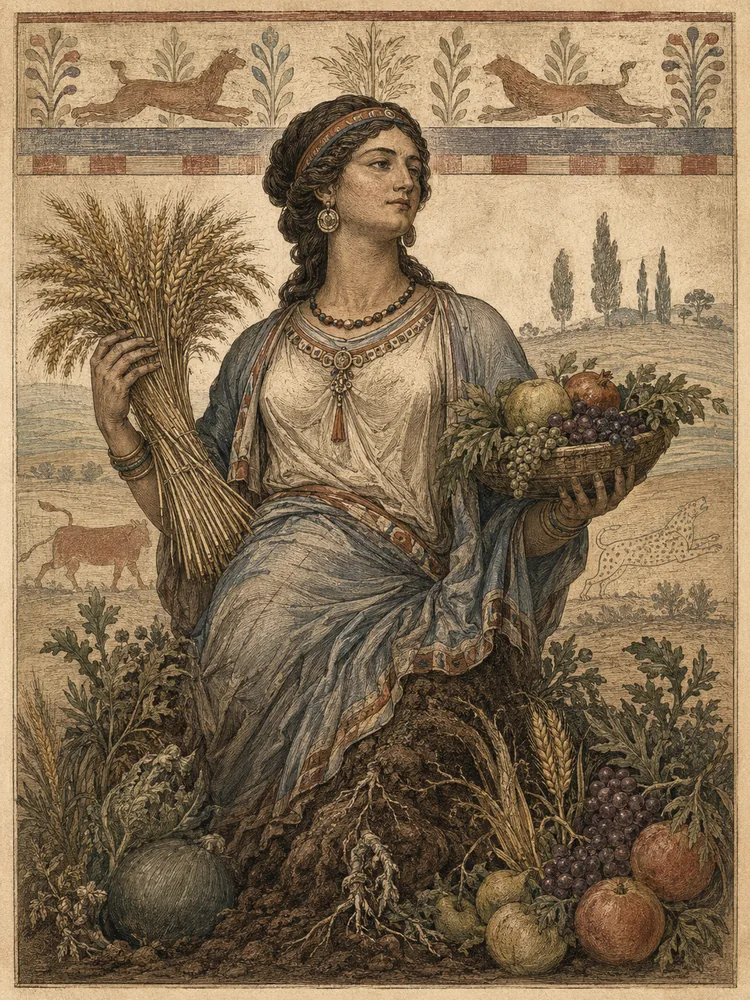
Cel was the Etruscan earth-mother, the divine personification of the cultivated soil and of the broader maternal earth. Her name comes from the Etruscan word for 'earth' (cela, cognate with the Latin tellus), and she was the deity to whom prayers were addressed at the planting and the harvest, at the founding of cities (where her assent was sought before the plow drew the first furrow of the city-walls), and at burials (where the body was committed to her care).

She had a particular function as the patroness of the foundation-rite of cities. When a new Etruscan city was to be built, the founder yoked a bull and a cow to a plow and drew a furrow around the area to be enclosed. The plowed line was the sacred boundary of the city, and the soil thrown up by the plow was carried inward to make the embankment of the rampart. This rite, called the sulcus primigenius, was performed in the presence of Cel and addressed to her; the city, once founded, was literally a portion of her body marked off for human habitation. The Romans inherited the rite from the Etruscans and continued it through the imperial period; Romulus's foundation of Rome was performed in this Etruscan manner, and the same rite was used at the founding of every Roman colonia thereafter.

Cel had her own festival on the equinox of autumn, when the harvest was complete and the seed for next year was being placed in the earth; the rite was a thanksgiving for the year's abundance and a petition for the seed's preservation through the winter. She was particularly approached by women, who offered her bread, milk, and honey at thresholds and at boundary-stones.

On the Piacenza Liver, Cel occupies a region in the lower hemisphere — the chthonic side — confirming her identification as an earth-mother with associations both fertile and funerary. She was one of the deities to whom the dead were commended in the Etruscan funerary cult, and tombs are sometimes addressed to her by formulas of the kind 'to Cel, mother of all' (Cel-Ati, the second word being the Etruscan for 'mother').
Curator’s note

What the sources say, and what later tradition added. The sources for this bay

Cel is named on the Piacenza Liver. The word cela 'earth' is documented in the inscriptions and is the basis of the divine name. The sulcus primigenius rite is described by Plutarch (Romulus 11), Varro (De Lingua Latina 5.143), and Servius (commentary on Aeneid 5.755), all of whom attribute the rite explicitly to Etruscan origin. Cel's role as patroness of the foundation rite is discussed in de Grummond, Etruscan Myth, chapter 4. The relation to Roman Tellus, treated in Vol IV of this anthology, is parallel rather than identical: the two are independent earth-mothers, with the Etruscan probably older. Cel-Ati ('Cel the Mother') as a funerary formula is documented in inscriptions from Tarquinia and elsewhere.

Kin in the sources

Each tie is quoted from the entry that states it.

When the sources speak

Dated witnesses for The Powers of the Sun, Moon and Earth. A date marks when the evidence was written down, not when the belief began. The whole timeline

c. 900–750 BCE
Villanovan communities establish the Iron Age background from which historically Etruscan cities emerge.
c. 750–600 BCE
Orientalizing exchange and urban growth transform elite ritual, iconography, writing, and sanctuary display.
c. 600–475 BCE
Etruscan city-states reach their widest political and artistic influence; temples and mythic imagery proliferate.
c. 474 BCE
The defeat at Cumae marks changing Etruscan power in Campania and the Tyrrhenian world.
5th–4th centuries BCE
Tomb painting, mirrors, votive deposits, and regional cults provide dense evidence for divine and funerary imagery.
396–264 BCE
Roman conquest progressively incorporates Etruscan cities while Etruscan priestly expertise remains prestigious.
2nd–1st centuries BCE
Late inscriptions and Roman antiquarian interest document cultural integration and the persistence of divinatory traditions.
1st century BCE–1st century CE
Cicero, Varro, Livy, Seneca, and others preserve testimony about haruspicy, lightning, and prodigies.

Floor plan

The rooms follow one another in the order their peoples first appear in the written record.

  1. The Cradle of Citiesc. 3400 BCE to 395 CE. 115 works
  2. The Gift of the Nilec. 4000 BCE to 395 CE. 73 works
  3. The Olympian Orderc. 1600 BCE to 750 CE. 152 works
  4. The Persian Worldc. 2000 BCE to 1010 CE. 30 works
  5. The Levantine Borderlandsc. 1200 BCE to 500 CE. 20 works
  6. The Edges of Empirec. 2000 BCE to 1500 CE. 33 works
  7. The Etruscan Worldc. 900 BCE to 750 CE. 22 works
  8. The Roman Inheritancec. 1200 BCE to 500 CE. 58 works
  9. The Northern Inheritancec. 2000 BCE to 1600 CE. 131 works