A Compendium of the Ancient Gods
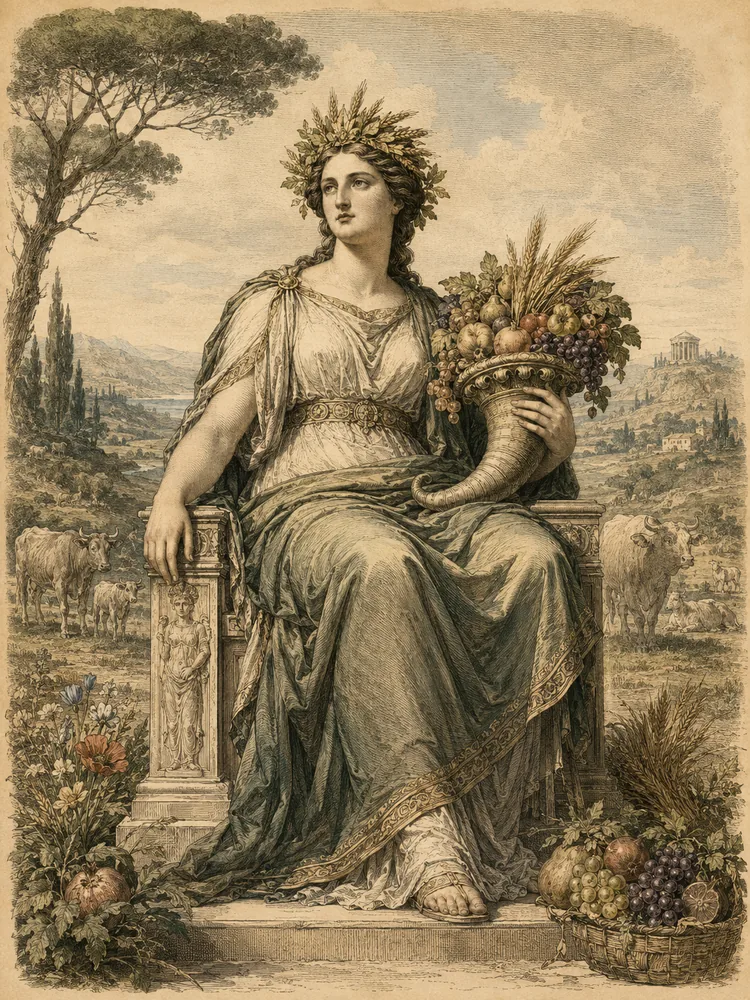
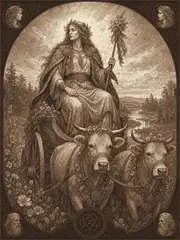
Tellus, plate

Tellus was the Roman earth-mother, called Tellus Mater or Terra Mater, the goddess of the soil considered both as the source of fertility and as the receiver of the dead. Where the Greeks had Gaia, the Romans had Tellus, and the connection was felt by both the priests and the philosophers. But the Roman conception was practical: Tellus was the field that bore the harvest, the earth into which the dead were laid, the firm ground beneath the worshipper's feet. She was less a cosmic primordial in the Italic conception than a working goddess of every farmstead.

Her great festival was the Fordicidia of April 15, when pregnant cows were sacrificed to her — one in each of the thirty curiae of Rome, and one upon the Capitoline by the Pontifex Maximus. The unborn calves were torn from their mothers' bodies and burnt, the ash being preserved by the Vestal Virgins for use at the Parilia six days later, when shepherds and flocks were purified by leaping through smoke and bonfires. So Tellus and the pastoral goddess Pales were linked in the cycle of spring rites, by which the productive year was opened.

Tellus had a temple on the Esquiline Hill, vowed during the Samnite Wars at a moment when the earth shook beneath the Roman army; the consul P. Sempronius Sophus made the vow in gratitude when the army survived. In imperial times Augustus restored the temple, and the great Ara Pacis of 9 BCE depicts Tellus on its eastern relief — a serene mother with two infants, surrounded by emblems of fertility — as the personification of the fruitful Italian peace that the Augustan settlement promised.
Curator’s note

What the sources say, and what later tradition added. The sources for this bay

The Fordicidia is described by Ovid (Fasti 4.629-672), Varro (De Lingua Latina 6.15), and Festus. The temple of Tellus on the Esquiline is mentioned by Livy (10.29.20, the vow) and Florus (1.14). The Augustan reading of Tellus on the Ara Pacis is much-discussed; Karl Galinsky's Augustan Culture (1996) gives a thorough survey of the iconography, and the figure is now generally accepted to be Tellus rather than (as older scholarship sometimes proposed) Italia or Venus. The earth-touching gesture noted under Ops applies equally to Tellus. Tellus and Terra Mater are essentially the same goddess; Tellus is the older Italic name, Terra Mater appears in Hellenizing contexts where the parallel with Gaia Meter is felt.

Kin in the sources

Each tie is quoted from the entry that states it.

The same god in other rooms

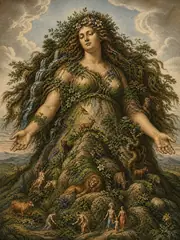
The ancient sources themselves name these as one god under different names. See Tellus and Nerthus hung together

When the sources speak

Dated witnesses for The Indigenous Italic Gods. A date marks when the evidence was written down, not when the belief began. The whole timeline

c. 1000–750 BCE
Iron Age communities of Latium and neighboring peoples develop the cult landscapes later absorbed into Roman tradition.
traditional 753 BCE
Roman foundation chronology places Romulus and the first civic institutions at the beginning of the city’s sacred history.
traditional 7th–6th centuries BCE
The regal period is credited with priesthoods, calendars, temples, and the organization of public rites.
509–264 BCE
Republican expansion incorporates Latin, Sabine, Etruscan, and Italian cults through treaty, migration, and evocatio.
264–146 BCE
Mediterranean conquest accelerates Greek interpretation and the importation or redefinition of foreign gods.
204 BCE
The Magna Mater is formally brought from Pessinus during the Second Punic War.
1st century BCE
Varro, Cicero, and other antiquarians document rites and divine names amid civil war and institutional change.
27 BCE–14 CE
Augustan restoration monumentalizes selected ancestral cults and rewrites Roman sacred history.

Floor plan

The rooms follow one another in the order their peoples first appear in the written record.

  1. The Cradle of Citiesc. 3400 BCE to 395 CE. 115 works
  2. The Gift of the Nilec. 4000 BCE to 395 CE. 73 works
  3. The Olympian Orderc. 1600 BCE to 750 CE. 152 works
  4. The Persian Worldc. 2000 BCE to 1010 CE. 30 works
  5. The Levantine Borderlandsc. 1200 BCE to 500 CE. 20 works
  6. The Edges of Empirec. 2000 BCE to 1500 CE. 33 works
  7. The Etruscan Worldc. 900 BCE to 750 CE. 22 works
  8. The Roman Inheritancec. 1200 BCE to 500 CE. 58 works
  9. The Northern Inheritancec. 2000 BCE to 1600 CE. 131 works