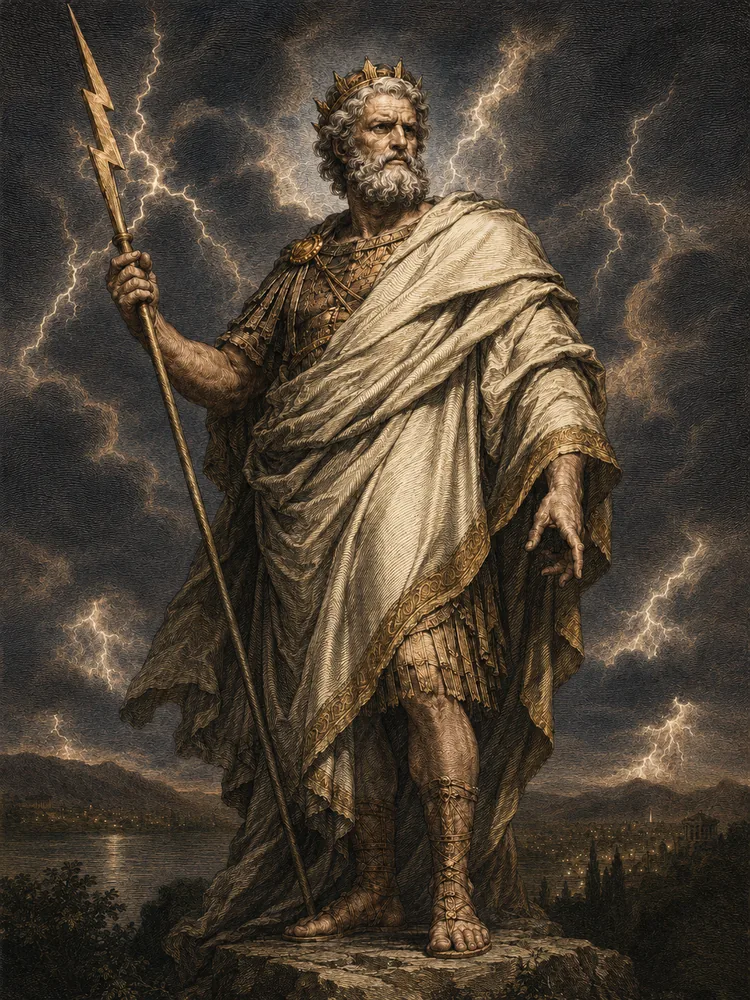
Where Jupiter cast the thunderbolt by day, Summanus cast it by night. So the Roman priesthood divided the heavens between the two gods, and gave each his own sphere. Summanus was an old Italic deity, much older than the cult of Jupiter Optimus Maximus on the Capitol, and his name was understood by the antiquaries as a contraction of sub-manus, "under the morning," or sub manibus, "the powers below" — the etymology was disputed even in antiquity.
His temple stood near the Circus Maximus, and was struck by a thunderbolt in the year 197 before our era, an ill omen that occasioned much consultation. Pliny records that during this episode the head of a terracotta statue of Summanus was carried off by the river; Cicero, in his De Divinatione, recalls the incident. The remarkable point about Summanus's worship was that his sacrificial cake, called summanalia, was made in the shape of a wheel — a sun-symbol, oddly enough, for a deity of the night-thunder; the cake-shape suggests that Summanus may have once been a sky-god in his own right, surviving as a specialist after Jupiter took the chief place.
By the late Republic, Summanus was little worshipped, and the festival of his temple-foundation on the twentieth of June (Vestalia week) was scarcely observed. Augustine, writing four hundred years later, mentions him only to mock the multiplication of Roman gods: he asks, with some justice, why the Romans needed two thunderbolt-gods when one would do.