A Compendium of the Ancient Gods
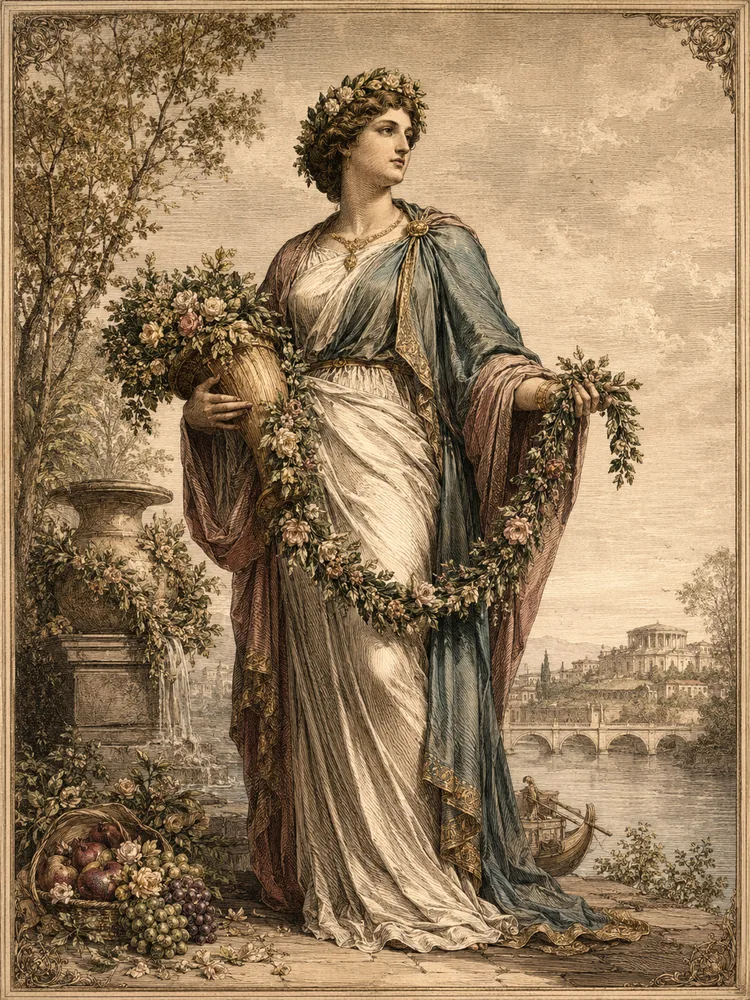
Anna Perenna, plate

Anna Perenna was an old Italic goddess of the year — anna being the same root as annus, with Perenna meaning "continuing through the year" — and her great festival was kept on the Ides of March, which had been the new year's day before the Julian reform. Upon that day all the people of Rome went out to the bank of the Tiber, encamped by the river in temporary shelters of branches, drank wine in great quantity, and prayed to live as many years as they had been able to drink cups of wine. The picnic in the river-meadow was followed by singing, dancing, and a generally bacchanalian conclusion.

Of who Anna Perenna had been before becoming the goddess of the year, the Romans told several stories. Some said she had been Anna, the sister of Dido of Carthage: that after Dido's death she had fled to Italy, where Aeneas had received her with kindness, but where she had aroused the jealousy of Lavinia and so cast herself into the river Numicius and become a nymph. Others said she was an old woman of Bovillae who had brought bread to the plebs during their secession to the Sacred Mount, and had been deified for that service. Still others identified her with Themis, or with Io, or with the moon. Ovid records all these accounts and seems untroubled to choose among them.

What the original cult of Anna Perenna was, beneath the fanciful etiologies, the Romans had largely forgotten. Recent excavations in Rome (uncovered in 1999 in the Piazza Euclide) revealed the cult-site of Anna Perenna, with hundreds of inscribed lead curse-tablets and votive coins thrown into the spring through the imperial period; the goddess was clearly invoked into the fourth century as a power both protective and dangerous, by people who knew her older than the festive picnic Ovid describes.
Curator’s note

What the sources say, and what later tradition added. The sources for this bay

The festival is described chiefly by Ovid (Fasti 3.523-696, an extended treatment with the various mythological identifications); Macrobius (Saturnalia 1.12.6) gives the etymology. The recently excavated cult-site at the Piazza Euclide is published by Marina Piranomonte (Anna Perenna: la fontana sacra, 2002, and subsequent articles). The lead tablets contain magical formulas in Latin and Greek, with curses against rival gladiators, charioteers, and personal enemies; the goddess is addressed there as a chthonic power, suggesting that beneath the cheerful Ides-of-March festival lay an older and more ambivalent figure. The Anna-of-Carthage story may be Ovidian invention, since it is found nowhere earlier; the Anna-of-Bovillae story has the marks of authentic plebeian tradition.

Kin in the sources

Each tie is quoted from the entry that states it.

When the sources speak

Dated witnesses for The Indigenous Italic Gods. A date marks when the evidence was written down, not when the belief began. The whole timeline

c. 1000–750 BCE
Iron Age communities of Latium and neighboring peoples develop the cult landscapes later absorbed into Roman tradition.
traditional 753 BCE
Roman foundation chronology places Romulus and the first civic institutions at the beginning of the city’s sacred history.
traditional 7th–6th centuries BCE
The regal period is credited with priesthoods, calendars, temples, and the organization of public rites.
509–264 BCE
Republican expansion incorporates Latin, Sabine, Etruscan, and Italian cults through treaty, migration, and evocatio.
264–146 BCE
Mediterranean conquest accelerates Greek interpretation and the importation or redefinition of foreign gods.
204 BCE
The Magna Mater is formally brought from Pessinus during the Second Punic War.
1st century BCE
Varro, Cicero, and other antiquarians document rites and divine names amid civil war and institutional change.
27 BCE–14 CE
Augustan restoration monumentalizes selected ancestral cults and rewrites Roman sacred history.

Floor plan

The rooms follow one another in the order their peoples first appear in the written record.

  1. The Cradle of Citiesc. 3400 BCE to 395 CE. 115 works
  2. The Gift of the Nilec. 4000 BCE to 395 CE. 73 works
  3. The Olympian Orderc. 1600 BCE to 750 CE. 152 works
  4. The Persian Worldc. 2000 BCE to 1010 CE. 30 works
  5. The Levantine Borderlandsc. 1200 BCE to 500 CE. 20 works
  6. The Edges of Empirec. 2000 BCE to 1500 CE. 33 works
  7. The Etruscan Worldc. 900 BCE to 750 CE. 22 works
  8. The Roman Inheritancec. 1200 BCE to 500 CE. 58 works
  9. The Northern Inheritancec. 2000 BCE to 1600 CE. 131 works