A Compendium of the Ancient Gods
Robigus, plate

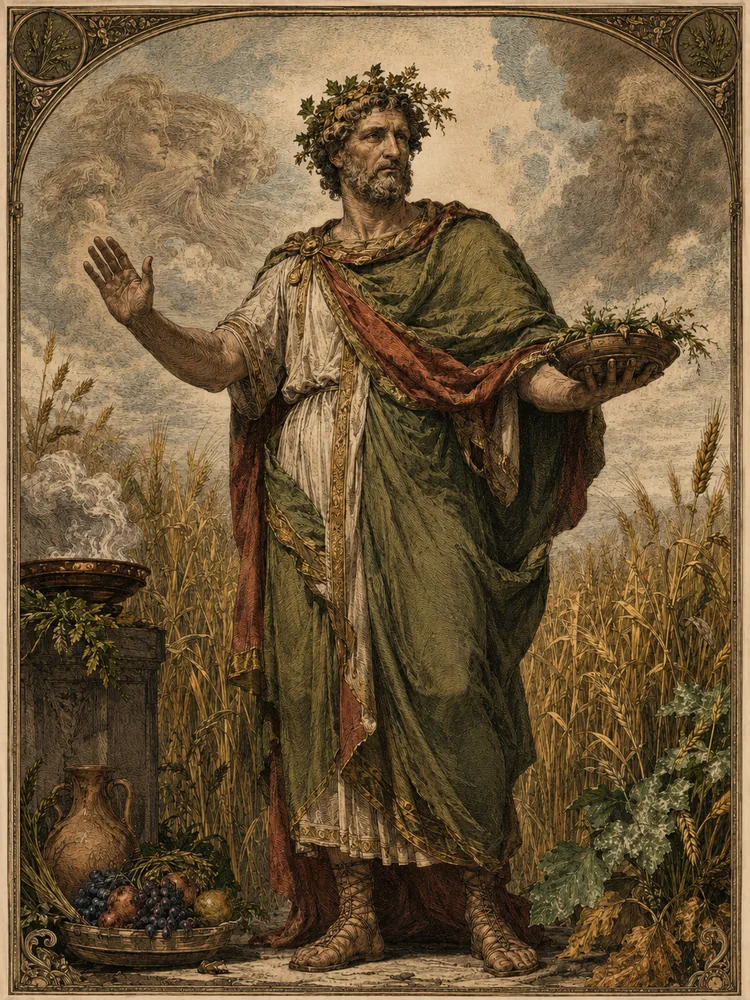
Of the lesser fears of the Roman farmer, none was more pressing than mildew — robigo or rubigo, the rust-fungus that turned the standing wheat brown in the field — and to deflect this disease the Romans had instituted the cult of Robigus, the male god (or, in some accounts, Robigo the goddess) who personified the disease itself. To worship the source of the fear, that the source might be appeased: this was a venerable Italic instinct, the same instinct by which the Romans honored Febris (fever) and Cloacina (the goddess of the drains).

Robigus was given his festival, the Robigalia, on the twenty-fifth of April — exactly when the wheat was setting its head and most vulnerable to rust. The flamen Quirinalis led a procession from Rome out the Via Claudia to the fifth milestone, where in a sacred grove the priest sacrificed a red dog and a sheep, and prayed to Robigus to spare the crops. The choice of a red dog is typically Roman: the color matched the disease's color, the dog was the alarm-animal that warded off intruders, and the sacrifice combined sympathetic magic with everyday symbolism.

By the late Republic the Robigalia was already an antiquity, kept by the priesthood as part of the annual ritual cycle but little understood by most Romans. Ovid records the rite with antiquarian interest. The Christian Church, when it absorbed the Roman calendar, transferred the date of April 25 to the Greater Litanies — the Major Rogations — and Christians went out in procession on that same day, praying to a different god for the same end.

Curator’s note

What the sources say, and what later tradition added. The sources for this bay

The Robigalia is described by Ovid (Fasti 4.901-942, who describes the procession he himself witnessed), Varro (De Re Rustica 1.1.6), Pliny (Naturalis Historia 18.285), and Tertullian (De Idololatria 14). The transfer to the Christian Major Rogations is documented in early-medieval calendars; Pope Gregory the Great institutionalized the date. Robigus and Robigo (male/female) are interchangeable in the sources; the variation reflects the ambiguity of personifying a disease, which is grammatically feminine in Latin but conceptually impersonal.

When the sources speak

Dated witnesses for The Indigenous Italic Gods. A date marks when the evidence was written down, not when the belief began. The whole timeline

c. 1000–750 BCE
Iron Age communities of Latium and neighboring peoples develop the cult landscapes later absorbed into Roman tradition.
traditional 753 BCE
Roman foundation chronology places Romulus and the first civic institutions at the beginning of the city’s sacred history.
traditional 7th–6th centuries BCE
The regal period is credited with priesthoods, calendars, temples, and the organization of public rites.
509–264 BCE
Republican expansion incorporates Latin, Sabine, Etruscan, and Italian cults through treaty, migration, and evocatio.
264–146 BCE
Mediterranean conquest accelerates Greek interpretation and the importation or redefinition of foreign gods.
204 BCE
The Magna Mater is formally brought from Pessinus during the Second Punic War.
1st century BCE
Varro, Cicero, and other antiquarians document rites and divine names amid civil war and institutional change.
27 BCE–14 CE
Augustan restoration monumentalizes selected ancestral cults and rewrites Roman sacred history.

Floor plan

The rooms follow one another in the order their peoples first appear in the written record.

  1. The Cradle of Citiesc. 3400 BCE to 395 CE. 115 works
  2. The Gift of the Nilec. 4000 BCE to 395 CE. 73 works
  3. The Olympian Orderc. 1600 BCE to 750 CE. 152 works
  4. The Persian Worldc. 2000 BCE to 1010 CE. 30 works
  5. The Levantine Borderlandsc. 1200 BCE to 500 CE. 20 works
  6. The Edges of Empirec. 2000 BCE to 1500 CE. 33 works
  7. The Etruscan Worldc. 900 BCE to 750 CE. 22 works
  8. The Roman Inheritancec. 1200 BCE to 500 CE. 58 works
  9. The Northern Inheritancec. 2000 BCE to 1600 CE. 131 works