A Compendium of the Ancient Gods
Awaiting its plate

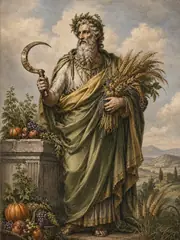
Lua was an obscure but highly archaic Italic goddess, named in old religious texts as the consort of Saturn — Lua Mater, or Lua Saturni — and she was the recipient of a strange and terrible offering: the arms of defeated enemies. After a victory, the Roman general would heap up the captured weapons on the field of battle, sacrifice them by fire, and dedicate them to Lua. In this destruction the spoils were not enriching the victor but were being given over to a divinity who consumed them; the rite was called the dedicatio, and was distinguished from the spoils that were taken back to Rome and dedicated to Jupiter Feretrius or carried in triumph.

The name Lua was understood by the Romans to derive from the verb luere, "to release, to wash away, to expiate"; the goddess was the power that purified the battlefield by destroying its weapons, that the victor might not be polluted by carrying home all that he had captured. So at least some pious survival from victory had to be given to her — and among the most pious of generals, like Aemilius Paullus and Marius and Scipio Africanus, this was conscientiously done.

By the imperial period Lua was little remembered; her name is preserved chiefly in the antiquarian compilations of Varro and Festus and in occasional inscriptions. The classical mythographers found her hard to place, and she has no Greek equivalent. She is one of those archaic Italic powers — alongside Vacuna, Furrina, Robigus, and the rest — whose original significance was lost even to the Romans of Cicero's day, but whose names continued to be uttered at the proper points in the priestly calendar.
Curator’s note

What the sources say, and what later tradition added. The sources for this bay

Lua is mentioned by Livy (8.1.6, 45.33.2 — the latter passage describing Aemilius Paullus dedicating the spoils after Pydna), Varro (De Lingua Latina 8.36), Aulus Gellius (13.23.2), and Augustine (City of God 4.16). The etymological connection to luere is given by Servius (commentary on Aeneid 3.139) and is generally accepted, though the older sense of "plague, pestilence" — making Lua the goddess of decay or destruction, who consumes weapons just as plague consumes men — is also possible (Wissowa). The Pydna passage is particularly explicit: "Aemilius gave the captured weapons to Lua Mater Saturni, and burnt them."

Kin in the sources

Each tie is quoted from the entry that states it.

When the sources speak

Dated witnesses for The Indigenous Italic Gods. A date marks when the evidence was written down, not when the belief began. The whole timeline

c. 1000–750 BCE
Iron Age communities of Latium and neighboring peoples develop the cult landscapes later absorbed into Roman tradition.
traditional 753 BCE
Roman foundation chronology places Romulus and the first civic institutions at the beginning of the city’s sacred history.
traditional 7th–6th centuries BCE
The regal period is credited with priesthoods, calendars, temples, and the organization of public rites.
509–264 BCE
Republican expansion incorporates Latin, Sabine, Etruscan, and Italian cults through treaty, migration, and evocatio.
264–146 BCE
Mediterranean conquest accelerates Greek interpretation and the importation or redefinition of foreign gods.
204 BCE
The Magna Mater is formally brought from Pessinus during the Second Punic War.
1st century BCE
Varro, Cicero, and other antiquarians document rites and divine names amid civil war and institutional change.
27 BCE–14 CE
Augustan restoration monumentalizes selected ancestral cults and rewrites Roman sacred history.

Floor plan

The rooms follow one another in the order their peoples first appear in the written record.

  1. The Cradle of Citiesc. 3400 BCE to 395 CE. 115 works
  2. The Gift of the Nilec. 4000 BCE to 395 CE. 73 works
  3. The Olympian Orderc. 1600 BCE to 750 CE. 152 works
  4. The Persian Worldc. 2000 BCE to 1010 CE. 30 works
  5. The Levantine Borderlandsc. 1200 BCE to 500 CE. 20 works
  6. The Edges of Empirec. 2000 BCE to 1500 CE. 33 works
  7. The Etruscan Worldc. 900 BCE to 750 CE. 22 works
  8. The Roman Inheritancec. 1200 BCE to 500 CE. 58 works
  9. The Northern Inheritancec. 2000 BCE to 1600 CE. 131 works