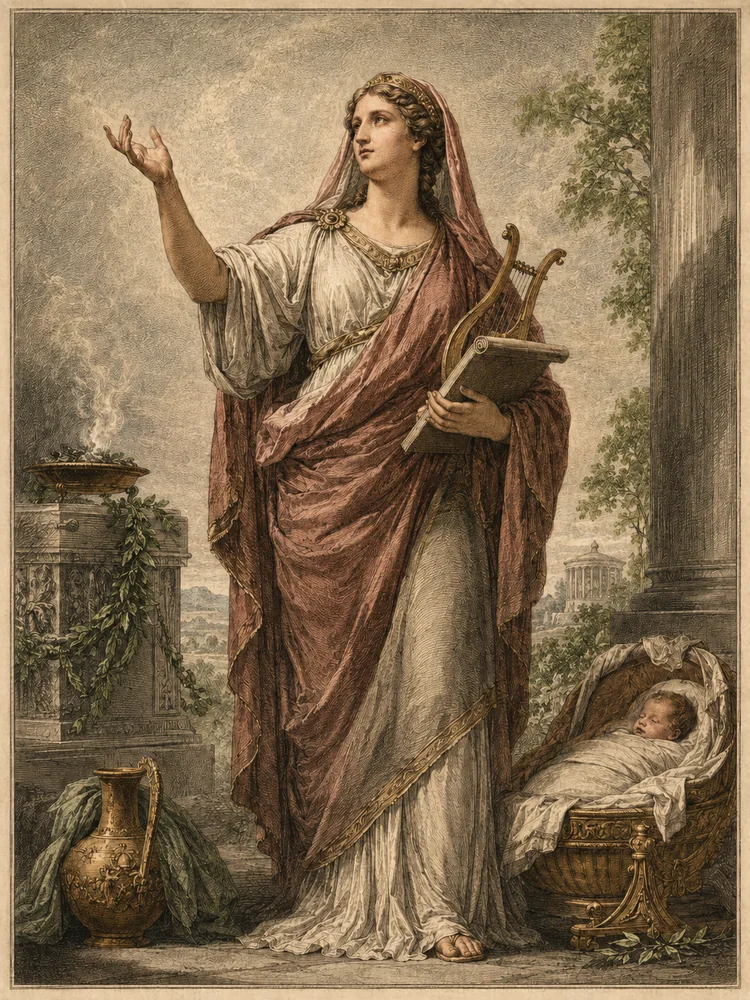

Carmenta was a goddess of childbirth and prophetic utterance, and her name was derived from carmen, "song, charm, formula" — for the prophetic songs that were spoken in her honor were a kind of magical poetry that sealed the future as it was uttered. She was an old Italic goddess, but the legend that grew up around her was Greek-Italic: she had been the mother of Evander, the Arcadian king who came to Italy generations before the Trojan War and founded the settlement that would one day become Rome. She herself, prophesying upon Evander's arrival, foresaw the city's coming greatness.
Two assistants stood with her: Antevorta, who looked forward to the future birth (or the head-first delivery), and Postvorta, who looked backward to the breech (or to the past that the child was leaving). Together the three were petitioned by mothers in labor, and the Carmentalia was kept on the eleventh and fifteenth of January in the goddess's temple at the foot of the Capitoline, by the gate that took her name — the Porta Carmentalis. Only women might offer at the rite, and they came in white robes; the meat of any animal that had been killed by means of leather was forbidden, for some old reason that the Romans had forgotten.
Carmenta's prophetic role was older and more important than her childbirth role, but by Cicero's time she was associated chiefly with the latter. The Carmenta who had foreseen the founding of Rome belonged to the deep past; the Carmenta of contemporary worship was the protectress of the woman in labor, who whispered the right charm to ease delivery.