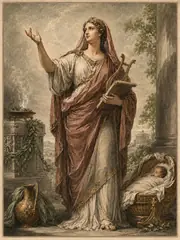
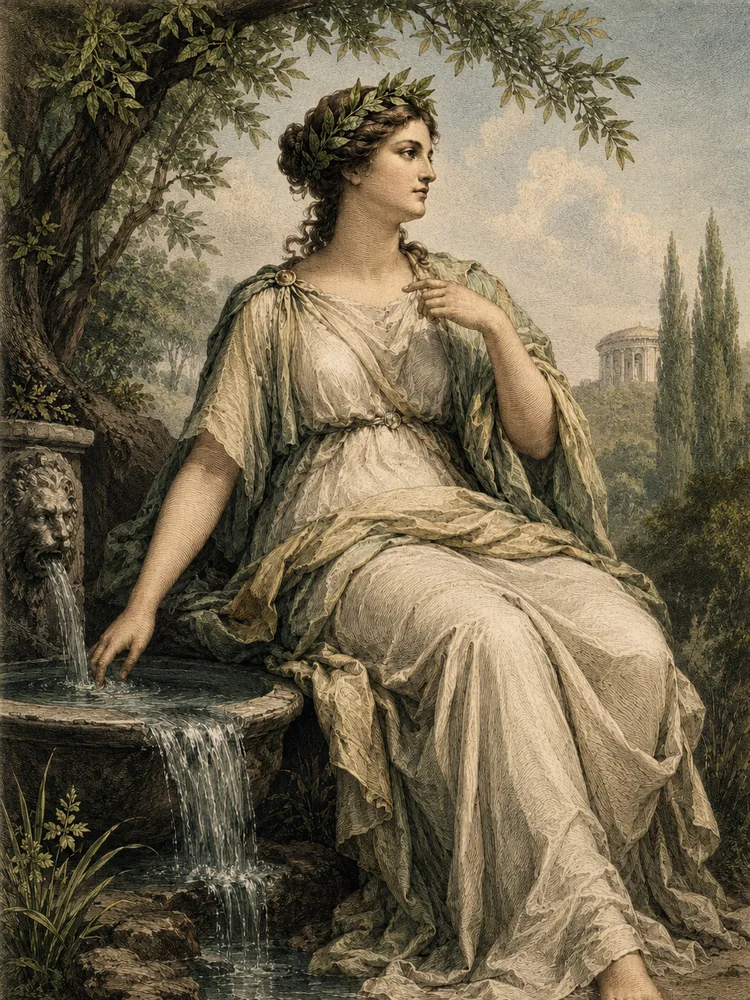
Egeria was a water-nymph of the spring at the Porta Capena, just outside the gates of Rome on the road to Aricia; she was the lover and counselor of Numa Pompilius, the second king of Rome, who reigned after Romulus. By night Numa would go to her grove and meet her there, and from her advice he derived all the religious institutions by which he organized the state — the priesthoods, the calendar, the festivals, the rites.
It was Egeria, the legend went, who had taught Numa how to capture the lightning-spirit Picus and Faunus together, and force them to summon Jupiter himself to disclose to the king the formula for averting lightning-strikes. It was Egeria who instructed him in the proper lengths of months, the proper days for sacrifice, the names of the gods to whom each kind of grain belonged. The wisdom of Numa was in fact the wisdom of his nymph-consort, and the orderly Roman religion that his successors inherited was her gift through him.
When Numa died after his long reign, Egeria's grief was so great that her tears fell unceasingly. Diana, taking pity, transformed her into the spring at Aricia in Diana's own sacred grove, and there her water flows still. The pious Romans who came to bathe in the spring's healing waters were said to be touching what had once been Egeria's grief.
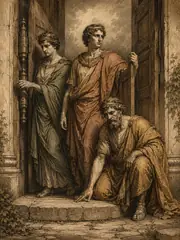
The sacred grove of the Camenae, just outside Rome, was where Egeria had originally met Numa; in the Republic this grove and its spring were a place of pilgrimage. Juvenal in the second century after our era complains of finding the grove tenanted by Jewish beggars, who paid rent to the city for the use of the precinct — an early instance of the Jewish presence in suburban Rome, and a sign of how thoroughly the old cults had decayed by the imperial period.
Curator’s note
What the sources say, and what later tradition added. The sources for this bay
Egeria appears in Livy (1.19, 1.21), Ovid (Fasti 3.275-276, Metamorphoses 15.482-551), Plutarch (Numa 4, 8, 13, 15), Cicero (De Legibus 1.4, De Republica 2.26-28), and Juvenal (Satire 3.10-20, the famous passage on the grove of the Camenae). The Picus and Faunus episode is told most fully in Ovid (Fasti 3.291-348). The Aricia association — where Egeria's spring is located in the grove of Diana Nemorensis — is preserved in Ovid and in Strabo (5.3.12); the Lake of Nemi remained a major cult site through the imperial period. Egeria has been read as a Vatic, prophetic, water-nymph type, with parallels in Greek Cassotis at Delphi and in Italian Carmenta; the figure stands at the intersection of prophetic inspiration and dynastic legitimation.
When the sources speak
Dated witnesses for The Indigenous Italic Gods. A date marks when the evidence was written down, not when the belief began. The whole timeline
- c. 1000–750 BCE
- Iron Age communities of Latium and neighboring peoples develop the cult landscapes later absorbed into Roman tradition.
- traditional 753 BCE
- Roman foundation chronology places Romulus and the first civic institutions at the beginning of the city’s sacred history.
- traditional 7th–6th centuries BCE
- The regal period is credited with priesthoods, calendars, temples, and the organization of public rites.
- 509–264 BCE
- Republican expansion incorporates Latin, Sabine, Etruscan, and Italian cults through treaty, migration, and evocatio.
- 264–146 BCE
- Mediterranean conquest accelerates Greek interpretation and the importation or redefinition of foreign gods.
- 204 BCE
- The Magna Mater is formally brought from Pessinus during the Second Punic War.
- 1st century BCE
- Varro, Cicero, and other antiquarians document rites and divine names amid civil war and institutional change.
- 27 BCE–14 CE
- Augustan restoration monumentalizes selected ancestral cults and rewrites Roman sacred history.