A Compendium of the Ancient Gods
The Spirits of the Doorway, plate

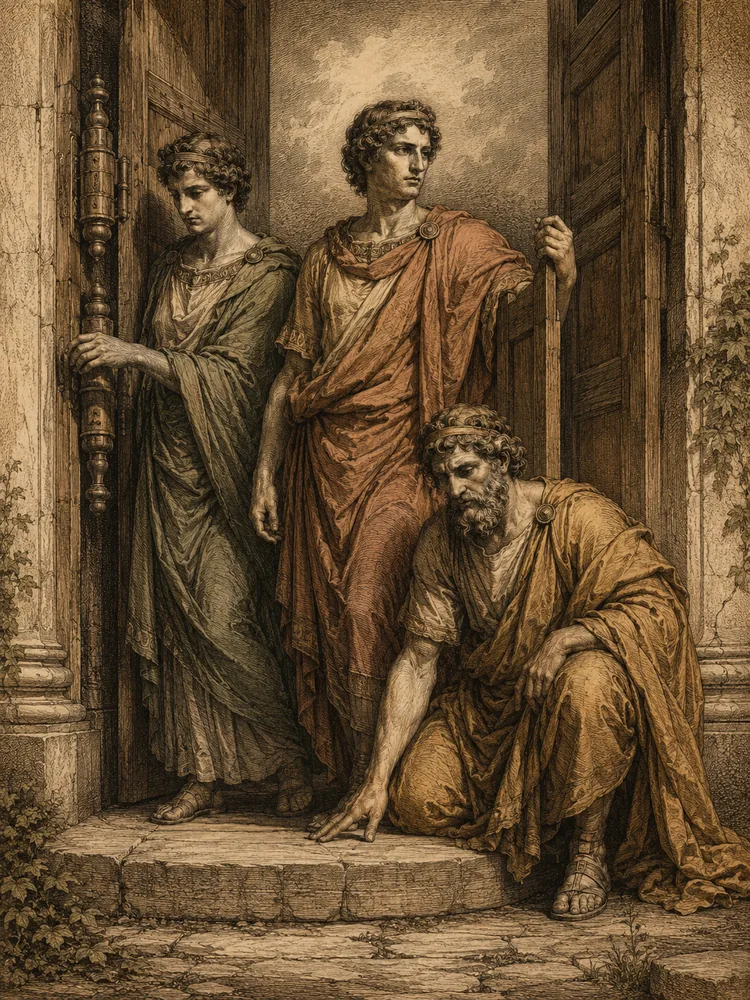
The Roman house had its gods, and they were placed not only at the hearth and the storeroom (where dwelt the Lares and Penates) but at the door itself, that point of passage between the household and the world. Three powers were invoked at the doorway: Forculus, who watched over the door-leaf (forulus); Cardea, who watched over the hinge (cardo); and Limentinus, who watched over the threshold (limen). These were not so much gods as functions made divine — the parts of the door each having its own protective spirit.

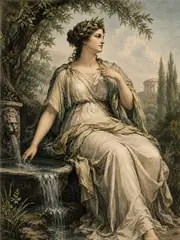
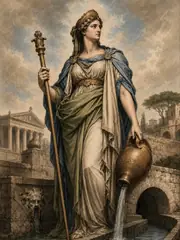
Of the three, Cardea acquired by far the fullest mythology, partly through the ingenuity of Ovid. He preserves the story that Cardea had once been a mortal nymph called Crane, who had charmed Janus the two-faced god by her beauty; in gratitude for her favors, Janus had given her the power of the hinge — the power to open and shut, to admit and exclude — and he had given her also the white-thorn branch by which she might drive away the evil striges, those night-birds that drank the blood of infants in their cradles.

Forculus and Limentinus appear in the antiquarian sources but have no narrative; they are functions, not personalities. Augustine, in his great mockery of Roman polytheism, takes them as his prime example: "Why," he asks, "did the Romans need three gods for one door, when they could not fail to know that a single doorkeeper would have done? Was Forculus to keep watch on the leaf while Cardea watched the hinge and Limentinus the threshold? Did they take turns?" The mockery is unfair — for the Romans saw not three gods but three functions of one phenomenon — but it captures something real: the Roman religious instinct to multiply specialist powers until every aspect of the smallest task was divinely accompanied.

Curator’s note

What the sources say, and what later tradition added. The sources for this bay

Cardea-Crane is described in Ovid's Fasti 6.101-168 (the white-thorn and the striges). Forculus and Limentinus appear chiefly in the polemical Christian sources — Augustine (City of God 4.8, 6.7) and Tertullian (Ad Nationes 2.15) — who use them as examples of polytheistic absurdity. They are also listed by Arnobius (Adversus Nationes 4.9). The list of doorway-spirits sometimes includes Janus himself (the door, ianua) and the obscure Stata Mater (the standing door-pillar); these various "god of every part of the door" lists are derived from the Indigitamenta of the pontifices, the priestly handbook of named functional spirits to be invoked at every juncture of life — a class of texts entirely lost but reconstructable from quotations in the sources noted above.

Kin in the sources

Each tie is quoted from the entry that states it.

When the sources speak

Dated witnesses for The Indigenous Italic Gods. A date marks when the evidence was written down, not when the belief began. The whole timeline

c. 1000–750 BCE
Iron Age communities of Latium and neighboring peoples develop the cult landscapes later absorbed into Roman tradition.
traditional 753 BCE
Roman foundation chronology places Romulus and the first civic institutions at the beginning of the city’s sacred history.
traditional 7th–6th centuries BCE
The regal period is credited with priesthoods, calendars, temples, and the organization of public rites.
509–264 BCE
Republican expansion incorporates Latin, Sabine, Etruscan, and Italian cults through treaty, migration, and evocatio.
264–146 BCE
Mediterranean conquest accelerates Greek interpretation and the importation or redefinition of foreign gods.
204 BCE
The Magna Mater is formally brought from Pessinus during the Second Punic War.
1st century BCE
Varro, Cicero, and other antiquarians document rites and divine names amid civil war and institutional change.
27 BCE–14 CE
Augustan restoration monumentalizes selected ancestral cults and rewrites Roman sacred history.

Floor plan

The rooms follow one another in the order their peoples first appear in the written record.

  1. The Cradle of Citiesc. 3400 BCE to 395 CE. 115 works
  2. The Gift of the Nilec. 4000 BCE to 395 CE. 73 works
  3. The Olympian Orderc. 1600 BCE to 750 CE. 152 works
  4. The Persian Worldc. 2000 BCE to 1010 CE. 30 works
  5. The Levantine Borderlandsc. 1200 BCE to 500 CE. 20 works
  6. The Edges of Empirec. 2000 BCE to 1500 CE. 33 works
  7. The Etruscan Worldc. 900 BCE to 750 CE. 22 works
  8. The Roman Inheritancec. 1200 BCE to 500 CE. 58 works
  9. The Northern Inheritancec. 2000 BCE to 1600 CE. 131 works