A Compendium of the Ancient Gods
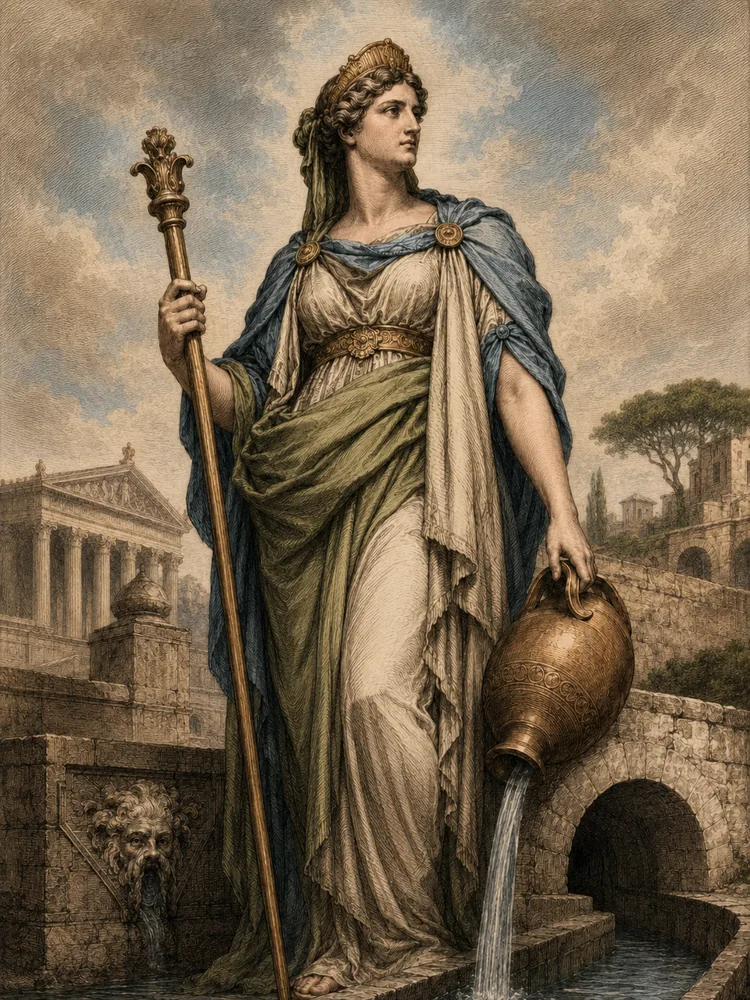
Cloacina, plate

Cloacina was a Roman goddess of purification, whose name derived from cluere or cluere, "to cleanse," though by the time of the late Republic the Romans had come to associate her name with the Cloaca Maxima, the great sewer that drained the Forum and emptied into the Tiber. Her shrine, the Sacrum Cloacinae, stood at one end of the Cloaca's covered course, by the Basilica Aemilia in the Forum itself — a small round shrine surrounded by railings, depicted on coins of the Republic and excavated in the modern period.

The legend connected her with the rape of the Sabines: when the war between Romans and Sabines was at last ended through the intercession of the captive women, the men of both peoples had purified themselves with myrtle branches at the spot where Cloacina's shrine afterward stood, and the goddess of the place — older, anonymous — was thereafter called by the name of the purification. Hence she was sometimes identified with Venus Cloacina, Venus the Purifier; the myrtle that surrounded her shrine was sacred to Venus, and the goddess of love and the goddess of cleansing were drawn together in this archaic rite.

By the late Republic, her function as drain-goddess had eclipsed her function as purifier-goddess, and Cloacina became something of a comic figure — Pliny the Elder records that her statue stood for the last great drain inspector among the gods. But the older Cloacina, the goddess of the spring waters that purified soldiers after war, retained a place in the priestly calendar, and the small round shrine in the Forum was preserved with care into the imperial period.

Curator’s note

What the sources say, and what later tradition added. The sources for this bay

Cloacina is described by Pliny (Naturalis Historia 15.119, 19.50), Livy (3.48.5, the location), Lactantius (Divinae Institutiones 1.20), and Augustine (City of God 4.8). The Sabine purification etiology is in Pliny. The shrine is depicted on a denarius of L. Mussidius Longus (42 BCE) — one of the most important numismatic records of an obscure cult-site. The shrine itself was excavated in the 1899 campaign in the Forum by Boni and is visible today; it is an early instance of religious archaeology revealing a textually attested cult-site. The Venus Cloacina identification is interesting but probably late and learned rather than original.

When the sources speak

Dated witnesses for The Indigenous Italic Gods. A date marks when the evidence was written down, not when the belief began. The whole timeline

c. 1000–750 BCE
Iron Age communities of Latium and neighboring peoples develop the cult landscapes later absorbed into Roman tradition.
traditional 753 BCE
Roman foundation chronology places Romulus and the first civic institutions at the beginning of the city’s sacred history.
traditional 7th–6th centuries BCE
The regal period is credited with priesthoods, calendars, temples, and the organization of public rites.
509–264 BCE
Republican expansion incorporates Latin, Sabine, Etruscan, and Italian cults through treaty, migration, and evocatio.
264–146 BCE
Mediterranean conquest accelerates Greek interpretation and the importation or redefinition of foreign gods.
204 BCE
The Magna Mater is formally brought from Pessinus during the Second Punic War.
1st century BCE
Varro, Cicero, and other antiquarians document rites and divine names amid civil war and institutional change.
27 BCE–14 CE
Augustan restoration monumentalizes selected ancestral cults and rewrites Roman sacred history.

Floor plan

The rooms follow one another in the order their peoples first appear in the written record.

  1. The Cradle of Citiesc. 3400 BCE to 395 CE. 115 works
  2. The Gift of the Nilec. 4000 BCE to 395 CE. 73 works
  3. The Olympian Orderc. 1600 BCE to 750 CE. 152 works
  4. The Persian Worldc. 2000 BCE to 1010 CE. 30 works
  5. The Levantine Borderlandsc. 1200 BCE to 500 CE. 20 works
  6. The Edges of Empirec. 2000 BCE to 1500 CE. 33 works
  7. The Etruscan Worldc. 900 BCE to 750 CE. 22 works
  8. The Roman Inheritancec. 1200 BCE to 500 CE. 58 works
  9. The Northern Inheritancec. 2000 BCE to 1600 CE. 131 works