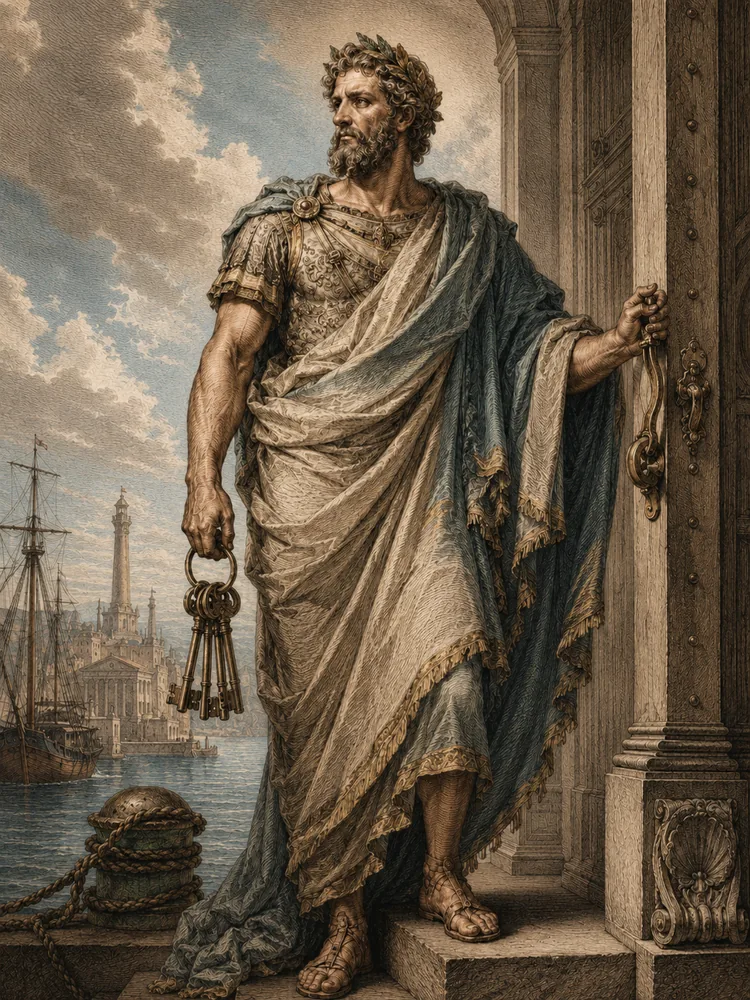
Portunus was the Roman god of harbors and gates, whose name derived from portus, the harbor, and porta, the gate — the two senses being closely related in archaic Latin, both signifying a place of entry and exit. He was depicted holding a key, the symbol of his office: the harbor's mouth opened and closed to ships as the gate opened and closed to travelers, and Portunus held the keys to both. His great temple stood near the Tiber on the Forum Boarium, beside the Pons Aemilius — the bridge that crossed the river at the river's harbor — and the temple still stands today, well-preserved through having been converted into a church in the early Middle Ages.
His festival, the Portunalia, was on the seventeenth of August. The flamen Portunalis, one of the lesser flamines (and his existence proves the antiquity of the cult), threw keys into the fire on this day — a rite whose meaning the Romans of the Republic had already lost. Possibly it was a propitiation: the keys offered to the god in token of his mastery, the fire reducing them to a state where they could be the god's own. Possibly it was a reverse rite, the god being asked to relinquish the keys to the human worshippers for a day. The Romans were not certain.
In the late Republic, Portunus was sometimes identified with the Greek Palaemon-Melicertes, the boy who had been turned into a sea-god after his mother Ino threw him from a cliff; the identification is loose and rests chiefly on the parallel function (harbor-protector) rather than on any genealogical claim. Portunus remained a Roman god throughout, with his Roman temple, his Roman flamen, and his Roman festival; the Greek equation was an afterthought.
Curator’s note
What the sources say, and what later tradition added. The sources for this bay
Portunus is described by Varro (De Lingua Latina 6.19, where the Portunalia is entered), Festus (s.v. Portunalia), Ovid (Fasti 6.547, alluded to in connection with Mater Matuta whose temple stood nearby), and Cicero (De Natura Deorum 2.66, the equation with Palaemon). The temple in the Forum Boarium is the famous travertine tetrastyle Ionic temple of c. 100 BCE — small, beautiful, and one of the best-preserved Roman temples of any period; it became the church of S. Maria in Gradellis, then S. Maria Egiziaca, and is now usually open to visitors as the Tempio di Portuno. Earlier scholarship sometimes called it the Temple of Fortuna Virilis; the identification with Portunus is now accepted on the basis of topographical coincidence with the literary descriptions.
When the sources speak
Dated witnesses for The Indigenous Italic Gods. A date marks when the evidence was written down, not when the belief began. The whole timeline
- c. 1000–750 BCE
- Iron Age communities of Latium and neighboring peoples develop the cult landscapes later absorbed into Roman tradition.
- traditional 753 BCE
- Roman foundation chronology places Romulus and the first civic institutions at the beginning of the city’s sacred history.
- traditional 7th–6th centuries BCE
- The regal period is credited with priesthoods, calendars, temples, and the organization of public rites.
- 509–264 BCE
- Republican expansion incorporates Latin, Sabine, Etruscan, and Italian cults through treaty, migration, and evocatio.
- 264–146 BCE
- Mediterranean conquest accelerates Greek interpretation and the importation or redefinition of foreign gods.
- 204 BCE
- The Magna Mater is formally brought from Pessinus during the Second Punic War.
- 1st century BCE
- Varro, Cicero, and other antiquarians document rites and divine names amid civil war and institutional change.
- 27 BCE–14 CE
- Augustan restoration monumentalizes selected ancestral cults and rewrites Roman sacred history.