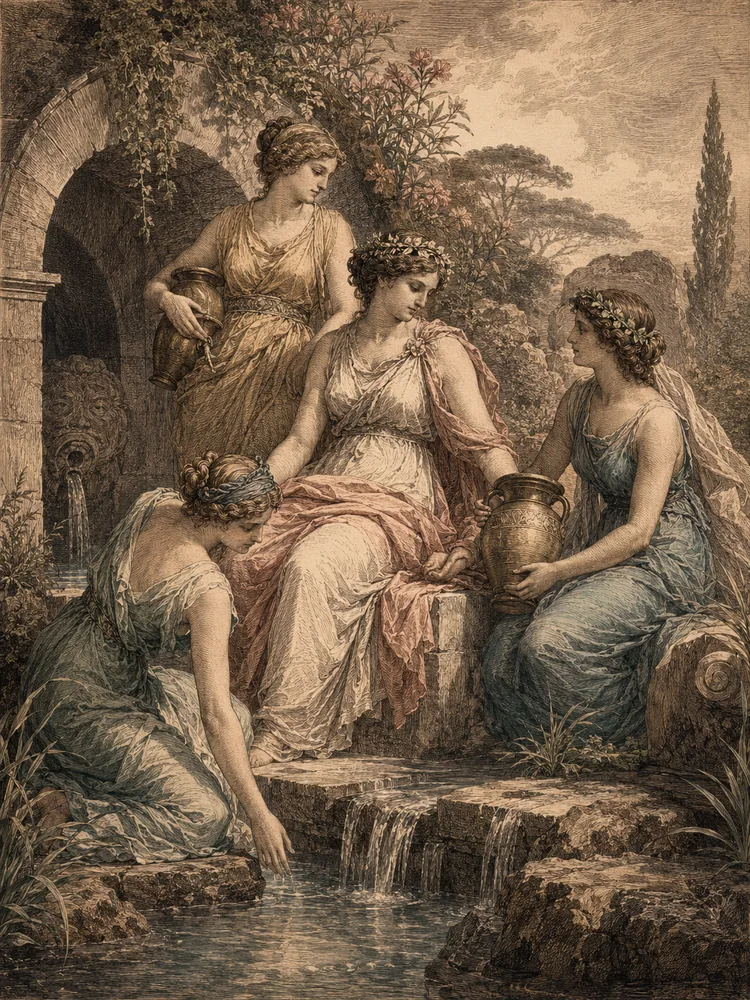
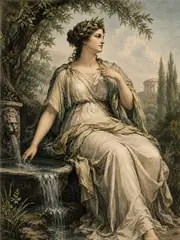
Before the Greek Muses had become familiar at Rome, the Romans had their own Muses — the Camenae — who were not the goddesses of the arts but water-nymphs of a particular spring just outside the city, by the Porta Capena, in a sacred grove. There were four of them according to the older traditions: Antevorta, Postvorta, Carmenta, and a fourth whose name varied (Egeria is sometimes given). They were the nymphs of poetic and prophetic inspiration, drawing-water-of-prophecy.
When the Greek Muses were imported by the educated Romans of the third century before our era, the Camenae and the Muses were equated, and Livius Andronicus in translating the Odyssey into Latin Saturnians spoke of "divine Camena" where Homer had "Muse." The substitution stuck for a generation but did not last; by Cicero's time the Greek Musa was the standard Latin word for the divinity of poetry, and the Camenae had become a pious archaism, mentioned in the antiquarian books and not invoked elsewhere.
Yet the spring at the Porta Capena remained, and the Vestal Virgins drew water from it daily for the sacred rites; the bronze shrine that stood beside it was carried at last to the temple of Hercules and the Muses by the censor Fulvius Nobilior in 187 BCE. There the Camenae and the Greek Muses stood side by side, in a temple where Roman tradition and Greek learning met as they so often did — the Roman cult marking what the Romans had been before they became the Greeks' inheritors, the Greek cult marking what they had become.
Curator’s note
What the sources say, and what later tradition added. The sources for this bay
The Camenae are described by Livy (1.21.3, the spring), Plutarch (Numa 13), Ovid (Fasti 3.275-276), and Servius (commentary on Eclogues 7.21). The Livius Andronicus Odyssey opening — Virum mihi, Camena, insece versutum, "sing to me, Camena, of the man of many turnings" — is preserved in fragment 1 (Warmington edition) and is one of the earliest surviving lines of Latin literature. Fulvius Nobilior's transfer of the bronze shrine to his temple of Hercules of the Muses is described by Servius. The Camenae's grove was the same grove of which Juvenal complained had been let out to Jewish beggars (3.10-20 — see Egeria entry above).
When the sources speak
Dated witnesses for The Indigenous Italic Gods. A date marks when the evidence was written down, not when the belief began. The whole timeline
- c. 1000–750 BCE
- Iron Age communities of Latium and neighboring peoples develop the cult landscapes later absorbed into Roman tradition.
- traditional 753 BCE
- Roman foundation chronology places Romulus and the first civic institutions at the beginning of the city’s sacred history.
- traditional 7th–6th centuries BCE
- The regal period is credited with priesthoods, calendars, temples, and the organization of public rites.
- 509–264 BCE
- Republican expansion incorporates Latin, Sabine, Etruscan, and Italian cults through treaty, migration, and evocatio.
- 264–146 BCE
- Mediterranean conquest accelerates Greek interpretation and the importation or redefinition of foreign gods.
- 204 BCE
- The Magna Mater is formally brought from Pessinus during the Second Punic War.
- 1st century BCE
- Varro, Cicero, and other antiquarians document rites and divine names amid civil war and institutional change.
- 27 BCE–14 CE
- Augustan restoration monumentalizes selected ancestral cults and rewrites Roman sacred history.