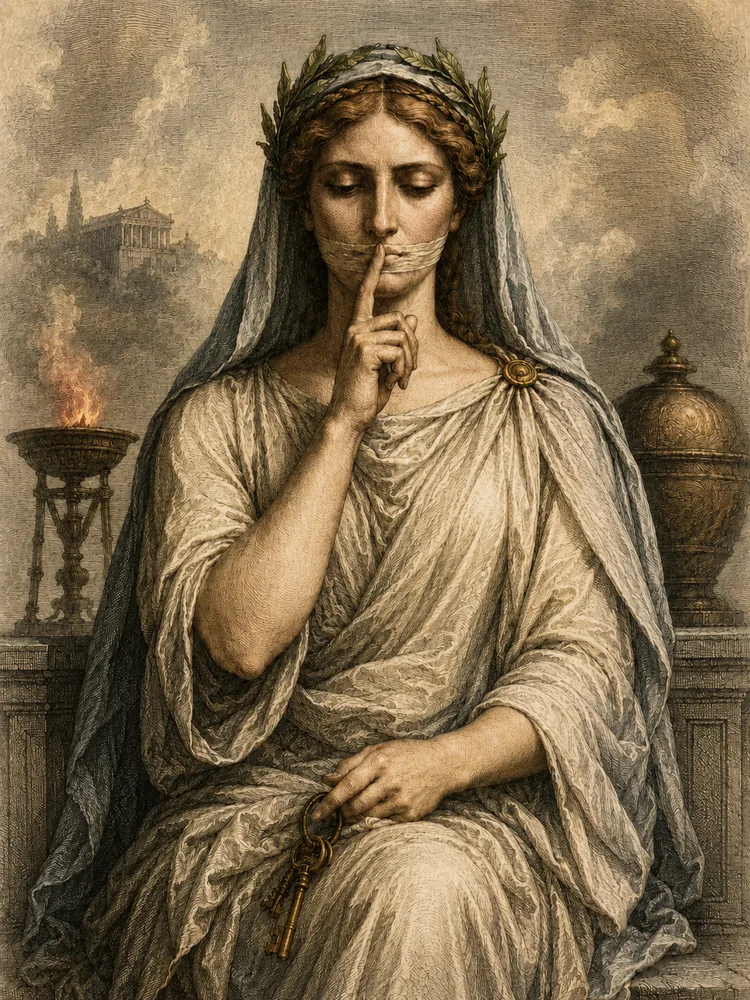
Angerona was an old Roman goddess of an unusual sort: a goddess of silence, whose statue showed her with her finger pressed to her lips and her mouth bound with a fillet, in token that she could not speak. Her festival, the Divalia or Angeronalia, was kept on the twenty-first of December, the winter solstice — the year's longest night, the moment of pause before the days lengthened — and this calendar position is suggestive: Angerona was the deity of the still moment, the dark turning, the held breath of the year.
She was credited by the priestly tradition with a great secret: she knew the secret name of Rome, the alternative name by which the city might be invoked, which was never spoken aloud and which, if spoken by an enemy and the proper rite performed, would call away the city's tutelary deities and leave it defenseless. This secret name — Angerona's name — was kept by the priesthood, and one priest alone in each generation was entrusted with it; even the consuls did not know. Pliny records that any man who pronounced the secret name would be put to death without trial, by ancient law.
The goddess was also invoked against angina, the choking-sickness, by sympathetic magic — silence and breathlessness being kindred — and her name was sometimes derived (rightly or not) from the verb angere, to choke. By the late Republic her festival had grown faint, but Macrobius records that it was still kept in his time, a rite for the pontifex maximus alone, performed at the altar of Vola Diva ("the goddess Vola") in the Sacrum Volupiae, on the slope of the Palatine.
Curator’s note
What the sources say, and what later tradition added. The sources for this bay
Angerona is described by Macrobius (Saturnalia 1.10.7-8, 3.9.4-5, the secret name passage), Varro (De Lingua Latina 6.23, the Angeronalia), Pliny (Naturalis Historia 3.65, the secret name passage with the death-penalty rule), Solinus (1.4-6), Festus (s.v. Angerona), and Augustine (City of God 1.30 — sneering at the secret name). The secret name of Rome is one of the genuine mysteries of Roman religion; modern scholarship (Stanley Weinstock, Jane Snyder) has examined the doctrine of the secret name without recovering what the name itself was — a point on which the ancient authorities are uniformly silent, as one would expect. Some modern guesses include 'Amor' (Roma reversed) and 'Valentia,' but neither is well-supported.
When the sources speak
Dated witnesses for The Indigenous Italic Gods. A date marks when the evidence was written down, not when the belief began. The whole timeline
- c. 1000–750 BCE
- Iron Age communities of Latium and neighboring peoples develop the cult landscapes later absorbed into Roman tradition.
- traditional 753 BCE
- Roman foundation chronology places Romulus and the first civic institutions at the beginning of the city’s sacred history.
- traditional 7th–6th centuries BCE
- The regal period is credited with priesthoods, calendars, temples, and the organization of public rites.
- 509–264 BCE
- Republican expansion incorporates Latin, Sabine, Etruscan, and Italian cults through treaty, migration, and evocatio.
- 264–146 BCE
- Mediterranean conquest accelerates Greek interpretation and the importation or redefinition of foreign gods.
- 204 BCE
- The Magna Mater is formally brought from Pessinus during the Second Punic War.
- 1st century BCE
- Varro, Cicero, and other antiquarians document rites and divine names amid civil war and institutional change.
- 27 BCE–14 CE
- Augustan restoration monumentalizes selected ancestral cults and rewrites Roman sacred history.