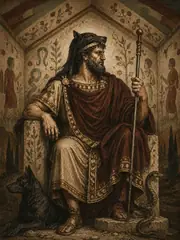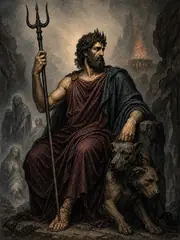
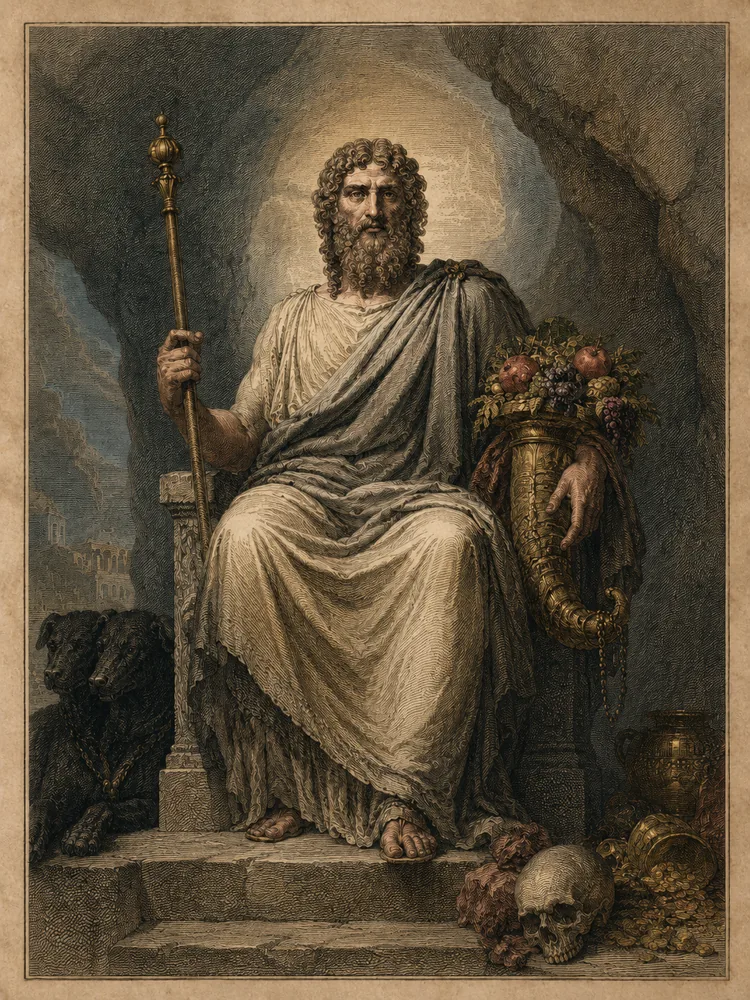

Dis Pater was the Roman god of the dead, ruler of the underworld and of all that lay beneath the earth — the buried wealth, the buried bodies, the precious metals in the rocks. His name was an abbreviation: Dives Pater, "Rich Father," the same epithet that the Greeks had given to Hades-Plouton, the Wealthy One. The Romans took the name as a calque of the Greek; the Italic underworld-god proper was Orcus, with whom Dis Pater overlapped.
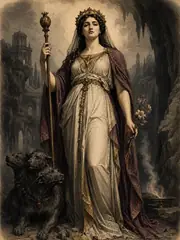
Dis was worshipped together with his consort Proserpina at an underground altar in the Campus Martius, in a place called the Tarentum, near the Tiber. According to the legend recorded by Valerius Maximus, the cult had been founded by a Sabine, Valesius, whose three sick children had been healed by water from the Tarentum drawn at midnight, and who had thereafter built an altar to Dis and Proserpina there. The altar was kept covered, and was uncovered only for the special games called the Ludi Saeculares — the Centennial Games — which were held in time of national crisis or every saeculum (about every 110 years) to mark the great divisions of Roman history. Augustus celebrated them in 17 BCE, with Horace's Carmen Saeculare composed for the occasion.
The image of Dis was rare in Roman art; he was felt as a power inimical to the ordinary purposes of religion, and one did not pray to him for favors but invoked him to leave the worshipper alone. The dirt of his altar was black, the animals sacrificed to him were black, the ceremonies took place by night. The Romans had no festival for him in the public calendar of the Republic — only the special games, the dark rites — and the more popular underworld powers (Mania, Hecate, Manes) were the ones in everyday cult.