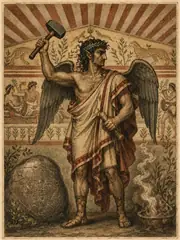
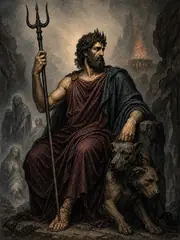
Older than Dis Pater in Italy, and at the foundation never quite reduced to identity with him, was Orcus, the Italic god of the dead. Orcus was not a courtly underworld king like the Hellenized Dis; he was a darker, hairier, more terrifying figure — a hunter, a binder, a snatcher of mortals. He was depicted as a bearded ogre with a thick body, sometimes winged, with a great hammer or mallet that he carried for striking down the souls of the dying. Etruscan tomb-paintings preserve images of him that influenced the Roman imagination, and the medieval orco — the ogre of folktales — descends from him directly.
Orcus was the punisher of perjury and the taker of those who broke their oaths. "To swear by Orcus" was the strongest oath a Roman could give, for it called upon the god of the dead to drag the perjurer below if the oath were broken. He was also the snatcher of life — the sudden force that took men down without warning, the embodied principle of mortality. "Death itself" might be one Roman translation of his name; "the underworld" might be another; the difference was less clear in his case than in that of Dis or Hades.
By the late Republic, Orcus and Dis Pater had been largely conflated, with Dis Pater the standard literary name and Orcus surviving as a poetic synonym, used especially when the more terrifying or archaic side of the underworld was meant. Virgil uses both: Dis when the underworld is being described as a courtly realm, Orcus when its terror is being emphasized. The two names cover the same realm from different angles, the one Hellenic, the other Italic; and the Italic side, the wilder side, is the older.
Curator’s note
What the sources say, and what later tradition added. The sources for this bay
Orcus appears in Ennius (Annales fragments), Plautus (frequently, as a stock terror — Bacchides 198, Captivi 868, etc.), Lucretius (1.115, 5.996), Virgil (Aeneid 2.398, 4.242, 6.273), Servius (commentary on the same), and the late mythographers. The Etruscan iconography of Orcus, with the hammer or mallet (closely paralleled in the Etruscan Charun), is preserved in tombs at Tarquinia and Vulci; the Tomba dell'Orco at Tarquinia (4th century BCE) is named for him. The medieval and modern inheritance of orco/ogre is well-traced in Carlo Ginzburg's Ecstasies.
When the sources speak
Dated witnesses for The Indigenous Italic Gods. A date marks when the evidence was written down, not when the belief began. The whole timeline
- c. 1000–750 BCE
- Iron Age communities of Latium and neighboring peoples develop the cult landscapes later absorbed into Roman tradition.
- traditional 753 BCE
- Roman foundation chronology places Romulus and the first civic institutions at the beginning of the city’s sacred history.
- traditional 7th–6th centuries BCE
- The regal period is credited with priesthoods, calendars, temples, and the organization of public rites.
- 509–264 BCE
- Republican expansion incorporates Latin, Sabine, Etruscan, and Italian cults through treaty, migration, and evocatio.
- 264–146 BCE
- Mediterranean conquest accelerates Greek interpretation and the importation or redefinition of foreign gods.
- 204 BCE
- The Magna Mater is formally brought from Pessinus during the Second Punic War.
- 1st century BCE
- Varro, Cicero, and other antiquarians document rites and divine names amid civil war and institutional change.
- 27 BCE–14 CE
- Augustan restoration monumentalizes selected ancestral cults and rewrites Roman sacred history.