A Compendium of the Ancient Gods
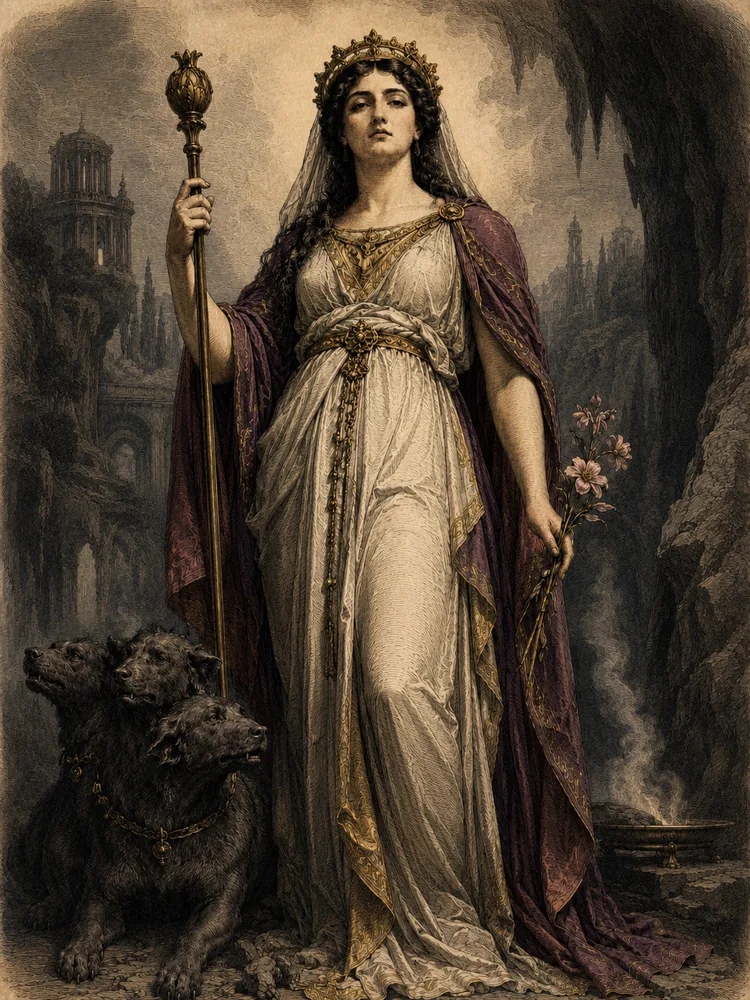
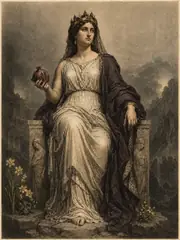
Proserpina, plate

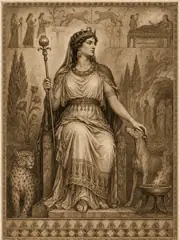
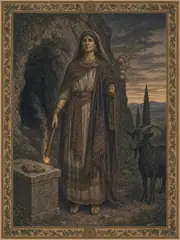
Proserpina was the Roman name for the goddess whom the Greeks called Persephone — daughter of Ceres (Demeter), wife of Dis Pater (Hades), queen of the underworld for the half of the year when she was below, returning to her mother for the half when the earth was fertile. The Roman story followed the Greek closely, and indeed by the late Republic the cult was thoroughly Hellenized, with the Greek myth taught in Roman schools as the explanation of the seasons. But the cult was old in Italy too, and the Roman Proserpina retained some features of an earlier Italic underworld goddess.

She was worshipped together with Dis Pater at the underground altar in the Campus Martius (the Tarentum, mentioned in the entry on Dis Pater above), and the Ludi Saeculares were dedicated to the pair. Her separate cult — without Dis — was less developed in Rome itself than at the great south-Italian sanctuary at Locri, where the Greek cult of Persephone was practiced from the sixth century before our era and where Roman pilgrims of later generations would still come to make offerings. The famous pinakes of Locri — small terracotta plaques depicting Persephone with Hades, Persephone with Ceres, Persephone with Hermes — are now in the Reggio museum and are among the most precious documents of pre-Roman Italian religion.

Proserpina was also identified with the moon, particularly with the moon in its waning phase; this lunar identification was not Greek but Italic, an older stratum that survives in the philosophical handbooks. In the Roman imagination, she was the queen of the dead in winter, the bride of the spring at her return, and the moon between earth and heaven — a triple figure, more developed in Italy than her Greek prototype. The poets of the imperial period, especially Claudian (whose unfinished De Raptu Proserpinae of c. 400 CE is the great Latin treatment), gave her a richness of poetic detail equal to the Greek.
Curator’s note

What the sources say, and what later tradition added. The sources for this bay

Proserpina appears in Ovid (Fasti 4.417-620, Metamorphoses 5.341-661), Cicero (In Verrem 2.4.107, on the Locrian sanctuary), Lactantius (Divinae Institutiones 1.21), Servius (commentary on Aeneid 6.138), and Claudian (De Raptu Proserpinae). The Ludi Saeculares record her cult with Dis Pater. The Locrian pinakes were excavated by Paolo Orsi in the early twentieth century and have been the subject of much recent scholarship (notably Hinrich Prückner, Die lokrischen Tonreliefs, 1968, and Diego Elia, 2010). The lunar identification is attested in Varro (De Lingua Latina 5.68) and is part of the same astronomical theology that put Diana, Hecate, and Proserpina in a triple lunar cycle.

Kin in the sources

Each tie is quoted from the entry that states it.

The same god in other rooms

The ancient sources themselves name these as one god under different names. See Persephone, Ataecina, Phersipnai and Proserpina hung together

When the sources speak

Dated witnesses for The Indigenous Italic Gods. A date marks when the evidence was written down, not when the belief began. The whole timeline

c. 1000–750 BCE
Iron Age communities of Latium and neighboring peoples develop the cult landscapes later absorbed into Roman tradition.
traditional 753 BCE
Roman foundation chronology places Romulus and the first civic institutions at the beginning of the city’s sacred history.
traditional 7th–6th centuries BCE
The regal period is credited with priesthoods, calendars, temples, and the organization of public rites.
509–264 BCE
Republican expansion incorporates Latin, Sabine, Etruscan, and Italian cults through treaty, migration, and evocatio.
264–146 BCE
Mediterranean conquest accelerates Greek interpretation and the importation or redefinition of foreign gods.
204 BCE
The Magna Mater is formally brought from Pessinus during the Second Punic War.
1st century BCE
Varro, Cicero, and other antiquarians document rites and divine names amid civil war and institutional change.
27 BCE–14 CE
Augustan restoration monumentalizes selected ancestral cults and rewrites Roman sacred history.

Floor plan

The rooms follow one another in the order their peoples first appear in the written record.

  1. The Cradle of Citiesc. 3400 BCE to 395 CE. 115 works
  2. The Gift of the Nilec. 4000 BCE to 395 CE. 73 works
  3. The Olympian Orderc. 1600 BCE to 750 CE. 152 works
  4. The Persian Worldc. 2000 BCE to 1010 CE. 30 works
  5. The Levantine Borderlandsc. 1200 BCE to 500 CE. 20 works
  6. The Edges of Empirec. 2000 BCE to 1500 CE. 33 works
  7. The Etruscan Worldc. 900 BCE to 750 CE. 22 works
  8. The Roman Inheritancec. 1200 BCE to 500 CE. 58 works
  9. The Northern Inheritancec. 2000 BCE to 1600 CE. 131 works