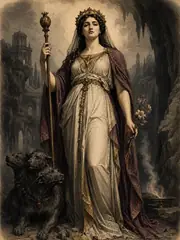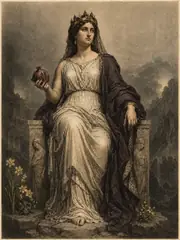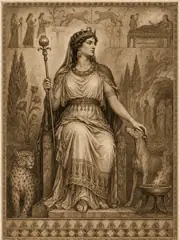
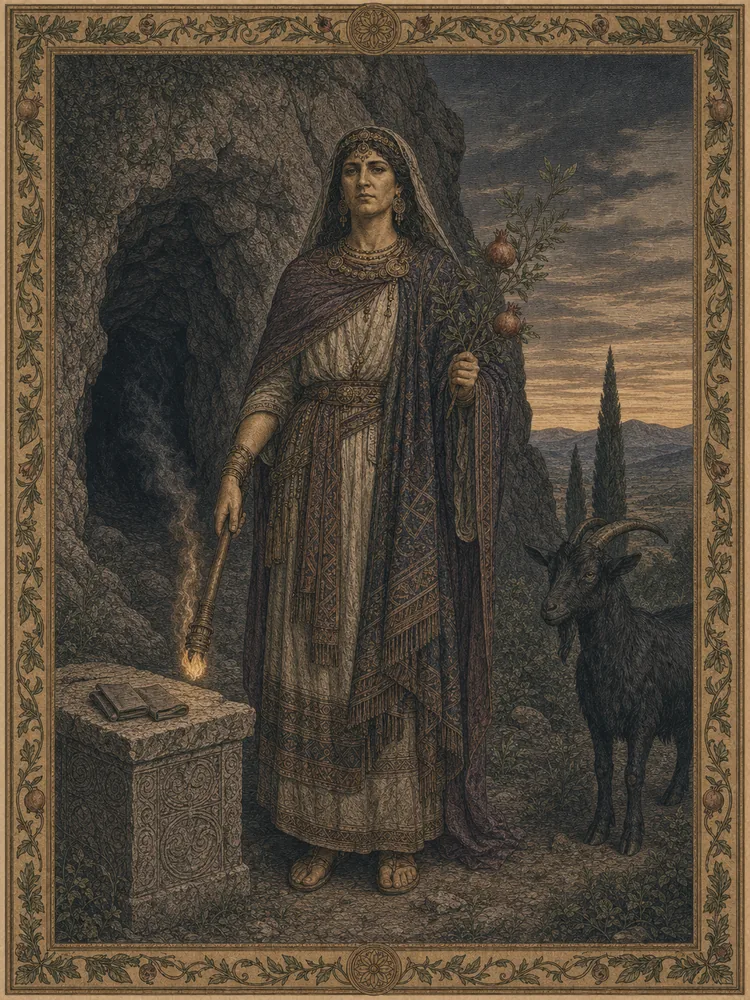
Ataecina (or Adaegina) was a chthonic goddess of the Lusitanian-Celtiberian region, particularly venerated in the territory between modern Estremadura in Portugal and Caceres in Spain. She was identified by the Romans with Proserpina (the Latin form of the Greek Persephone) and was a goddess of the underworld, of the dead, of regeneration, and of the curse — the last of these functions being the most distinctive in the surviving record. She was the divine recipient of defixiones, the lead curse-tablets on which a worshipper would write his curse against an enemy and deposit the tablet in a chthonic shrine, addressed to the goddess.
Her chief sanctuary was at Turobriga (probably modern Aroche near Huelva, though the identification is contested), where a substantial corpus of dedicatory inscriptions and votives has been recovered. The dedications include both pious offerings (gratitude for the goddess's benefactions, healing, the safe return of the lost) and curse-tablets (requests for harm to be inflicted on named individuals, with elaborate formulas invoking Ataecina to bring the curses to fulfillment). The curse-tablet tradition has parallels in the Greek-Roman Mediterranean (the great corpora of curse-tablets from Athens, Rome, and Bath), and the Iberian material participates in this widespread Mediterranean practice.
Her name Ataecina is of uncertain etymology — possibly Celtic (with a meaning along the lines of 'she of the night' or 'the dark one'), possibly pre-Celtic from a Lusitanian or older Iberian substrate. The variability of the name in inscriptions (Ataecina, Adaegina, Adaecina, Atticina) suggests that the underlying form had been imperfectly assimilated to Latin orthography, with different attempts at transcription preserving different vocalic or consonantal aspects of the original.
The cult was suppressed with the Christianization of Iberia, but elements of the curse-tablet tradition survived in the medieval European traditions of magical practice — the medieval Spanish gypsy-magic, the Iberian witch-cults of the early modern period, and various folk-traditions of curse and counter-curse. The continuity is harder to document specifically than for some other transitions but the broader pattern is clear: chthonic-magical traditions of the ancient Mediterranean did not disappear with Christianization but went underground (literally, in some cases) and persisted in folk-magical practice for many centuries.