A Compendium of the Ancient Gods
Bandua, plate

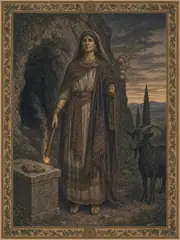
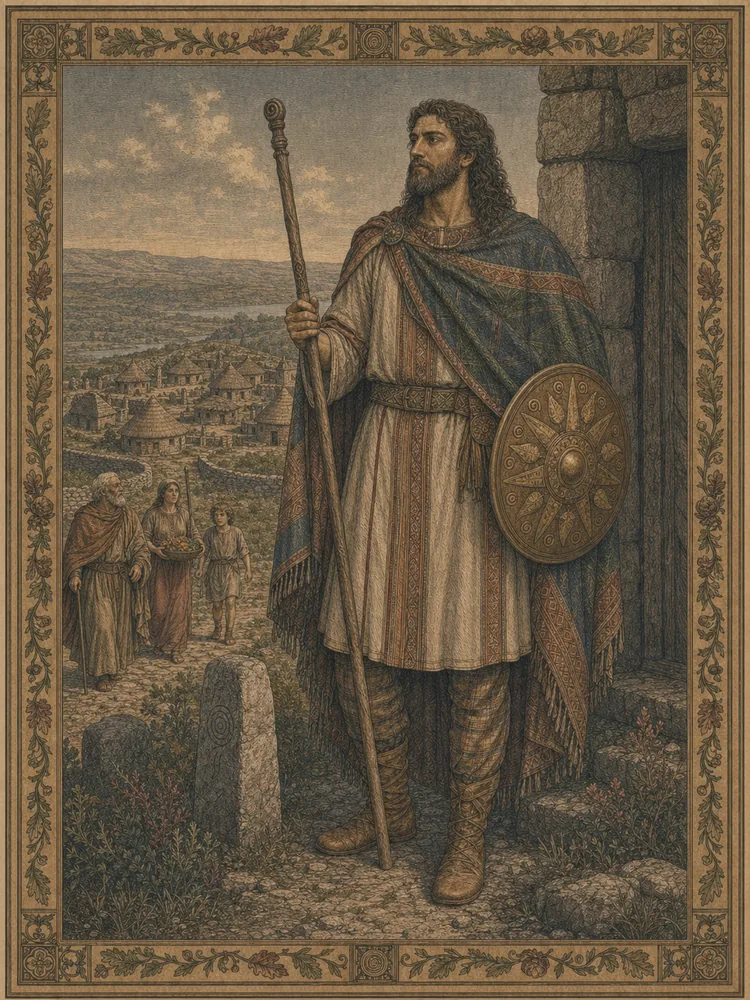
Bandua (or Bandus) was a tutelary deity widely worshipped in the Lusitanian-Celtiberian region, with the distinctive feature that the deity's name was almost always paired with a place-epithet identifying the particular locality whose patron he was: Bandua Aetobricus, Bandua Veigebrecus, Bandua Apolosegus, Bandua Aitatecus, and many others. There were dozens of local Banduas, each tied to a specific community, and the inscriptions preserve a rich record of how the deity was multiplied across the political-territorial landscape of pre-Roman and early-Roman Iberia.

The figure represents a religious pattern characteristic of the Iberian peninsula: the local divinity, named only with a generic root and a place-modifier, who was the patron of a specific community without being part of a larger pantheon. Each oppidum (the fortified hilltop settlements characteristic of the region) had its own Bandua, with its own name-form, its own sanctuary, its own rites; the Romans, encountering this proliferation, recorded the names dutifully but did not attempt to consolidate them into a single regional cult.

Whether Bandua was male or female is debated; the inscriptions preserve grammatical forms supporting both readings, and the deity appears to have been ambiguously gendered, with some local manifestations male (Bandua Veigebrecus is dative-ablative, suggesting a masculine form) and others female (Bandua Aitatecus, in the form preserved in some inscriptions, suggests a feminine form). The variability has been read as evidence that 'Bandua' was a generic word for 'tutelary deity' rather than a specific name — a Lusitanian equivalent of the Latin 'Genius' or 'Tutela' — with each locality having its own gendered form of the local protector.

The Bandua-pattern is one of the clearest cases in the Iberian record of religious localization. Where the Mediterranean civilizations had developed great pan-regional pantheons, the Iberian-Lusitanian tradition had remained at the level of local protectors, each community with its own divinity. The Roman administrative consolidation began the process of integration, but the indigenous pattern was preserved in the inscriptions of the imperial period, and the Bandua-network is one of the chief documents of pre-Roman religious organization in the western peninsula.
Curator’s note

What the sources say, and what later tradition added. The sources for this bay

Bandua is documented in scores of inscriptions across the Lusitanian-Celtiberian region; the standard reference is the Hispania Epigraphica catalogue and José d'Encarnação's various publications. The pattern of place-name epithets is treated in Francisco Marco Simón's articles on Iberian religion and in the various contributions to the volumes on pre-Roman Iberian religion published by the Universidad de Salamanca. The gender ambiguity is discussed in Marco Simón and Manuel Salinas de Frías.

Kin in the sources

Each tie is quoted from the entry that states it.

When the sources speak

Dated witnesses for The Iberian Pantheon. A date marks when the evidence was written down, not when the belief began. The whole timeline

2nd–1st millennia BCE
Bronze and Iron Age regional cultures establish the archaeological backgrounds later labeled Thracian, Illyrian, Iberian, Caucasian, and Libyan.
8th–6th centuries BCE
Greek and Phoenician colonization creates new inscriptional, artistic, and commercial contact zones.
6th–4th centuries BCE
Classical authors begin describing frontier peoples and translating local gods into Greek categories.
3rd–1st centuries BCE
Hellenistic kingdoms, Carthage, and Rome intensify political and cultic exchange.
1st century BCE–3rd century CE
Roman provincial rule produces dedications, coins, reliefs, and interpretive equations across the Balkans, Iberia, Caucasus, and North Africa.
4th–7th centuries CE
Christianization and imperial change end or transform many public cult institutions while names persist in texts and places.
medieval period
Georgian chronicles and epic traditions, Iberian memory, and North African historical sources reshape pre-Christian inheritances.
6th–3rd centuries BCE
Indigenous scripts, sanctuaries, and Mediterranean contacts diversify the religious record.

Floor plan

The rooms follow one another in the order their peoples first appear in the written record.

  1. The Cradle of Citiesc. 3400 BCE to 395 CE. 115 works
  2. The Gift of the Nilec. 4000 BCE to 395 CE. 73 works
  3. The Olympian Orderc. 1600 BCE to 750 CE. 152 works
  4. The Persian Worldc. 2000 BCE to 1010 CE. 30 works
  5. The Levantine Borderlandsc. 1200 BCE to 500 CE. 20 works
  6. The Edges of Empirec. 2000 BCE to 1500 CE. 33 works
  7. The Etruscan Worldc. 900 BCE to 750 CE. 22 works
  8. The Roman Inheritancec. 1200 BCE to 500 CE. 58 works
  9. The Northern Inheritancec. 2000 BCE to 1600 CE. 131 works