A Compendium of the Ancient Gods
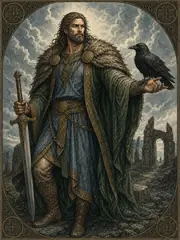
Reue, plate

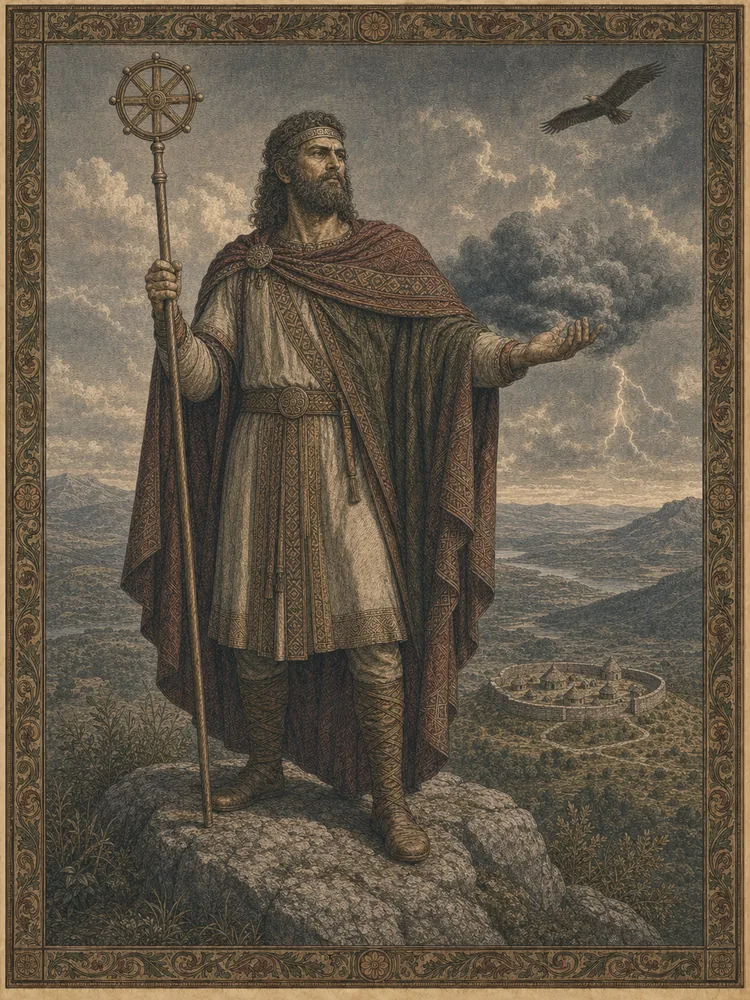
Reue (variant Reve, Reua) was the Lusitanian sky-god, the supreme deity of the indigenous pantheon of the western Iberian peninsula. His name is cognate with the Indo-European sky-god root *dyews (giving Greek Zeus, Latin Iuppiter, Vedic Dyaus, Norse Tyr, and others), with the typical Celtic-Lusitanian phonetic shifts; Reue is thus the local Iberian reflex of the great Indo-European sky-father, preserved in his Lusitanian name and worship.

The dedicatory inscriptions to Reue are concentrated in the northern Portuguese and northwestern Spanish regions, with epithets that link him to particular sanctuaries (Reue Anabaraegus, Reue Larauco, Reue Reumirago, and others). The pattern is similar to that of Bandua (in the previous entry) — the high-god is multiplied across local sanctuaries, with each manifestation tied to a particular cult-place — but Reue's general theological function as sky-god and supreme deity is more clearly preserved than Bandua's local-protector function. The Lusitanians had a developed sky-religion, with Reue at its summit, and the Roman administrative absorption of the region preserved his cult under the dedications that survive.

Some inscriptions associate Reue with rivers or with mountain-tops, suggesting that the sky-god was conceived as the divinity of the heavens that arched over the land and watered the rivers from above; this aspect connects him with broader Indo-European patterns of the sky-god as the guarantor of natural order and of the cycle of the seasons. The full mythology of Reue is largely lost; the inscriptions preserve names and epithets but no narratives, and we have no Lusitanian texts that would give us the deity's myths.

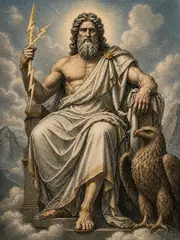
After the Roman annexation of Lusitania, Reue was identified with Iuppiter Optimus Maximus in the standard Roman provincial syncretism, and the cult continued under this Roman name for several centuries before being extinguished by the Christianization of the peninsula in the fourth and fifth centuries. The figure preserves, however, the clearest evidence we have for the indigenous Lusitanian high-god religion of the pre-Roman period.
Curator’s note

What the sources say, and what later tradition added. The sources for this bay

Reue is documented in numerous Lusitanian-Roman inscriptions; the standard references are the same as for Bandua. The Indo-European etymological connection to *dyews is treated in Calvert Watkins's How to Kill a Dragon and in the various Indo-European etymological dictionaries; the Lusitanian phonetic developments are discussed in F. Villar's Estudios de celtibérico y de toponimia prerromana (1995) and related publications. The standard treatment of Lusitanian religion is Marco Simón's various works.

Kin in the sources

Each tie is quoted from the entry that states it.

When the sources speak

Dated witnesses for The Iberian Pantheon. A date marks when the evidence was written down, not when the belief began. The whole timeline

2nd–1st millennia BCE
Bronze and Iron Age regional cultures establish the archaeological backgrounds later labeled Thracian, Illyrian, Iberian, Caucasian, and Libyan.
8th–6th centuries BCE
Greek and Phoenician colonization creates new inscriptional, artistic, and commercial contact zones.
6th–4th centuries BCE
Classical authors begin describing frontier peoples and translating local gods into Greek categories.
3rd–1st centuries BCE
Hellenistic kingdoms, Carthage, and Rome intensify political and cultic exchange.
1st century BCE–3rd century CE
Roman provincial rule produces dedications, coins, reliefs, and interpretive equations across the Balkans, Iberia, Caucasus, and North Africa.
4th–7th centuries CE
Christianization and imperial change end or transform many public cult institutions while names persist in texts and places.
medieval period
Georgian chronicles and epic traditions, Iberian memory, and North African historical sources reshape pre-Christian inheritances.
6th–3rd centuries BCE
Indigenous scripts, sanctuaries, and Mediterranean contacts diversify the religious record.

Floor plan

The rooms follow one another in the order their peoples first appear in the written record.

  1. The Cradle of Citiesc. 3400 BCE to 395 CE. 115 works
  2. The Gift of the Nilec. 4000 BCE to 395 CE. 73 works
  3. The Olympian Orderc. 1600 BCE to 750 CE. 152 works
  4. The Persian Worldc. 2000 BCE to 1010 CE. 30 works
  5. The Levantine Borderlandsc. 1200 BCE to 500 CE. 20 works
  6. The Edges of Empirec. 2000 BCE to 1500 CE. 33 works
  7. The Etruscan Worldc. 900 BCE to 750 CE. 22 works
  8. The Roman Inheritancec. 1200 BCE to 500 CE. 58 works
  9. The Northern Inheritancec. 2000 BCE to 1600 CE. 131 works