A Compendium of the Ancient Gods
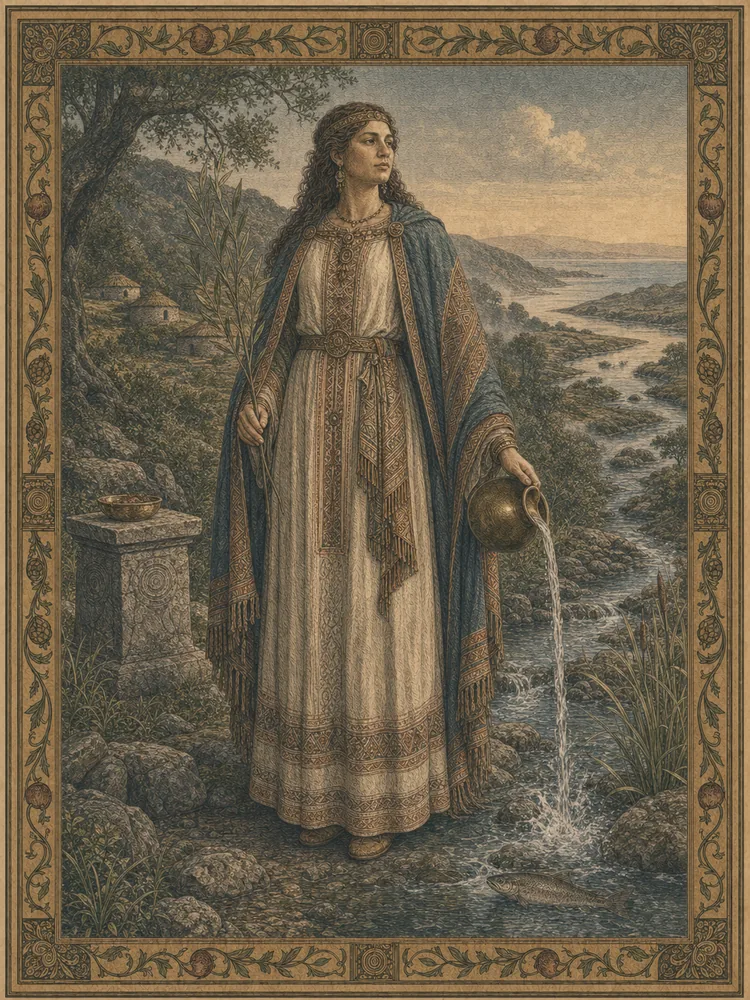
Nabia, plate

Nabia was a goddess of springs and rivers in the Lusitanian-Galician region, particularly venerated in the northwestern Iberian peninsula (modern northern Portugal and Galicia). The dedicatory inscriptions to her are concentrated in this region, with epithets sometimes connecting her to specific water-sources (Nabia Corona, Nabia Elaesurraega, and others). She was identified by the Romans with the Latin Diana, with Victoria, with Nymphae, and with Fortuna in different contexts — reflecting the breadth of her functions and the difficulty Roman administrators had in finding a single Mediterranean equivalent.

Her name Nabia is probably from a Celtic-Lusitanian root meaning 'flowing' or 'water' (cognate with various Celtic words for river and stream), and her function was that of the guardian of waters — both the rivers that nourished the agricultural lands and the springs that emerged from the earth. The northwestern Iberian peninsula is a region of abundant water-sources, with countless springs, streams, and small rivers; Nabia's cult was the regional expression of the religious importance of these waters to the local population.

The cult had both general and local aspects. As a general regional deity, Nabia was invoked across northwestern Iberia by the Lusitanian and Galician populations under both indigenous and Roman administration. As a local deity, she was tied to particular water-sources, with each sanctuary having its own epithet and its own rites. The pattern resembles that of Bandua and Reue (in previous entries), with the deity multiplied across local manifestations while retaining a recognizable common identity.

After the Christianization of northwestern Iberia, Nabia's cult was absorbed into the various water-related Christian devotions of the region (the cults of springs sacred to particular saints, the Marian devotions at certain water-sources). The continuity of holy waters across religious transitions is a deep pattern in European folk religion, and the Galician and northern Portuguese tradition of pilgrimages to springs preserves elements of the older Nabia-cult, transferred onto the Christian framework. The figure herself is preserved in the Roman-period inscriptions but has no specific medieval afterlife.
Curator’s note

What the sources say, and what later tradition added. The sources for this bay

Nabia is documented in inscriptions across northwestern Iberia. The standard reference is José d'Encarnação's Divindades indígenas sob o domínio romano em Portugal and the Hispania Epigraphica catalogue. The standard treatment of Galician-Lusitanian religion is in Francisco Marco Simón and others' contributions, including the publications of the Universidade de Santiago de Compostela. The Indo-European etymology of the name is discussed in F. Villar's various works on Iberian-Celtic linguistics.

Kin in the sources

Each tie is quoted from the entry that states it.

When the sources speak

Dated witnesses for The Iberian Pantheon. A date marks when the evidence was written down, not when the belief began. The whole timeline

2nd–1st millennia BCE
Bronze and Iron Age regional cultures establish the archaeological backgrounds later labeled Thracian, Illyrian, Iberian, Caucasian, and Libyan.
8th–6th centuries BCE
Greek and Phoenician colonization creates new inscriptional, artistic, and commercial contact zones.
6th–4th centuries BCE
Classical authors begin describing frontier peoples and translating local gods into Greek categories.
3rd–1st centuries BCE
Hellenistic kingdoms, Carthage, and Rome intensify political and cultic exchange.
1st century BCE–3rd century CE
Roman provincial rule produces dedications, coins, reliefs, and interpretive equations across the Balkans, Iberia, Caucasus, and North Africa.
4th–7th centuries CE
Christianization and imperial change end or transform many public cult institutions while names persist in texts and places.
medieval period
Georgian chronicles and epic traditions, Iberian memory, and North African historical sources reshape pre-Christian inheritances.
6th–3rd centuries BCE
Indigenous scripts, sanctuaries, and Mediterranean contacts diversify the religious record.

Floor plan

The rooms follow one another in the order their peoples first appear in the written record.

  1. The Cradle of Citiesc. 3400 BCE to 395 CE. 115 works
  2. The Gift of the Nilec. 4000 BCE to 395 CE. 73 works
  3. The Olympian Orderc. 1600 BCE to 750 CE. 152 works
  4. The Persian Worldc. 2000 BCE to 1010 CE. 30 works
  5. The Levantine Borderlandsc. 1200 BCE to 500 CE. 20 works
  6. The Edges of Empirec. 2000 BCE to 1500 CE. 33 works
  7. The Etruscan Worldc. 900 BCE to 750 CE. 22 works
  8. The Roman Inheritancec. 1200 BCE to 500 CE. 58 works
  9. The Northern Inheritancec. 2000 BCE to 1600 CE. 131 works