
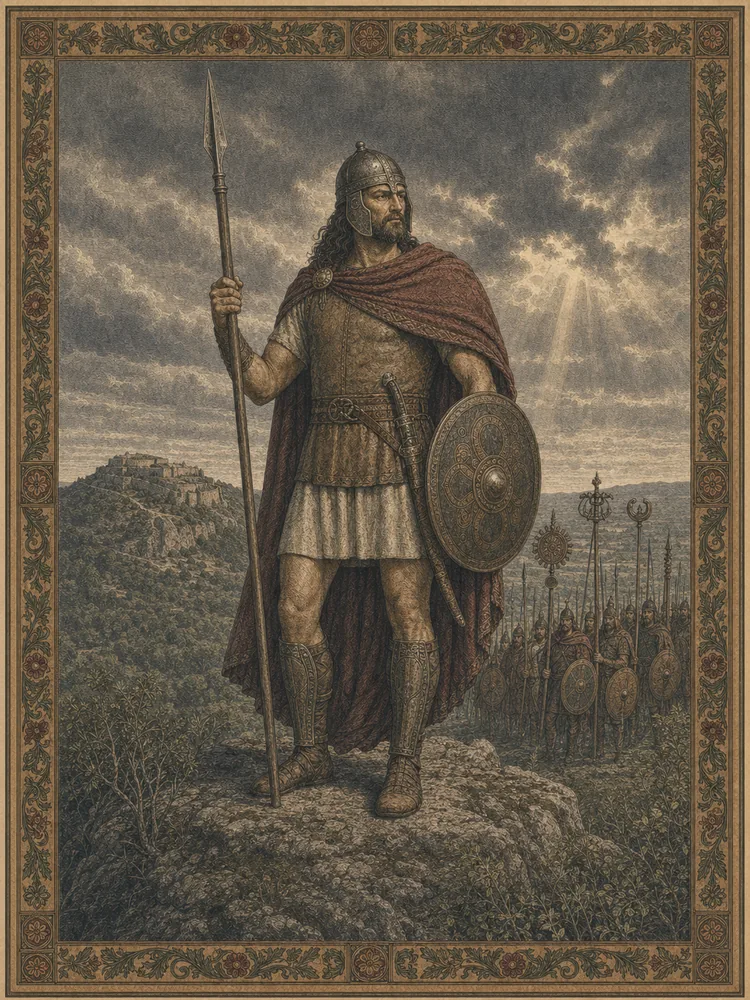
Cariocecus was the Lusitanian war-god, identified by the Romans with Mars and venerated particularly in the western and central regions of the peninsula. The dedicatory inscriptions to him are concentrated in modern central Portugal, with the typical late-Republican and early-imperial Roman date. The cult was that of a tribal warrior-god, the patron of the Lusitanian fighting-men, the divine warrant of victory in war and of military prowess.
The Lusitanians were among the most warlike peoples of pre-Roman Iberia, and resisted the Roman conquest with particular ferocity through the second century before our era. The Lusitanian Wars (155-139 BCE), fought by the Lusitanian leader Viriathus against successive Roman armies, ended only with Viriathus's assassination by his own men, who had been bribed by the Romans; the campaign was one of the longest and bloodiest of Rome's western conquests. Cariocecus was the divine patron of this resistance, and his cult flourished in precisely the regions where the resistance was strongest.
His iconography is poorly preserved — few surviving reliefs are securely identifiable as Cariocecus rather than as the Roman Mars under whose name he was eventually subsumed — but the standard pattern of the warrior-god (helmeted, armed with spear and shield, sometimes accompanied by his sacred animals) probably applies. The typical sacrificial offerings to Cariocecus included the spoils of war and (in some accounts) human sacrifices in the case of major military undertakings; Strabo (3.3.6) describes the Lusitanian custom of sacrificing prisoners of war, presumably to Cariocecus or a related war-deity, and reading the future from the manner of the prisoner's death.
After the Roman pacification of Lusitania, the cult was absorbed into the worship of Mars in the standard provincial syncretism, and Cariocecus's distinct character was largely lost. The figure preserves, however, the clearest evidence we have for the indigenous Lusitanian war-religion, and the testimony of Strabo on human sacrifice (whether or not it survived into the Roman period) gives us a glimpse of the rites that the Lusitanians had practiced before the Roman administration brought such practices to an end.