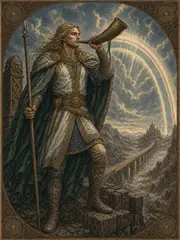
A Compendium of the Ancient Gods
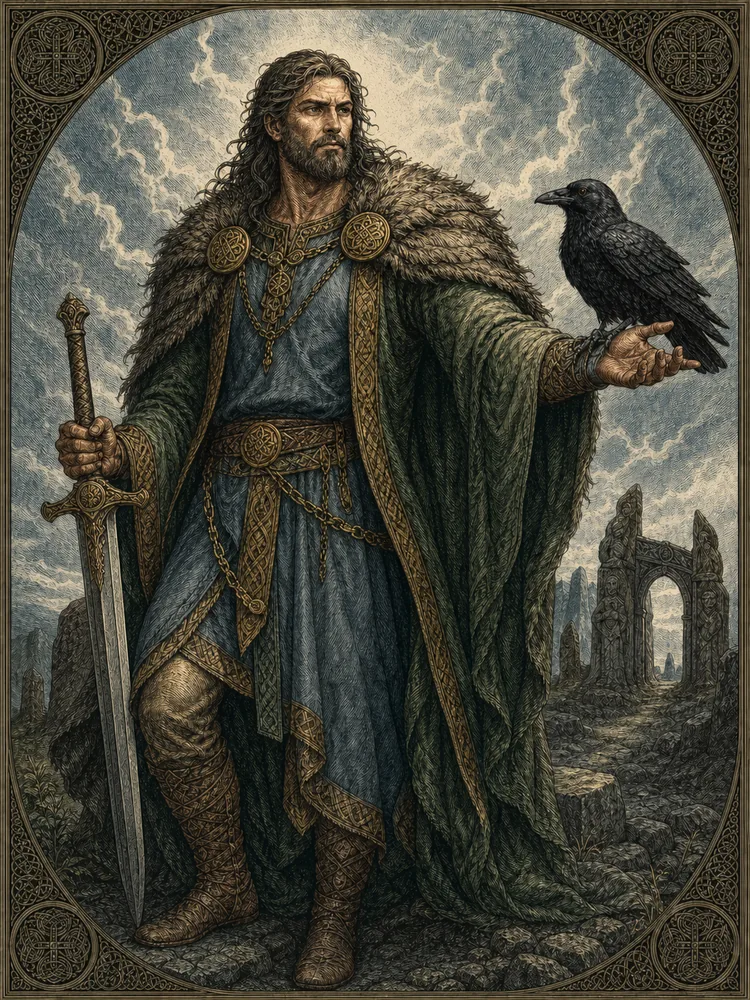
Týr, plate

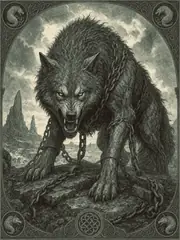
Týr (Anglo-Saxon Tīw, whence Tuesday) was the original sky-and-war god of the Germanic peoples — his name is etymologically the same as Greek Zeus and Latin Jupiter, both descended from the Indo-European *Dyeus, the Sky-Father — but in the Eddic tradition he had been displaced from supremacy by Odin, and survived as a more specialized god of single combat, of legal proceedings, and of the binding of oaths. His most famous deed was the binding of the wolf Fenrir. The wolf, son of Loki, had been growing dangerously large among the gods, and they resolved to bind him; they made three chains in succession (the first two of which Fenrir broke), and at last had the dwarves forge a magical chain Gleipnir, made from impossible things (the noise of a cat's footfall, the beard of a woman, the roots of a mountain, the sinews of a bear, the breath of a fish, the spittle of a bird). Fenrir, suspicious, would only consent to be tested with the chain if one of the gods would put a hand in his mouth as pledge of good faith. Týr alone consented. The chain held; the gods laughed; and Fenrir bit off Týr's hand. Týr thereafter was one-handed, the god of those who had given a hand for the binding of dangerous things — by extension, the god of those who keep faith at cost.

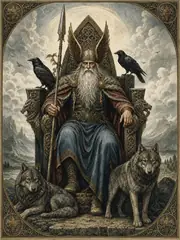
He had little extended mythology beyond this episode; the older Indo-European Sky-Father whose place he had once held was largely transferred to Odin. At Ragnarök, Týr will fight the great hellhound Garmr, and the two will kill each other.
Curator’s note

What the sources say, and what later tradition added. The sources for this bay

The Fenrir-binding is in Gylfaginning 34. The etymological identity with Greek Zeus and Latin Jupiter is among the most secure connections in Indo-European linguistics; the displacement of the original Indo-European sky-god by Odin in Germanic tradition is one of the more striking developments. Týr's continental Germanic equivalence to Mars in the Roman interpretatio (preserved in the day-name Tuesday = dies Martis = Tīwesdæg) reflects the war-god aspect that survived into the Germanic period after the displacement of the sky-god aspect. Tacitus, Germania 9, mentions Mars among the principal gods of the Germani — this is plausibly Týr.

Kin in the sources

Each tie is quoted from the entry that states it.

When the sources speak

Dated witnesses for The Norse and Germanic Gods. A date marks when the evidence was written down, not when the belief began. The whole timeline

2nd–1st millennia BCE
Indo-European language dispersals and regional Bronze Age cultures provide a remote comparative background, not a recoverable common canon.
c. 500 BCE–1 CE
Iron Age material culture, names, sanctuaries, and classical ethnography offer early but external evidence for Celtic and Germanic religions.
1st–4th centuries CE
Roman inscriptions and provincial cults preserve many Celtic, Germanic, and local divine names.
4th–8th centuries CE
Migration-period and early medieval conversion transform ritual institutions while heroic traditions continue.
8th–11th centuries CE
Viking Age poetry, runic evidence, archaeology, and Scandinavian conversion form the core context of Norse myth.
9th–12th centuries CE
Slavic, Baltic, and Finnic traditions enter chronicles and missionary accounts, often through hostile observers.
11th–14th centuries CE
Irish, Welsh, and Icelandic manuscripts preserve major narrative corpora in Christian literary environments.
12th–16th centuries CE
Saxo, saga compilers, Baltic chroniclers, and later antiquarians systematize or reinterpret older material.

Floor plan

The rooms follow one another in the order their peoples first appear in the written record.

  1. The Cradle of Citiesc. 3400 BCE to 395 CE. 115 works
  2. The Gift of the Nilec. 4000 BCE to 395 CE. 73 works
  3. The Olympian Orderc. 1600 BCE to 750 CE. 152 works
  4. The Persian Worldc. 2000 BCE to 1010 CE. 30 works
  5. The Levantine Borderlandsc. 1200 BCE to 500 CE. 20 works
  6. The Edges of Empirec. 2000 BCE to 1500 CE. 33 works
  7. The Etruscan Worldc. 900 BCE to 750 CE. 22 works
  8. The Roman Inheritancec. 1200 BCE to 500 CE. 58 works
  9. The Northern Inheritancec. 2000 BCE to 1600 CE. 131 works