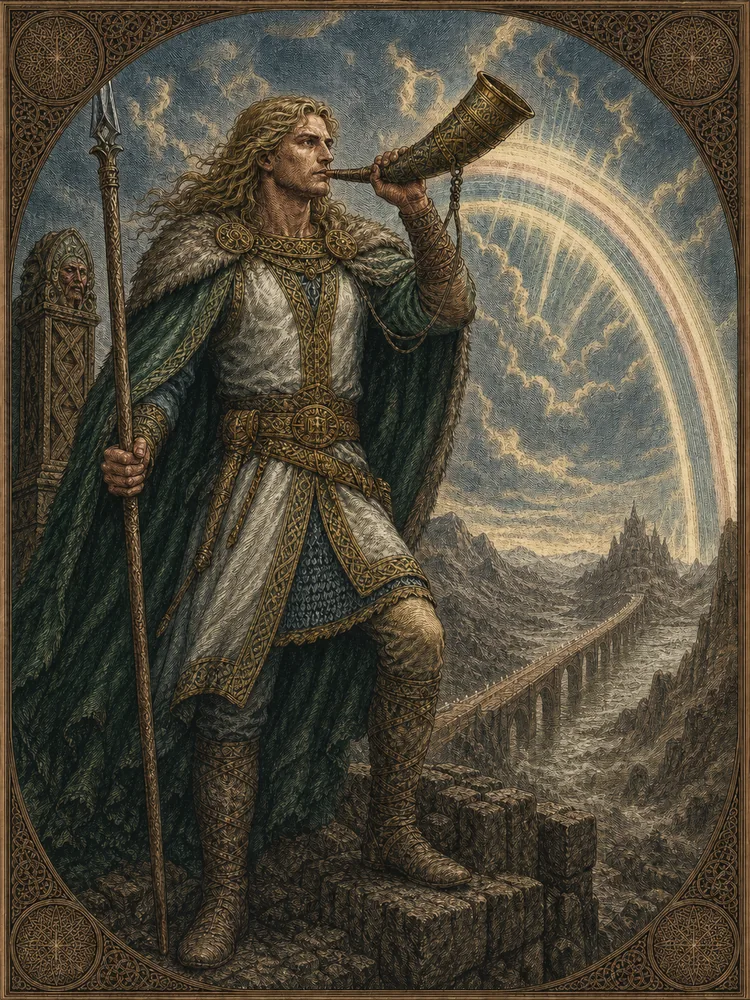
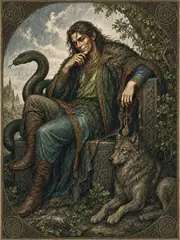
Heimdallr was the watchman of the gods, guardian of the rainbow-bridge Bifrost that connected Asgard to Midgard. He had been born of nine mothers (in some accounts the nine daughters of the sea-god Aegir, in others nine giantesses); he had teeth of gold, eyes that could see for a hundred leagues by day or by night, ears that could hear the grass growing in the field and the wool growing on the sheep. He needed less sleep than a bird. He stood his watch on Bifrost, and he held the great horn Gjallarhorn, which he would blow at the approach of Ragnarök to warn the gods.
He had a peculiar role beyond the watchman-function: in the Eddic poem Rigsthula, Heimdallr (under the name Rig) had wandered the world of men in disguise and had fathered, on three different women in three different households, the three children who became the ancestors of the three social classes — Thrall (the slave), Karl (the freeman), and Jarl (the noble) — so that the social structure of Norse society was, mythologically, his work. At Ragnarök, he will fight Loki, and the two ancient enemies will kill each other simultaneously.
When the sources speak
Dated witnesses for The Norse and Germanic Gods. A date marks when the evidence was written down, not when the belief began. The whole timeline
- 2nd–1st millennia BCE
- Indo-European language dispersals and regional Bronze Age cultures provide a remote comparative background, not a recoverable common canon.
- c. 500 BCE–1 CE
- Iron Age material culture, names, sanctuaries, and classical ethnography offer early but external evidence for Celtic and Germanic religions.
- 1st–4th centuries CE
- Roman inscriptions and provincial cults preserve many Celtic, Germanic, and local divine names.
- 4th–8th centuries CE
- Migration-period and early medieval conversion transform ritual institutions while heroic traditions continue.
- 8th–11th centuries CE
- Viking Age poetry, runic evidence, archaeology, and Scandinavian conversion form the core context of Norse myth.
- 9th–12th centuries CE
- Slavic, Baltic, and Finnic traditions enter chronicles and missionary accounts, often through hostile observers.
- 11th–14th centuries CE
- Irish, Welsh, and Icelandic manuscripts preserve major narrative corpora in Christian literary environments.
- 12th–16th centuries CE
- Saxo, saga compilers, Baltic chroniclers, and later antiquarians systematize or reinterpret older material.