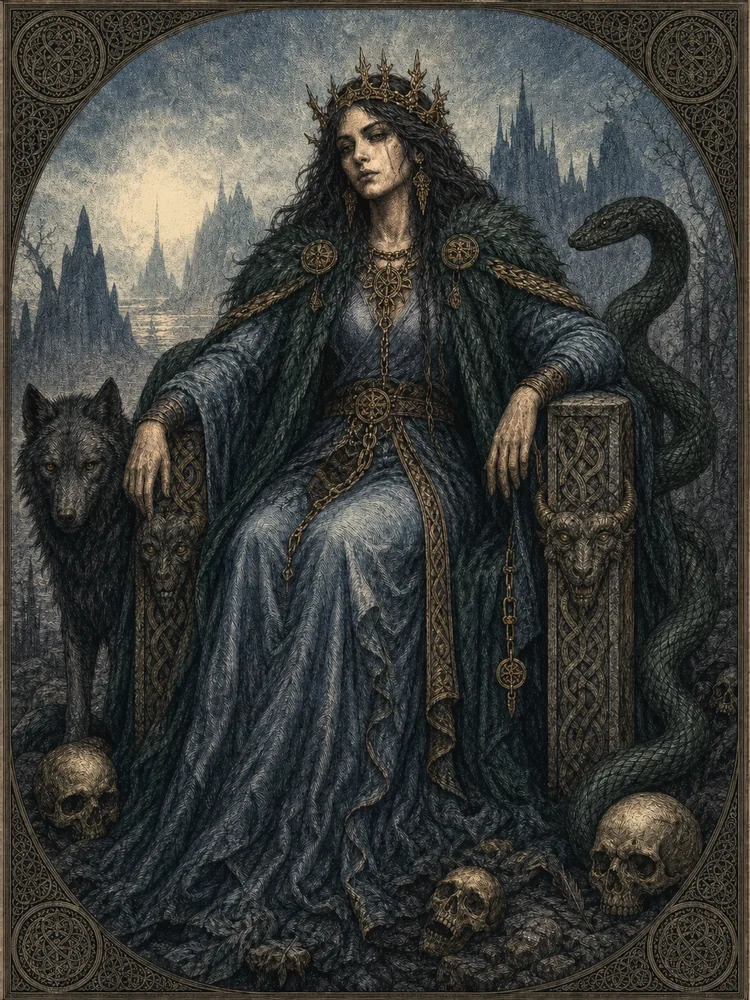
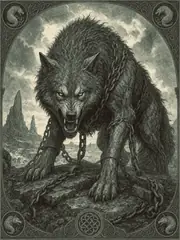
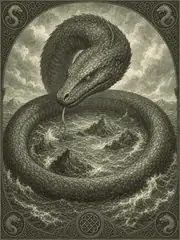
Hel was the queen of the underworld realm that bore her name (the name itself meaning "hidden," an etymology shared with English "hell" though the Norse Hel was a different conception — not, originally, a place of punishment, but the realm of those who had died of old age or sickness rather than honorably in battle). She was a daughter of Loki and the giantess Angrboða, sister of Fenrir and Jörmungandr; her appearance was unique among Norse divine figures, being half a normal woman and half a corpse — one side fair-skinned, the other black or putrid. Her hall was Éljúðnir; her plate was Hunger; her knife was Famine; her threshold was Stumbling-Block; her bed was Sick-Bed. She was the receiver of those who came to her — most of the dead, in fact, since most died in their beds and not in battle; only the battle-slain went to Odin or Freyja.
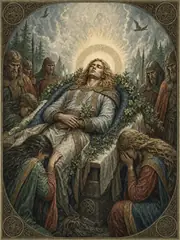
She had no mythological narrative beyond her receiving function and her role in the Baldr episode (where she agreed to release Baldr if every thing in the world wept for him, and where Loki — her father — refused as the giantess Þökk and so kept Baldr in her realm). At Ragnarök, the dead in her realm will be released; Loki will sail with them to fight the Aesir.
When the sources speak
Dated witnesses for The Norse and Germanic Gods. A date marks when the evidence was written down, not when the belief began. The whole timeline
- 2nd–1st millennia BCE
- Indo-European language dispersals and regional Bronze Age cultures provide a remote comparative background, not a recoverable common canon.
- c. 500 BCE–1 CE
- Iron Age material culture, names, sanctuaries, and classical ethnography offer early but external evidence for Celtic and Germanic religions.
- 1st–4th centuries CE
- Roman inscriptions and provincial cults preserve many Celtic, Germanic, and local divine names.
- 4th–8th centuries CE
- Migration-period and early medieval conversion transform ritual institutions while heroic traditions continue.
- 8th–11th centuries CE
- Viking Age poetry, runic evidence, archaeology, and Scandinavian conversion form the core context of Norse myth.
- 9th–12th centuries CE
- Slavic, Baltic, and Finnic traditions enter chronicles and missionary accounts, often through hostile observers.
- 11th–14th centuries CE
- Irish, Welsh, and Icelandic manuscripts preserve major narrative corpora in Christian literary environments.
- 12th–16th centuries CE
- Saxo, saga compilers, Baltic chroniclers, and later antiquarians systematize or reinterpret older material.