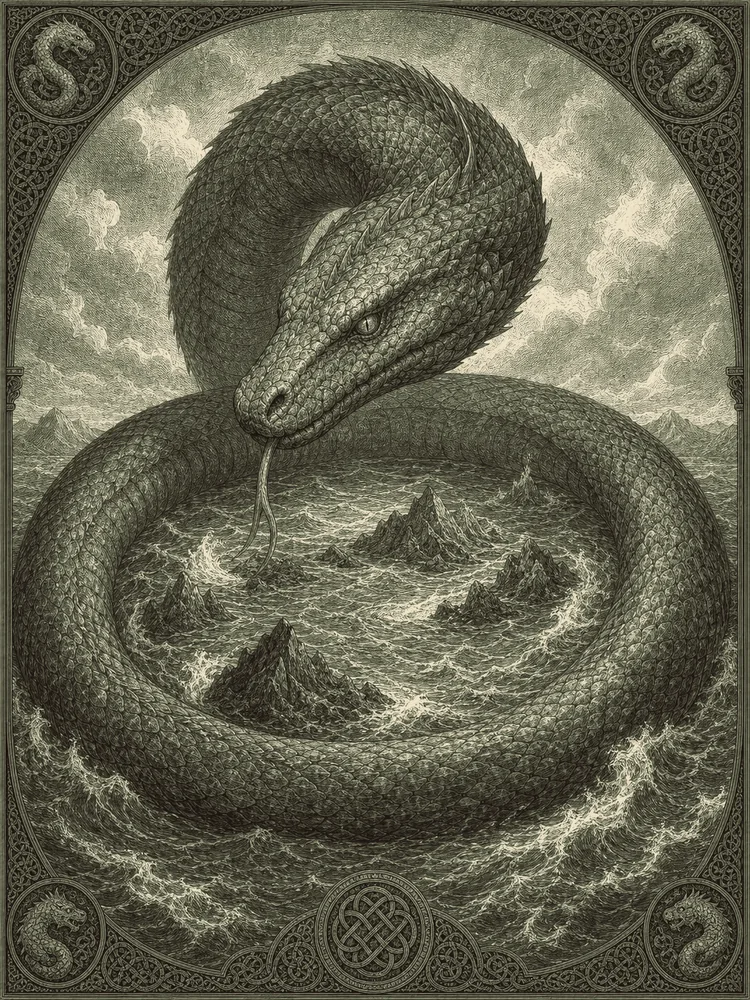
Jörmungandr was the great serpent who lay in the ocean encircling the world of men, son of Loki and Angrboða, brother of Fenrir and Hel. He had been thrown into the sea by Odin when the gods had foreseen his future role; he had grown to such enormous size that he encircled the entire globe, biting his own tail. He was Thor's chief enemy among the cosmic monsters; the two had fished for him together (in the Hymiskviða narrative told under Thor's entry), but Jörmungandr had escaped on that occasion. At Ragnarök, the World-Serpent would emerge from the sea; Thor would meet him in single combat; Thor would kill him with the hammer Mjölnir but would die nine paces later from the venom the serpent had spewed upon him. The figure of the world-encircling serpent (sometimes called the Midgard Serpent, Miðgarðsormr, in the Eddas) is parallel to other Indo-European world-serpents (Vedic Vritra, Iranian Aži Dahāka) and is among the most ancient mythological motifs; the version preserved in the Eddas is the most fully developed.
 Before thisFenrir
 Next on the wallSleipnir
Curator’s note
What the sources say, and what later tradition added. The sources for this bay
Gylfaginning 47 (the fishing episode), 51 (Ragnarök); Hymiskviða 17–24. The world-serpent biting its own tail is the figure that gave modern alchemical iconography the Ouroboros; the Norse version is one of several reflexes of an apparently very ancient Indo-European cosmological motif.
Kin in the sources
Each tie is quoted from the entry that states it.
 Child ofLoki
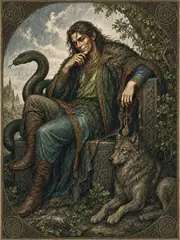
son of Loki and Angrboða, brother of Fenrir and Hel
- Sibling ofFenrir
son of Loki and Angrboða, brother of Fenrir and Hel
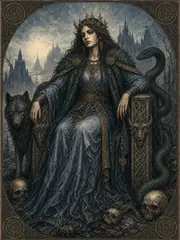 Sibling ofHel
son of Loki and Angrboða, brother of Fenrir and Hel
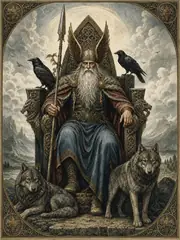 Rival ofOdin
He had been thrown into the sea by Odin when the gods had foreseen his future role
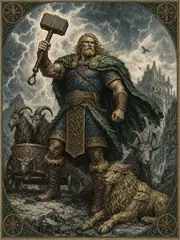 Rival ofThor
He was Thor's chief enemy among the cosmic monsters
- Slain byThor
Thor would kill him with the hammer Mjölnir but would die nine paces later from the venom
- SlewThor
Thor would kill him with the hammer Mjölnir but would die nine paces later from the venom
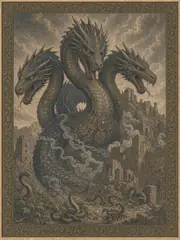 Compared withAži Dahāka
is parallel to other Indo-European world-serpents (Vedic Vritra, Iranian Aži Dahāka)
When the sources speak
Dated witnesses for The Norse and Germanic Gods. A date marks when the evidence was written down, not when the belief began. The whole timeline
- 2nd–1st millennia BCE
- Indo-European language dispersals and regional Bronze Age cultures provide a remote comparative background, not a recoverable common canon.
- c. 500 BCE–1 CE
- Iron Age material culture, names, sanctuaries, and classical ethnography offer early but external evidence for Celtic and Germanic religions.
- 1st–4th centuries CE
- Roman inscriptions and provincial cults preserve many Celtic, Germanic, and local divine names.
- 4th–8th centuries CE
- Migration-period and early medieval conversion transform ritual institutions while heroic traditions continue.
- 8th–11th centuries CE
- Viking Age poetry, runic evidence, archaeology, and Scandinavian conversion form the core context of Norse myth.
- 9th–12th centuries CE
- Slavic, Baltic, and Finnic traditions enter chronicles and missionary accounts, often through hostile observers.
- 11th–14th centuries CE
- Irish, Welsh, and Icelandic manuscripts preserve major narrative corpora in Christian literary environments.
- 12th–16th centuries CE
- Saxo, saga compilers, Baltic chroniclers, and later antiquarians systematize or reinterpret older material.