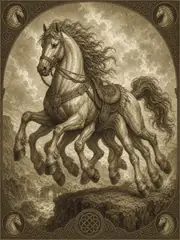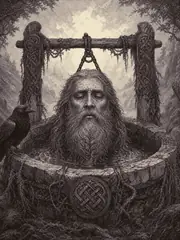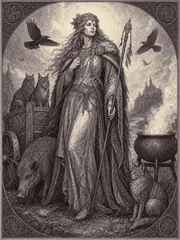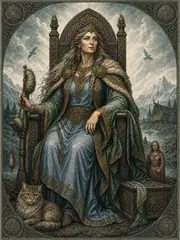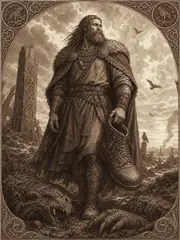
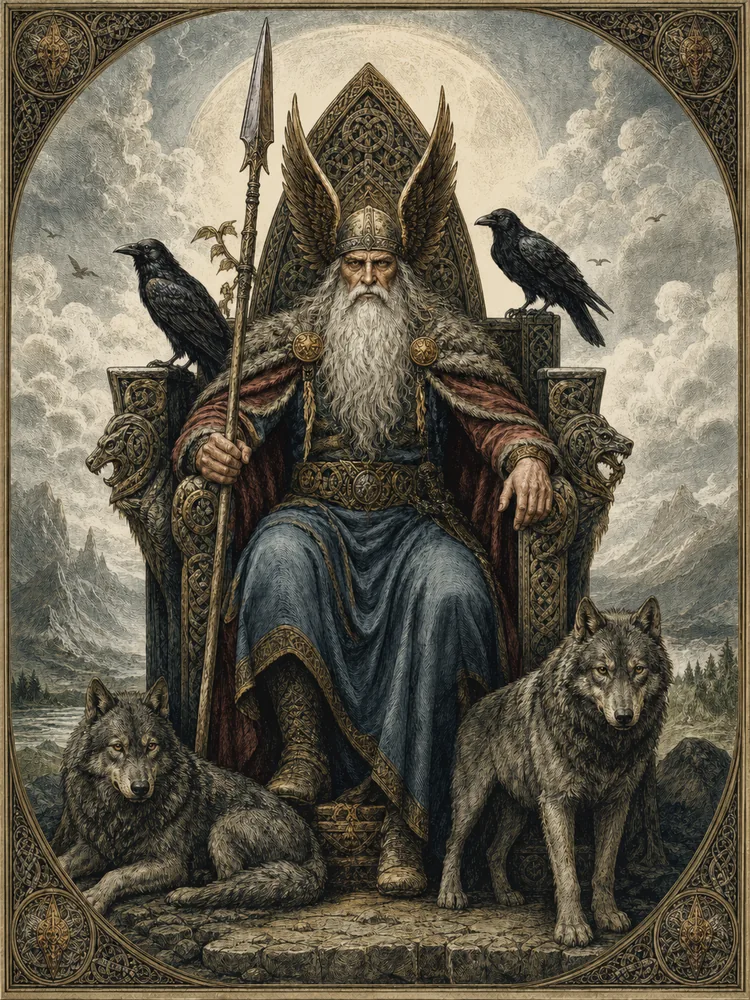
Odin (Old Norse Óðinn, Anglo-Saxon Wōden, whence Wednesday) was the chief of the Aesir, the Allfather of gods and men, the god of war, wisdom, poetry, magic, the runes, and the dead. He was a son of the proto-giant Borr and the giantess Bestla, brother of Vili and Vé (with whom he had killed the primal giant Ymir, from whose body the world was made: his flesh became the earth, his blood the sea, his bones the mountains, his skull the sky, his brain the clouds). He had one eye — having given the other in pledge for a drink from Mimir's well of wisdom — and his appearance was that of an old man, gray-bearded, in a wide-brimmed hat and a gray cloak, often disguised when he walked among men. He rode the eight-legged horse Sleipnir; he was attended by the two ravens Hugin (Thought) and Munin (Memory), who flew over the world by day and returned at evening to whisper in his ears all that they had seen; and by the two wolves Geri and Freki, who devoured the meat at his table while he himself drank only wine.
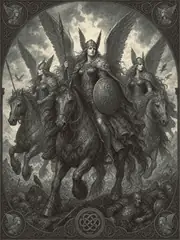
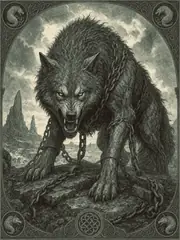
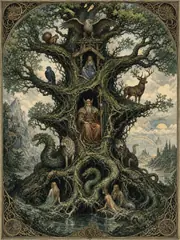
Odin's appetite for wisdom was insatiable. He had drunk from Mimir's well at the cost of his eye; he had hung upon Yggdrasil for nine nights and nine days, pierced by his own spear and offered as sacrifice to himself, that he might win the knowledge of the runes — the magical and prophetic alphabet by which the cosmos could be inscribed and influenced; he had stolen the mead of poetry from the giant Suttung, escaping in eagle-form, and from this mead the gift of poetry came to gods and to gifted mortals. He maintained, in his hall Valhalla in Asgard, an army of the dead — the Einherjar, the slain heroes brought to him from earthly battlefields by the Valkyries (treated below) — who feasted each evening and fought each day in preparation for Ragnarök. At Ragnarök, Odin would meet the wolf Fenrir in single combat and would be devoured.
His character was complex and not always benign. He was the god of poets and of kings, and granted his favors to those he chose; but he was also the god of treachery, of betrayal in battle, of the breaking of oaths when his interest required, of the favoring of one warrior over another for inscrutable reasons. The Eddic poems repeatedly warn against trusting Odin; he is the god of those who win, but also of those whom he chooses to abandon to their enemies for his own larger purposes. He was the master of seid, a kind of magic considered ergi (effeminate, unmanly), which he had learned from the Vanir goddess Freyja in the early days of the gods; the contradiction between Odin's masculine warrior-aspect and his magical-feminine aspect was deliberate and not resolved by the tradition. He had many names — over two hundred are recorded — reflecting his multiple aspects and the many guises in which he wandered among mortals.