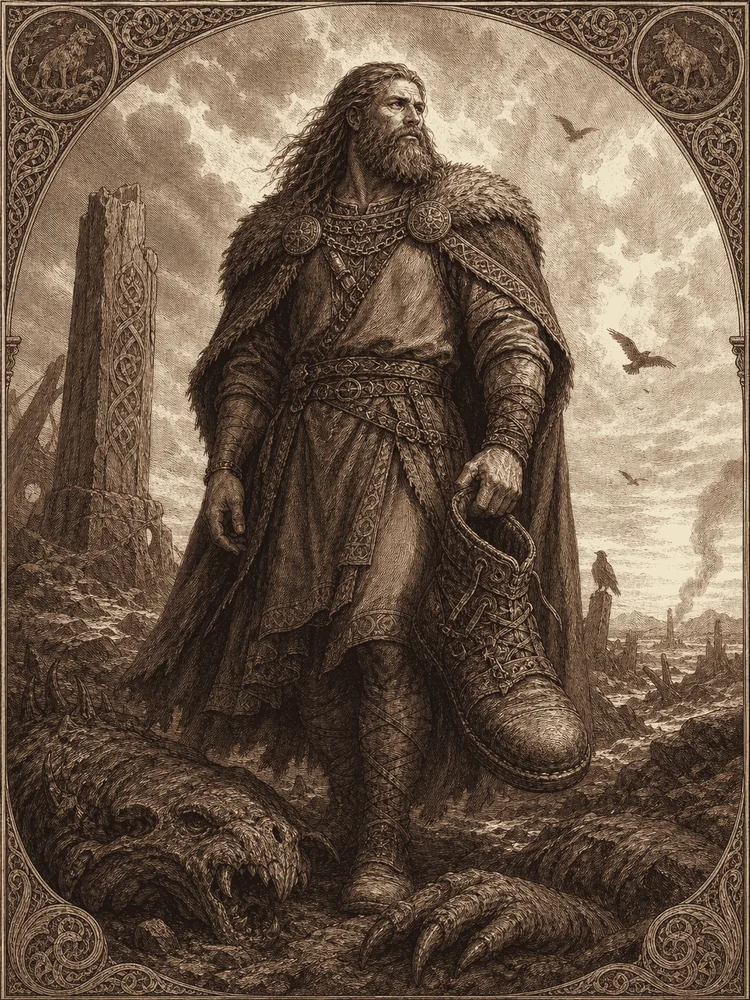
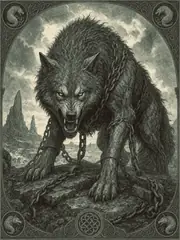
Vidar was a son of Odin by the giantess Gríðr, the silent god, the second-strongest of the Aesir after Thor, and the destined avenger of his father Odin at Ragnarök. He had a thick magical shoe, made (the Eddic poems said) of the leather-scraps that men cut from their own shoes when finishing them, gathered through all the ages by his mother and made into the great shoe with which he would crush the lower jaw of Fenrir at the end. (The implication that Norse cobblers were expected to dispose of their shoe-trimmings carefully, to contribute to the mythological shoe's making, is one of the more curious connections of Norse cosmic eschatology to ordinary practice.) When Fenrir would have killed Odin and devoured him at Ragnarök, Vidar would step into the wolf's mouth with his shoe-clad foot, push down its lower jaw, seize the upper, and tear the wolf apart. He would survive Ragnarök and live in the world that came after.
 Before thisBragi
 Next on the wallVali
Curator’s note
What the sources say, and what later tradition added. The sources for this bay
Gylfaginning 29, 51 (the Ragnarök prophecy); Vafþrúðnismál 51, 53. The shoe-making detail is in Snorri's Gylfaginning 51.
Kin in the sources
Each tie is quoted from the entry that states it.
 Child ofOdin
Vidar was a son of Odin by the giantess Gríðr, the silent god
 SlewFenrir
with which he would crush the lower jaw of Fenrir at the end
When the sources speak
Dated witnesses for The Norse and Germanic Gods. A date marks when the evidence was written down, not when the belief began. The whole timeline
- 2nd–1st millennia BCE
- Indo-European language dispersals and regional Bronze Age cultures provide a remote comparative background, not a recoverable common canon.
- c. 500 BCE–1 CE
- Iron Age material culture, names, sanctuaries, and classical ethnography offer early but external evidence for Celtic and Germanic religions.
- 1st–4th centuries CE
- Roman inscriptions and provincial cults preserve many Celtic, Germanic, and local divine names.
- 4th–8th centuries CE
- Migration-period and early medieval conversion transform ritual institutions while heroic traditions continue.
- 8th–11th centuries CE
- Viking Age poetry, runic evidence, archaeology, and Scandinavian conversion form the core context of Norse myth.
- 9th–12th centuries CE
- Slavic, Baltic, and Finnic traditions enter chronicles and missionary accounts, often through hostile observers.
- 11th–14th centuries CE
- Irish, Welsh, and Icelandic manuscripts preserve major narrative corpora in Christian literary environments.
- 12th–16th centuries CE
- Saxo, saga compilers, Baltic chroniclers, and later antiquarians systematize or reinterpret older material.