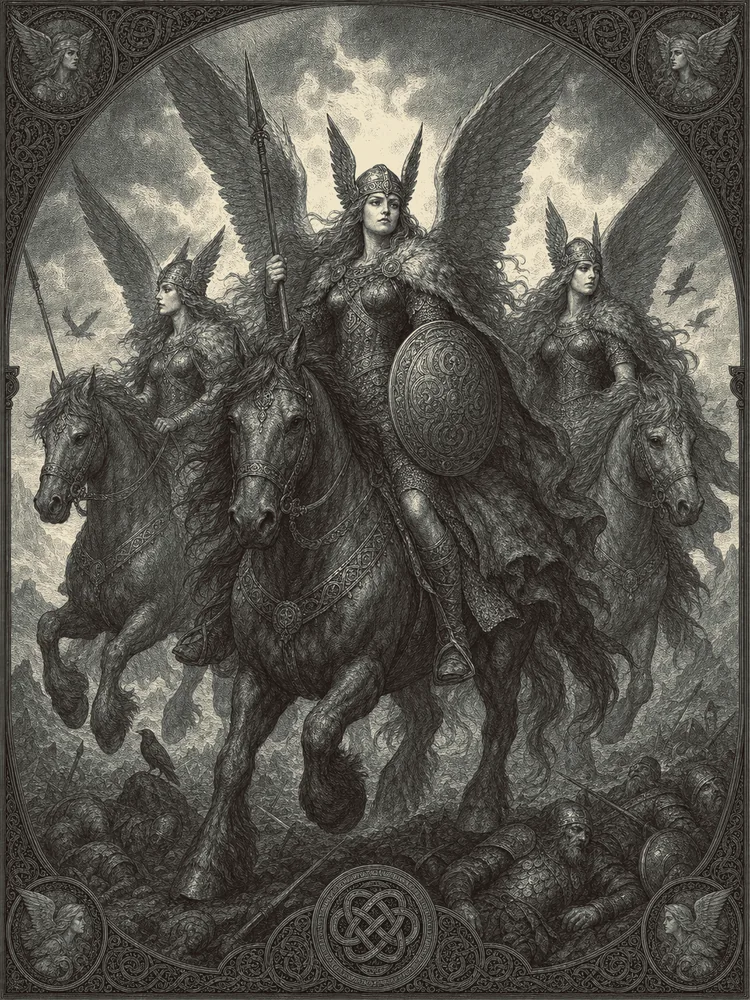
The Valkyries (Valkyrjur, "choosers of the slain") were the warrior-maidens who served Odin by choosing among the slain in earthly battles which dead warriors should be brought to Valhalla as Einherjar. They rode armored on horses through the air over battlefields, and at the appointed moment took the chosen dead and bore them up to Asgard. They were not simply collectors; they had agency in deciding who should die — Odin's choice was sometimes signaled by his giving them the orders, but they themselves sometimes intervened in battle, and in the Eddic and saga tradition they sometimes loved the warriors they had selected. The most famous Valkyrie of the heroic tradition is Brynhild (Brunhilde of Wagner's Ring), who in the Volsunga saga loves Sigurd the dragon-slayer, is given to Gunnar by Sigurd's deception, and brings about the great catastrophe of the Volsung tragedy. Beyond the named figures, the Valkyries were a numerous company; the Eddic poem Darraðarljóð ("Lay of Darts") gives a striking image of them weaving at a great loom whose warp is human entrails and whose weights are skulls, weaving the fates of warriors and the outcomes of battles.
 Before thisSleipnir
 Next on the wallNorns
Curator’s note
What the sources say, and what later tradition added. The sources for this bay
Grímnismál 36 (a list of Valkyries' names); Völuspá 30; Darraðarljóð (the loom-weaving image); Volsunga saga (Brynhild). The Valkyries have had a modern afterlife principally through Wagner's Die Walküre, with whose iconographic image (winged-helmeted warrior-maidens) the original Norse figure has only loose connection.
Kin in the sources
Each tie is quoted from the entry that states it.
 Companion ofOdin
were the warrior-maidens who served Odin by choosing among the slain in earthly battles
 Companion ofSigurd
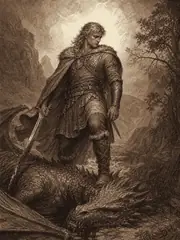
who in the Volsunga saga loves Sigurd the dragon-slayer
When the sources speak
Dated witnesses for The Norse and Germanic Gods. A date marks when the evidence was written down, not when the belief began. The whole timeline
- 2nd–1st millennia BCE
- Indo-European language dispersals and regional Bronze Age cultures provide a remote comparative background, not a recoverable common canon.
- c. 500 BCE–1 CE
- Iron Age material culture, names, sanctuaries, and classical ethnography offer early but external evidence for Celtic and Germanic religions.
- 1st–4th centuries CE
- Roman inscriptions and provincial cults preserve many Celtic, Germanic, and local divine names.
- 4th–8th centuries CE
- Migration-period and early medieval conversion transform ritual institutions while heroic traditions continue.
- 8th–11th centuries CE
- Viking Age poetry, runic evidence, archaeology, and Scandinavian conversion form the core context of Norse myth.
- 9th–12th centuries CE
- Slavic, Baltic, and Finnic traditions enter chronicles and missionary accounts, often through hostile observers.
- 11th–14th centuries CE
- Irish, Welsh, and Icelandic manuscripts preserve major narrative corpora in Christian literary environments.
- 12th–16th centuries CE
- Saxo, saga compilers, Baltic chroniclers, and later antiquarians systematize or reinterpret older material.