A Compendium of the Ancient Gods
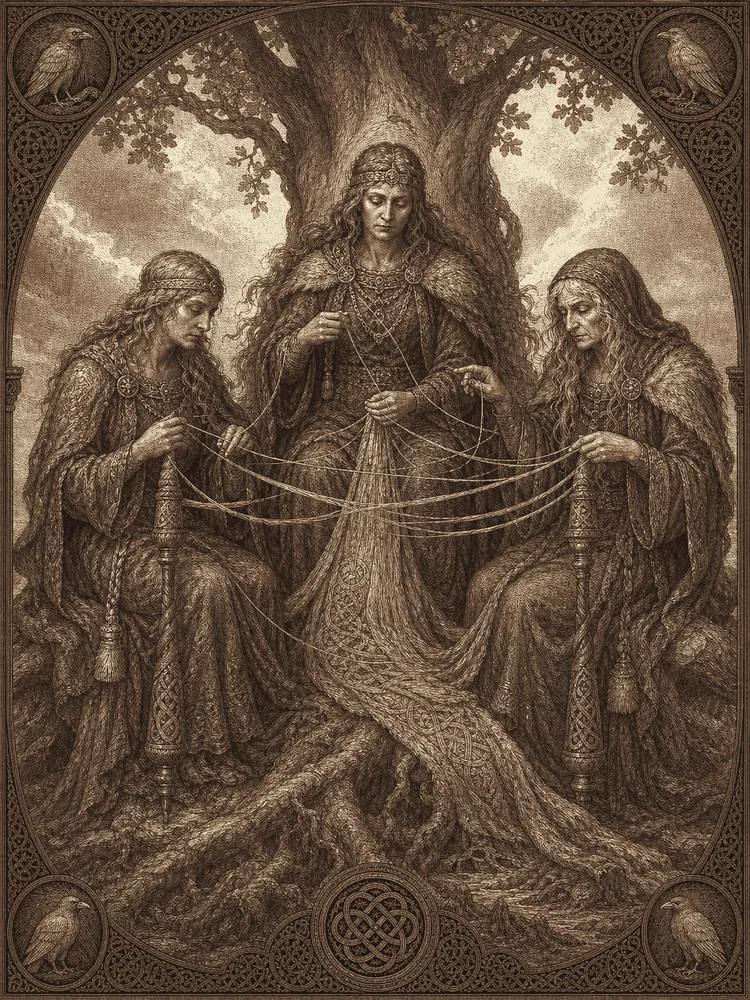
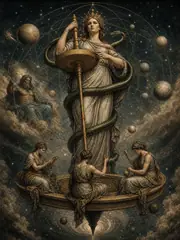
Norns, plate

The Norns were the three fates of Norse mythology: Urd ("the past, what has become"), Verðandi ("the present, what is becoming"), and Skuld ("the future, what shall be"). They dwelt at the well of Urd at the base of one of Yggdrasil's roots; they tended the World-Tree, watering it daily from the well, and their tendance was what kept the tree alive against the depredations of the dragons and stags that fed upon it. They wove the destinies of gods and men; they spoke the appointed shapes of lives at every birth, and what they spoke could not be unspoken. They were a parallel to the Greek Moirai (treated in Volume III), with whom they shared an evident Indo-European archetype, but the Norns were three by name and function rather than by subdivision (one each for past, present, and future, rather than three sisters dividing the single act of spinning, measuring, and cutting); they were also more sharply cosmological, their tendance of Yggdrasil being not a parallel to but the principal mode of their action.

There were also lesser norns — the Eddic poems hint at a numerous company of fates beyond the three principal — who attended individual births and assigned individual fortunes; both good and evil norns were said to attend each child, the evil norns producing the unfortunate fates that men experienced through no fault of their own.
Curator’s note

What the sources say, and what later tradition added. The sources for this bay

Gylfaginning 15 (the three principal Norns); Völuspá 20; Hávamál 84; Sigrdrífumál 17. The Indo-European parallels (Greek Moirai, Roman Parcae, Hindu Tridevi in some treatments, Slavic Sudice) reflect a deep antiquity for the conception of fate-personifying triads.

Kin in the sources

Each tie is quoted from the entry that states it.

When the sources speak

Dated witnesses for The Norse and Germanic Gods. A date marks when the evidence was written down, not when the belief began. The whole timeline

2nd–1st millennia BCE
Indo-European language dispersals and regional Bronze Age cultures provide a remote comparative background, not a recoverable common canon.
c. 500 BCE–1 CE
Iron Age material culture, names, sanctuaries, and classical ethnography offer early but external evidence for Celtic and Germanic religions.
1st–4th centuries CE
Roman inscriptions and provincial cults preserve many Celtic, Germanic, and local divine names.
4th–8th centuries CE
Migration-period and early medieval conversion transform ritual institutions while heroic traditions continue.
8th–11th centuries CE
Viking Age poetry, runic evidence, archaeology, and Scandinavian conversion form the core context of Norse myth.
9th–12th centuries CE
Slavic, Baltic, and Finnic traditions enter chronicles and missionary accounts, often through hostile observers.
11th–14th centuries CE
Irish, Welsh, and Icelandic manuscripts preserve major narrative corpora in Christian literary environments.
12th–16th centuries CE
Saxo, saga compilers, Baltic chroniclers, and later antiquarians systematize or reinterpret older material.

Floor plan

The rooms follow one another in the order their peoples first appear in the written record.

  1. The Cradle of Citiesc. 3400 BCE to 395 CE. 115 works
  2. The Gift of the Nilec. 4000 BCE to 395 CE. 73 works
  3. The Olympian Orderc. 1600 BCE to 750 CE. 152 works
  4. The Persian Worldc. 2000 BCE to 1010 CE. 30 works
  5. The Levantine Borderlandsc. 1200 BCE to 500 CE. 20 works
  6. The Edges of Empirec. 2000 BCE to 1500 CE. 33 works
  7. The Etruscan Worldc. 900 BCE to 750 CE. 22 works
  8. The Roman Inheritancec. 1200 BCE to 500 CE. 58 works
  9. The Northern Inheritancec. 2000 BCE to 1600 CE. 131 works