A Compendium of the Ancient Gods
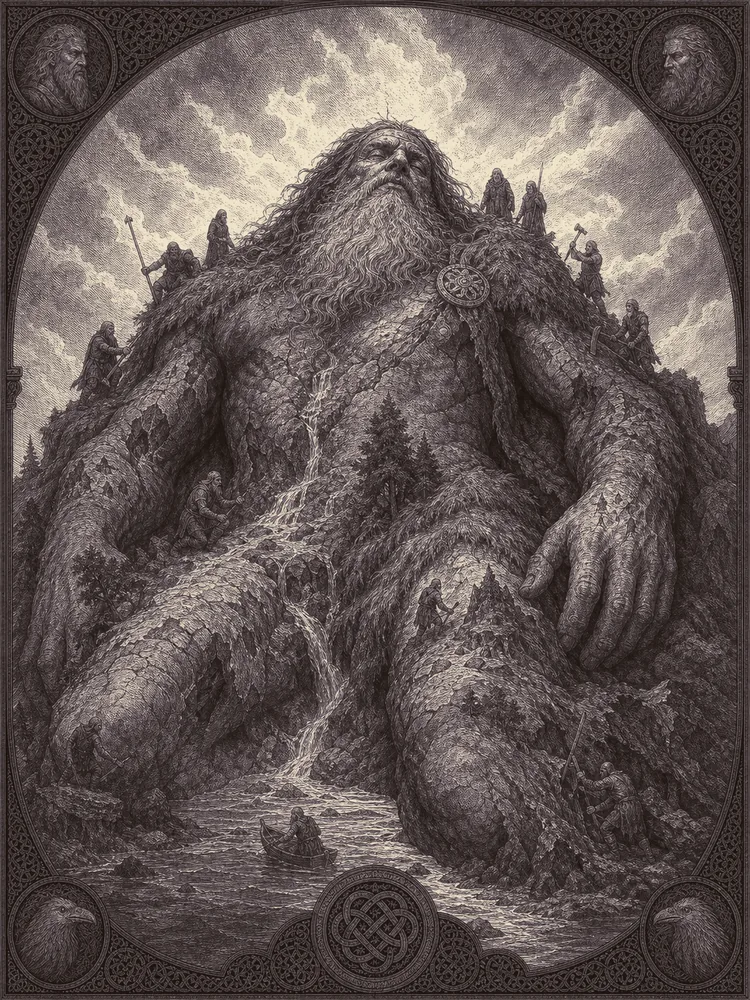
Ymir, plate

In the beginning, said the Norse poets, there was Ginnungagap, the Yawning Void — and on its northern side stretched Niflheim, the home of mist and ice, and on its southern side Muspelheim, the realm of fire. Where the rime of the one met the heat of the other, the ice began to drip and to take on form; and from the dripping was made the first living thing, who was called Ymir.

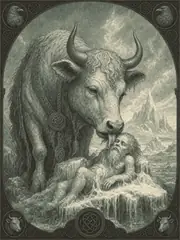
Ymir was a giant of vast proportions, neither male nor female alone but containing both, and from him sprang the race of frost-giants — under his arm a man and a woman were born of his sweat, and from his joined feet a six-headed son. Ymir lived from the milk of the cow Audhumla, who had likewise come into being out of the melting ice, and who licked salt from the rocks; from her tongue's licking emerged the first of the gods, the man Búri.

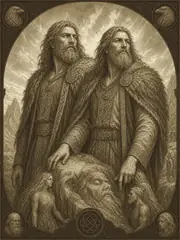
Búri begot Borr, who took to wife the giantess Bestla; and Borr and Bestla begot the three brothers Odin, Vili, and Vé. These three slew Ymir at last, for they could not bear the giant's growing race; and from his body they made the world. His flesh became the earth; his bones, the mountains; his blood, the seas (and so vast was the bleeding that it drowned all the giants save two, who escaped in a hollow tree); his skull, lifted upon four pillars at the cardinal points, became the dome of the sky; his brains, scattered, became the clouds; his hair, the trees; and his eyebrows the high wall of Midgard, the middle-earth that the gods built for their human children. So the world is built upon the corpse of the first giant, and the gods are murderers; and the children of Ymir whom they could not catch — the giants — have remained their everlasting enemies.
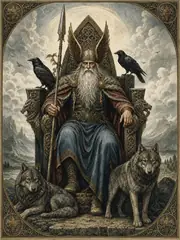
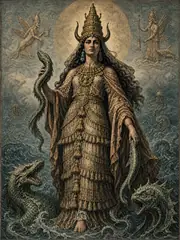
Curator’s note

What the sources say, and what later tradition added. The sources for this bay

Ymir's creation and dismemberment are recounted in the Prose Edda (Gylfaginning chapters 5-8) by Snorri Sturluson, drawing upon the older Eddic poems; the chief poetic source is Vǫluspá 3-6 and Vafþrúðnismál 21, 28-35. Grímnismál 40-41 describes the body-becomes-world cosmogony in particularly clear terms. The motif of the world made from the body of a primordial being has parallels in the Vedic Puruṣasūkta (Rigveda 10.90), in Babylonian Tiamat (Enuma Elish), and in Chinese Pangu — an Indo-European inheritance, in part, but probably also a more widespread cosmogonic type. Snorri's account is the fullest narrative we have, but it post-dates the conversion of Iceland to Christianity by some two centuries (c. 1220 CE) and reflects systematizing tendencies that the older poetic sources lack.

Kin in the sources

Each tie is quoted from the entry that states it.

When the sources speak

Dated witnesses for The Norse and Germanic Gods. A date marks when the evidence was written down, not when the belief began. The whole timeline

2nd–1st millennia BCE
Indo-European language dispersals and regional Bronze Age cultures provide a remote comparative background, not a recoverable common canon.
c. 500 BCE–1 CE
Iron Age material culture, names, sanctuaries, and classical ethnography offer early but external evidence for Celtic and Germanic religions.
1st–4th centuries CE
Roman inscriptions and provincial cults preserve many Celtic, Germanic, and local divine names.
4th–8th centuries CE
Migration-period and early medieval conversion transform ritual institutions while heroic traditions continue.
8th–11th centuries CE
Viking Age poetry, runic evidence, archaeology, and Scandinavian conversion form the core context of Norse myth.
9th–12th centuries CE
Slavic, Baltic, and Finnic traditions enter chronicles and missionary accounts, often through hostile observers.
11th–14th centuries CE
Irish, Welsh, and Icelandic manuscripts preserve major narrative corpora in Christian literary environments.
12th–16th centuries CE
Saxo, saga compilers, Baltic chroniclers, and later antiquarians systematize or reinterpret older material.

Floor plan

The rooms follow one another in the order their peoples first appear in the written record.

  1. The Cradle of Citiesc. 3400 BCE to 395 CE. 115 works
  2. The Gift of the Nilec. 4000 BCE to 395 CE. 73 works
  3. The Olympian Orderc. 1600 BCE to 750 CE. 152 works
  4. The Persian Worldc. 2000 BCE to 1010 CE. 30 works
  5. The Levantine Borderlandsc. 1200 BCE to 500 CE. 20 works
  6. The Edges of Empirec. 2000 BCE to 1500 CE. 33 works
  7. The Etruscan Worldc. 900 BCE to 750 CE. 22 works
  8. The Roman Inheritancec. 1200 BCE to 500 CE. 58 works
  9. The Northern Inheritancec. 2000 BCE to 1600 CE. 131 works