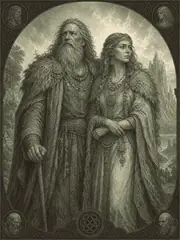
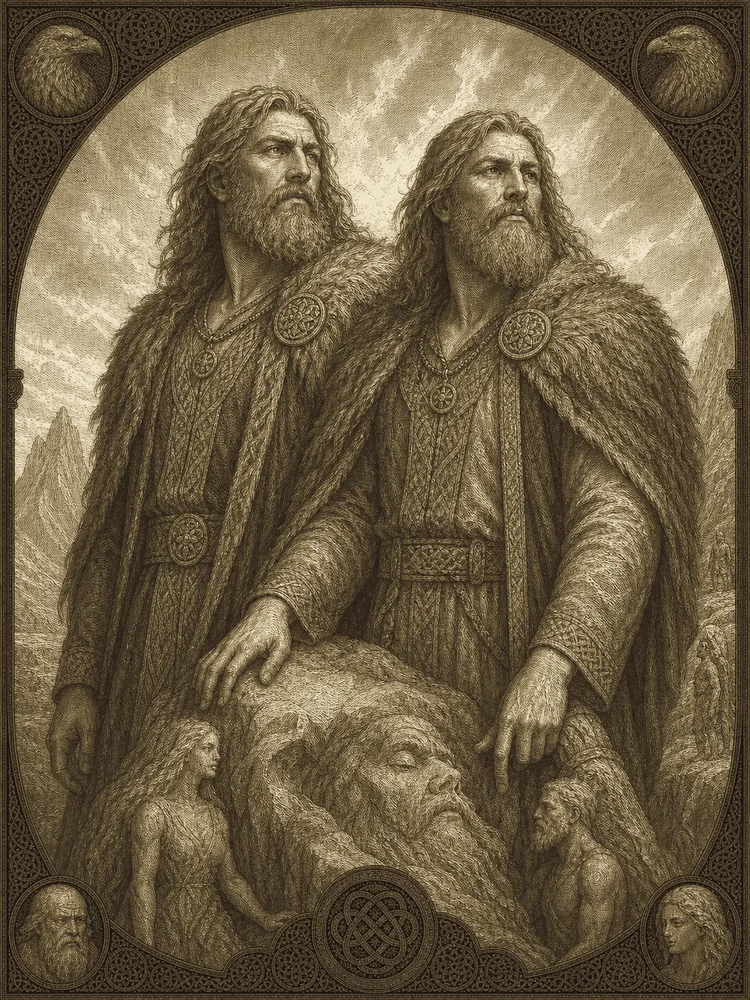
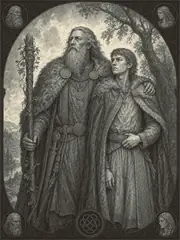
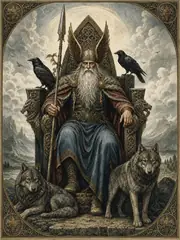
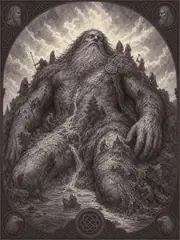
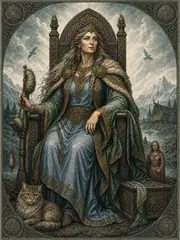
Vili and Vé were the younger brothers of Odin, the three together the sons of Borr and Bestla. They aided their elder brother in the slaying of Ymir and in the making of the world from his body. When the work was done, the three came upon two trees lying upon the seashore — an ash and an elm — and from these they fashioned the first man and the first woman, whom they named Ask and Embla. Odin gave them breath and spirit; one of his brothers (the sources differ which) gave them sense and motion; the other gave them shape, speech, and warmth. So humankind was created by all three brothers in concert, though Odin alone was thereafter the most worshipped.
Vili and Vé played one further role in the legends — and a strange one. While Odin was once long away from Asgard, his brothers took up his place, and (according to Lokasenna 26 and Ynglinga saga 3) they shared his wife Frigg between them as well. When Odin at last returned, he reclaimed his throne and his wife; the brothers withdrew, and were not punished, for among the gods such things were borne. The episode is the only one in which Vili and Vé are individually significant; thereafter they fade from the record.
Curator’s note
What the sources say, and what later tradition added. The sources for this bay
Vili and Vé appear in Gylfaginning chapters 6 and 9, in Vǫluspá 17-18 (where the three creators of humankind are named Odin, Hœnir, and Lóðurr — a different triad, raising the unresolved question whether Vili and Vé are alternative names for Hœnir and Lóðurr or whether the two triads are simply variant traditions), in Lokasenna 26 (Loki's taunt about Frigg), and in Snorri's Heimskringla (Ynglinga saga 3, the Frigg episode). The relation between the Odin/Vili/Vé triad and the Odin/Hœnir/Lóðurr triad is one of the great problems of Norse mythography. The Frigg-sharing episode probably preserves a memory of older fertility-rite practices than the systematized Christian-influenced Snorra Edda generally admits.
When the sources speak
Dated witnesses for The Norse and Germanic Gods. A date marks when the evidence was written down, not when the belief began. The whole timeline
- 2nd–1st millennia BCE
- Indo-European language dispersals and regional Bronze Age cultures provide a remote comparative background, not a recoverable common canon.
- c. 500 BCE–1 CE
- Iron Age material culture, names, sanctuaries, and classical ethnography offer early but external evidence for Celtic and Germanic religions.
- 1st–4th centuries CE
- Roman inscriptions and provincial cults preserve many Celtic, Germanic, and local divine names.
- 4th–8th centuries CE
- Migration-period and early medieval conversion transform ritual institutions while heroic traditions continue.
- 8th–11th centuries CE
- Viking Age poetry, runic evidence, archaeology, and Scandinavian conversion form the core context of Norse myth.
- 9th–12th centuries CE
- Slavic, Baltic, and Finnic traditions enter chronicles and missionary accounts, often through hostile observers.
- 11th–14th centuries CE
- Irish, Welsh, and Icelandic manuscripts preserve major narrative corpora in Christian literary environments.
- 12th–16th centuries CE
- Saxo, saga compilers, Baltic chroniclers, and later antiquarians systematize or reinterpret older material.