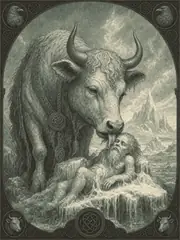
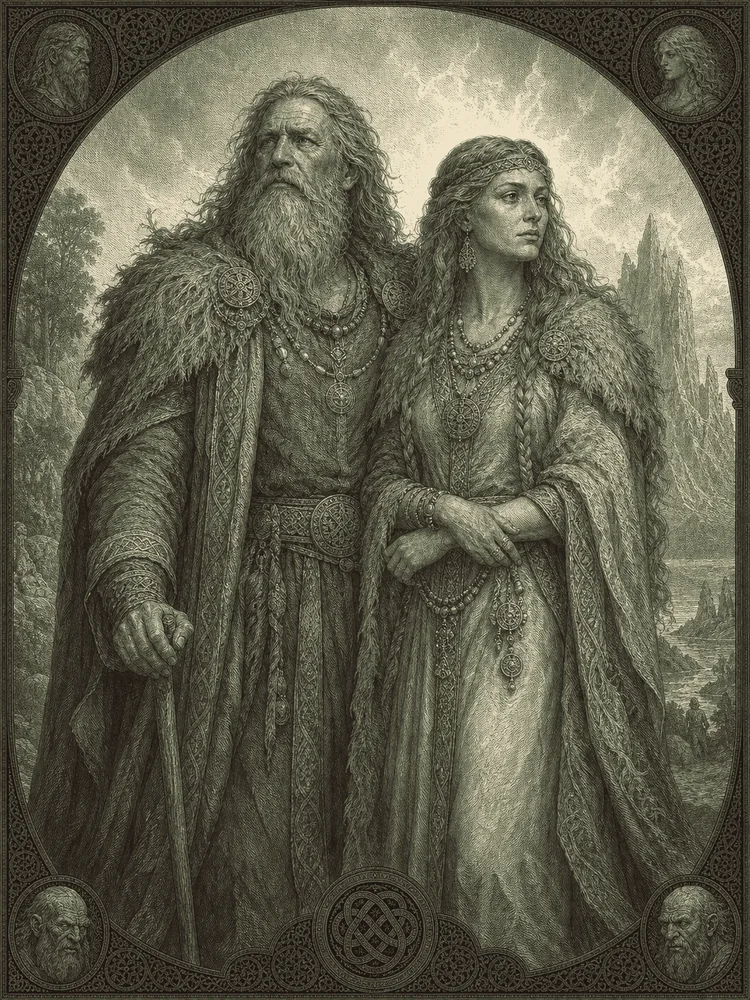
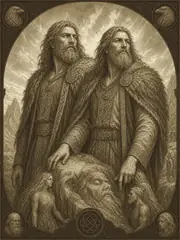
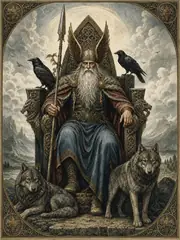
Búri the first god, who had been licked from the ice by Audhumla, begot a son named Borr; and Borr took to wife the giantess Bestla, daughter of the giant Bölthorn. Of this union were born three sons: Odin, who would become the chief of the gods, and his brothers Vili and Vé. So the first generation of the Aesir was already a mingling of god and giant — for the mother of Odin was a giantess, and the kinship between the rival kindreds was set at the very founding of the world.
Of Borr and Bestla almost nothing further is told. They appear in the genealogies and disappear; we do not know whether they ever beheld the murder of Ymir by their sons, or whether they took any part in the world's making. They are simply the names that hold the place where the kinship of gods and giants must be acknowledged.
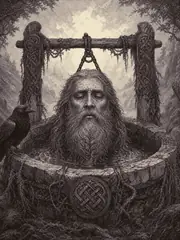
Bestla's brother — unnamed in the surviving Eddic verses, mentioned only obliquely — was thought by some scholars to be Mímir, the wisest of beings, who would later be Odin's counselor. If so, then Odin's wisdom came in part through his mother's family; the giants, though often the gods' enemies, were also their relatives by marriage and the keepers of older knowledge.
When the sources speak
Dated witnesses for The Norse and Germanic Gods. A date marks when the evidence was written down, not when the belief began. The whole timeline
- 2nd–1st millennia BCE
- Indo-European language dispersals and regional Bronze Age cultures provide a remote comparative background, not a recoverable common canon.
- c. 500 BCE–1 CE
- Iron Age material culture, names, sanctuaries, and classical ethnography offer early but external evidence for Celtic and Germanic religions.
- 1st–4th centuries CE
- Roman inscriptions and provincial cults preserve many Celtic, Germanic, and local divine names.
- 4th–8th centuries CE
- Migration-period and early medieval conversion transform ritual institutions while heroic traditions continue.
- 8th–11th centuries CE
- Viking Age poetry, runic evidence, archaeology, and Scandinavian conversion form the core context of Norse myth.
- 9th–12th centuries CE
- Slavic, Baltic, and Finnic traditions enter chronicles and missionary accounts, often through hostile observers.
- 11th–14th centuries CE
- Irish, Welsh, and Icelandic manuscripts preserve major narrative corpora in Christian literary environments.
- 12th–16th centuries CE
- Saxo, saga compilers, Baltic chroniclers, and later antiquarians systematize or reinterpret older material.