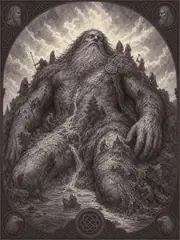
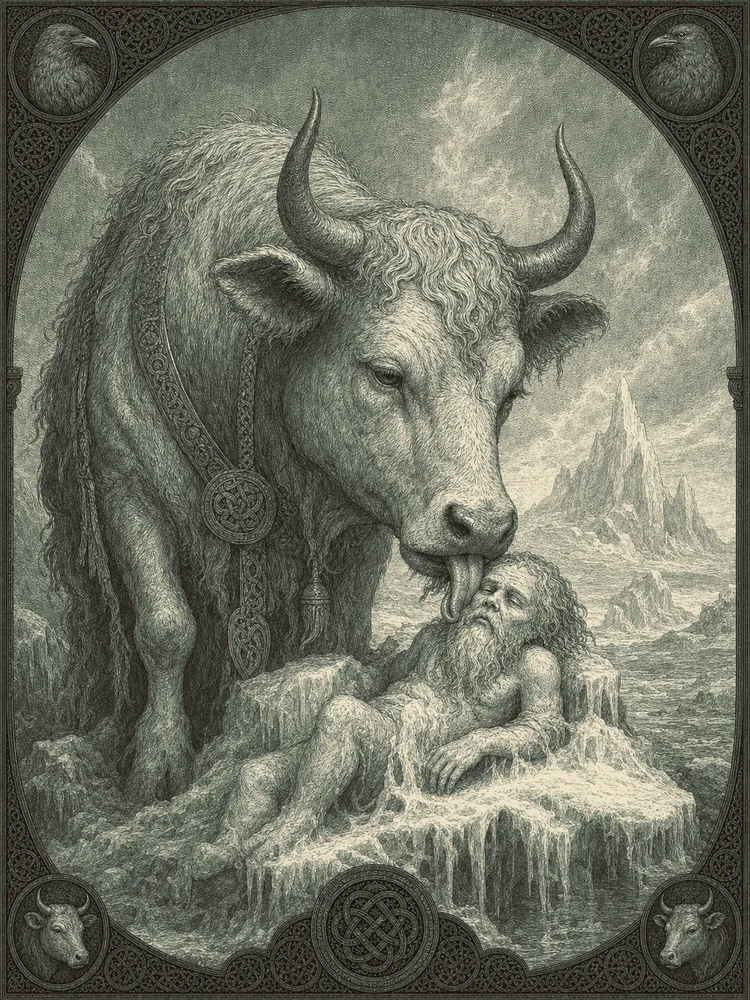
When out of the rime of the Yawning Void came Ymir, there came also a great cow, who was called Audhumla. From her four udders flowed four rivers of milk, and on this milk Ymir was nourished. The cow herself fed by licking the salty rime-stones that lay everywhere about; and from her licking, on the first day, the hair of a man emerged from the ice; on the second, his head; on the third, the whole man — and this was Búri, the ancestor of the gods.
Audhumla is one of the most peculiar figures in Norse cosmogony, for she is older than the gods and yet plays no part in the world's making save to nourish the first generation. Snorri preserves her name and function but tells no further story; she has no temple, no festival, no descendant cult that we know of. She is the silent matrix of life — the patient cow who licks the world into being and then disappears from the narrative — and the figure of her must be very old, far older than the Eddic poems that mention her only in passing.
When the sources speak
Dated witnesses for The Norse and Germanic Gods. A date marks when the evidence was written down, not when the belief began. The whole timeline
- 2nd–1st millennia BCE
- Indo-European language dispersals and regional Bronze Age cultures provide a remote comparative background, not a recoverable common canon.
- c. 500 BCE–1 CE
- Iron Age material culture, names, sanctuaries, and classical ethnography offer early but external evidence for Celtic and Germanic religions.
- 1st–4th centuries CE
- Roman inscriptions and provincial cults preserve many Celtic, Germanic, and local divine names.
- 4th–8th centuries CE
- Migration-period and early medieval conversion transform ritual institutions while heroic traditions continue.
- 8th–11th centuries CE
- Viking Age poetry, runic evidence, archaeology, and Scandinavian conversion form the core context of Norse myth.
- 9th–12th centuries CE
- Slavic, Baltic, and Finnic traditions enter chronicles and missionary accounts, often through hostile observers.
- 11th–14th centuries CE
- Irish, Welsh, and Icelandic manuscripts preserve major narrative corpora in Christian literary environments.
- 12th–16th centuries CE
- Saxo, saga compilers, Baltic chroniclers, and later antiquarians systematize or reinterpret older material.