A Compendium of the Ancient Gods
Hathor, plate

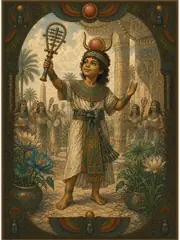
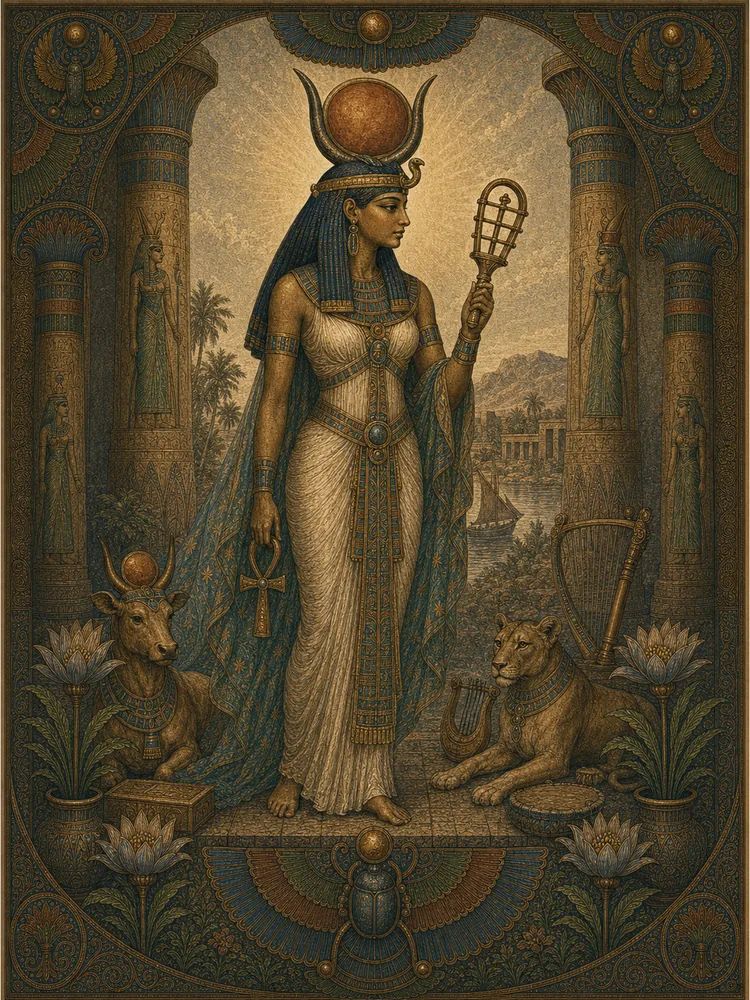
Hathor was, in her name and her oldest aspect, "the House of Horus" — Egyptian Hut-Heru — the heaven within which the falcon-god flew, and thus the great mother of the sky-gods. She was the daughter of Ra and his "Eye," the most often-cited of his daughters; her primary form was that of a cow, or a woman with a cow's ears or horns crowning a solar disk. Her great sanctuary was at Dendera, in Upper Egypt, where the Ptolemaic and Roman temple still stands as one of the best-preserved religious complexes from antiquity; lesser shrines were maintained throughout the country, particularly at Cusae, at the Sinai mining settlements (where she was "Lady of Turquoise"), and at the Theban necropolis (where she was "Lady of the West").

Her offices were various and joyful. She was the goddess of love and of erotic pleasure — the Egyptians did not separate this from the other dignities of the goddess, and her hymns are frankly sensuous. She was the goddess of music: of the sistrum, the rattled instrument that bore her face on its handle, and of the menat-necklace, whose shaking produced a similar sacred percussion. She was the goddess of dance, of intoxication, of the pleasures of the table; and at her great festival of drunkenness, the priestesses of Dendera danced and drank deep into the night, in commemoration of the famous occasion (told in the entry on Sekhmet below) when the goddess in her destroying form was lulled with red beer and saved mankind from her wrath. She was also a funerary goddess of the western mountain, who received the dead at the entrance to the necropolis and welcomed them as a mother welcomes her child; at the Theban necropolis, the figure of "Hathor of the West" emerging from the mountain to greet the dead is a standard motif of New Kingdom tomb-painting.

She was, in short, the principal goddess of the joys of life and of the gentle reception of death — and the Egyptians honored her with a love that the surviving liturgies still convey. "How beautiful is thy face," runs a Dendera hymn; "thou shinest like the stars in heaven; thou art adored when thou risest in the eastern horizon. The ladies of the harem follow thee; they praise thee with their music. The earth lies down in love at thy feet."
Curator’s note

What the sources say, and what later tradition added. The sources for this bay

Hathor's cult is attested from the earliest dynasties; the great temple at Dendera, in its present Ptolemaic-Roman form, was built upon the foundations of much older sanctuaries, the earliest demonstrably from the Old Kingdom and possibly Predynastic. The temple's astronomical ceiling, its zodiac (now in the Louvre), and its crypts are among the most theologically dense Egyptian survivals. The festival of drunkenness at Dendera is documented archaeologically by the so-called "Porch of Drunkenness" added by the Ptolemaic queen Hatshepsut II, with inscriptions describing the rite. Hathor's identification with Greek Aphrodite is attested from the Hellenistic period onward; the Greek visitors to Dendera understood her in this register. The seven Hathors — seven manifestations of the goddess who appeared at the birth of a child and pronounced its fate — are an elaboration of her cult attested in the New Kingdom (Tale of the Doomed Prince, Tale of Two Brothers); they parallel the Greek Moirai and the Roman Parcae, with the same protective-and-determining function.

Kin in the sources

Each tie is quoted from the entry that states it.

The same god in other rooms

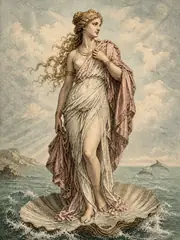
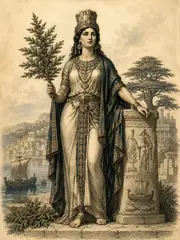
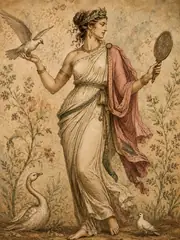
The ancient sources themselves name these as one god under different names. See Baalat Gebal, Hathor, Aphrodite and Turan hung together

When the sources speak

Dated witnesses for The Cities and the Sacred Animals. A date marks when the evidence was written down, not when the belief began. The whole timeline

c. 4000–3100 BCE
Predynastic regional symbols, burials, standards, and animal cults provide the deep background to later divine iconography.
c. 3100–2686 BCE
Early Dynastic kingship joins royal ideology to local cult centers and establishes many durable divine emblems.
c. 2686–2181 BCE
Old Kingdom pyramid complexes and the Pyramid Texts preserve the earliest large religious corpus.
c. 2181–1650 BCE
First Intermediate and Middle Kingdom traditions broaden mortuary access; Coffin Texts develop older royal materials.
c. 1550–1070 BCE
New Kingdom temple wealth, royal hymns, underworld books, and the Book of Going Forth by Day greatly expand the record.
c. 1353–1336 BCE
Akhenaten’s Aten program reorganizes royal cult but does not permanently erase the older divine plurality.
c. 1070–664 BCE
Third Intermediate Period priestly and regional powers reshape cult administration and divine kingship.
664–332 BCE
Late Period archaism, animal cults, and temple scholarship preserve and reinterpret older forms.

Floor plan

The rooms follow one another in the order their peoples first appear in the written record.

  1. The Cradle of Citiesc. 3400 BCE to 395 CE. 115 works
  2. The Gift of the Nilec. 4000 BCE to 395 CE. 73 works
  3. The Olympian Orderc. 1600 BCE to 750 CE. 152 works
  4. The Persian Worldc. 2000 BCE to 1010 CE. 30 works
  5. The Levantine Borderlandsc. 1200 BCE to 500 CE. 20 works
  6. The Edges of Empirec. 2000 BCE to 1500 CE. 33 works
  7. The Etruscan Worldc. 900 BCE to 750 CE. 22 works
  8. The Roman Inheritancec. 1200 BCE to 500 CE. 58 works
  9. The Northern Inheritancec. 2000 BCE to 1600 CE. 131 works